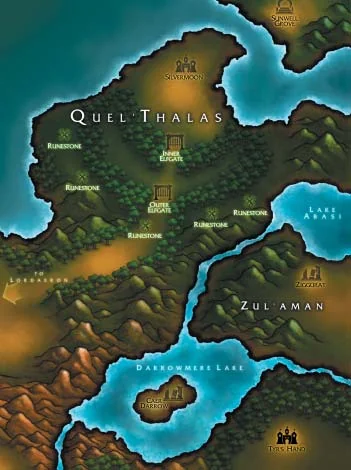
The original client view uses beta-client exploration-mask contours (build 1.60.1.69913). Both illustrated continent views use separately hand-traced, artwork-specific zone boundaries drawn against the owner-approved pre-Cataclysm visual reference. These are cartographic approximations, not gameplay/world coordinates; the original client contours remain unmodified.
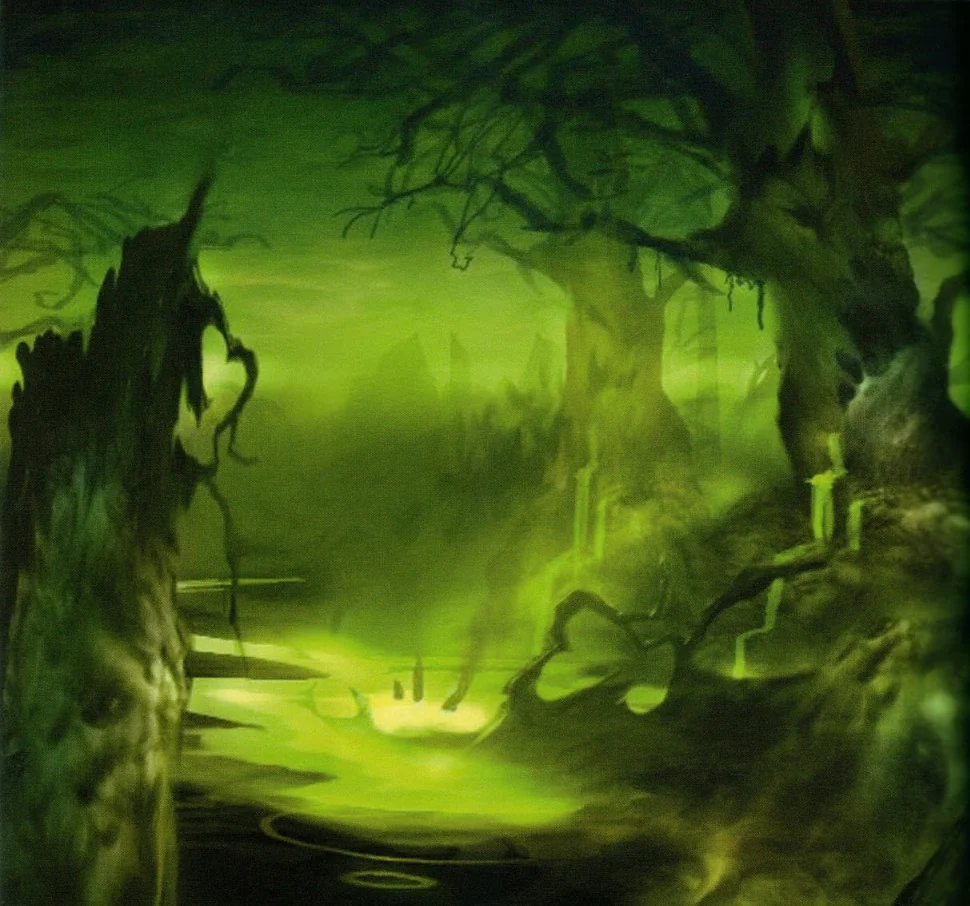
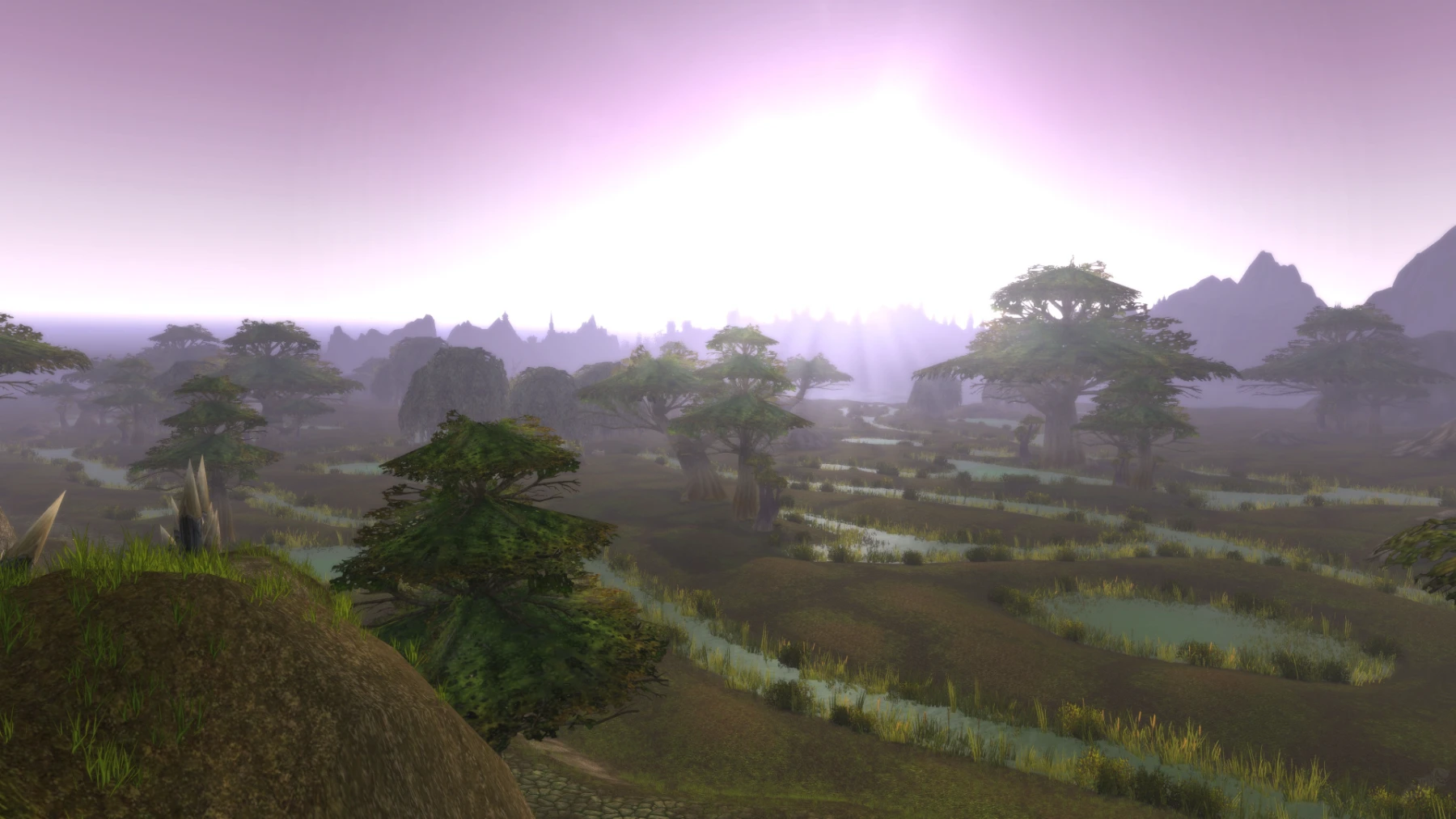
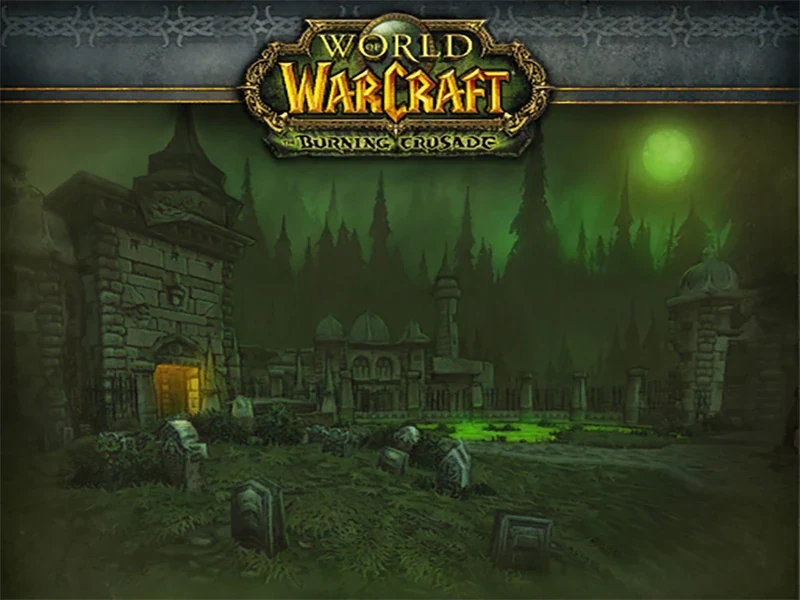
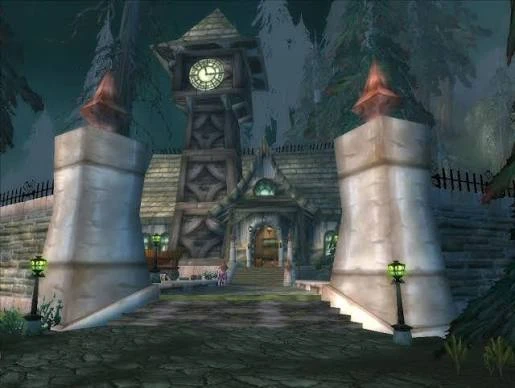
Tirisfal Glades were part of Lordaeron's ancient and royal heartland, and the magical Council of Tirisfal drew its name from the region. The Scourge destroyed its farms and capital, after which Sylvanas led free-willed undead to establish the Forsaken beneath the ruins. Scarlet zealots, lingering Scourge, and Forsaken settlers still contest the countryside.
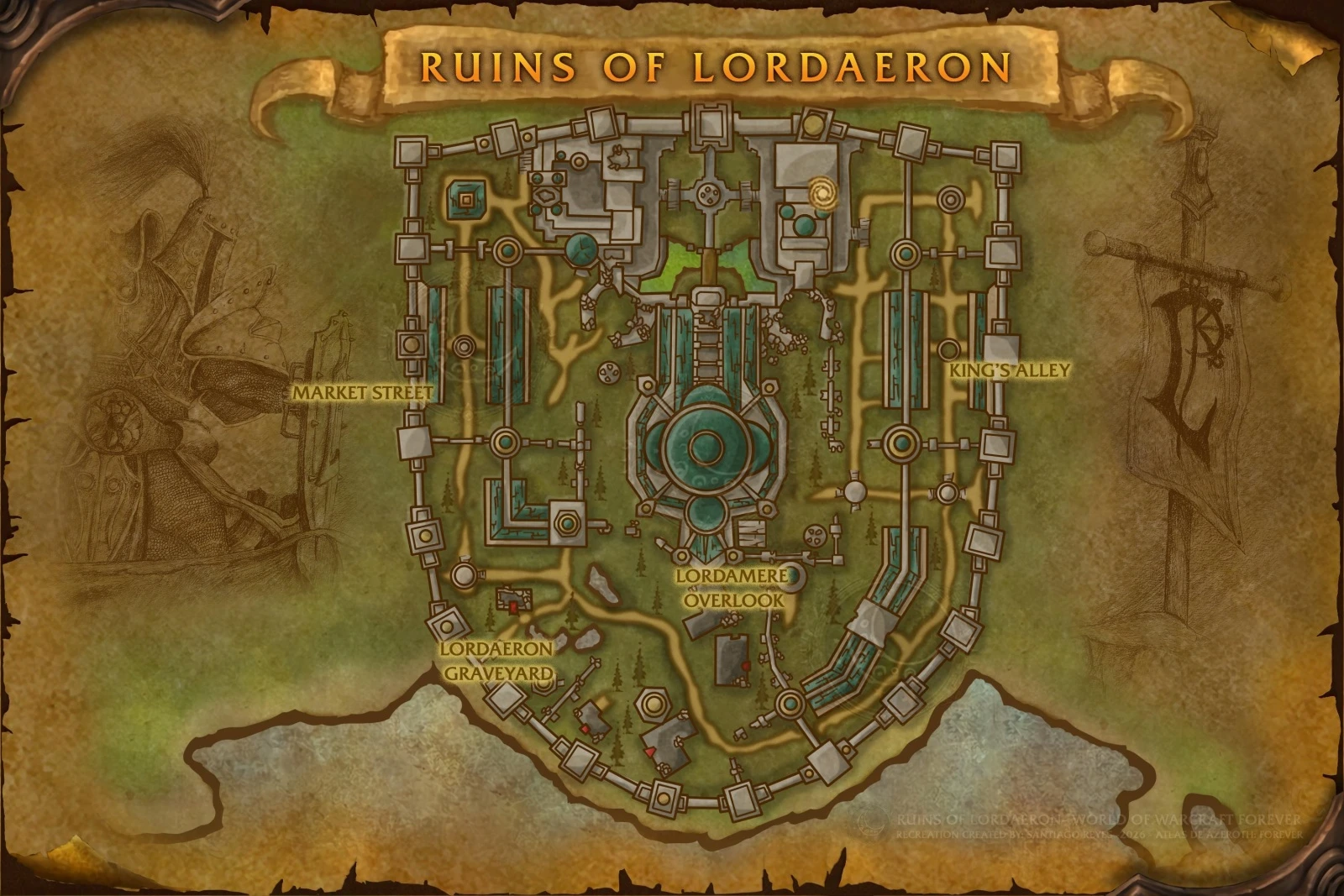
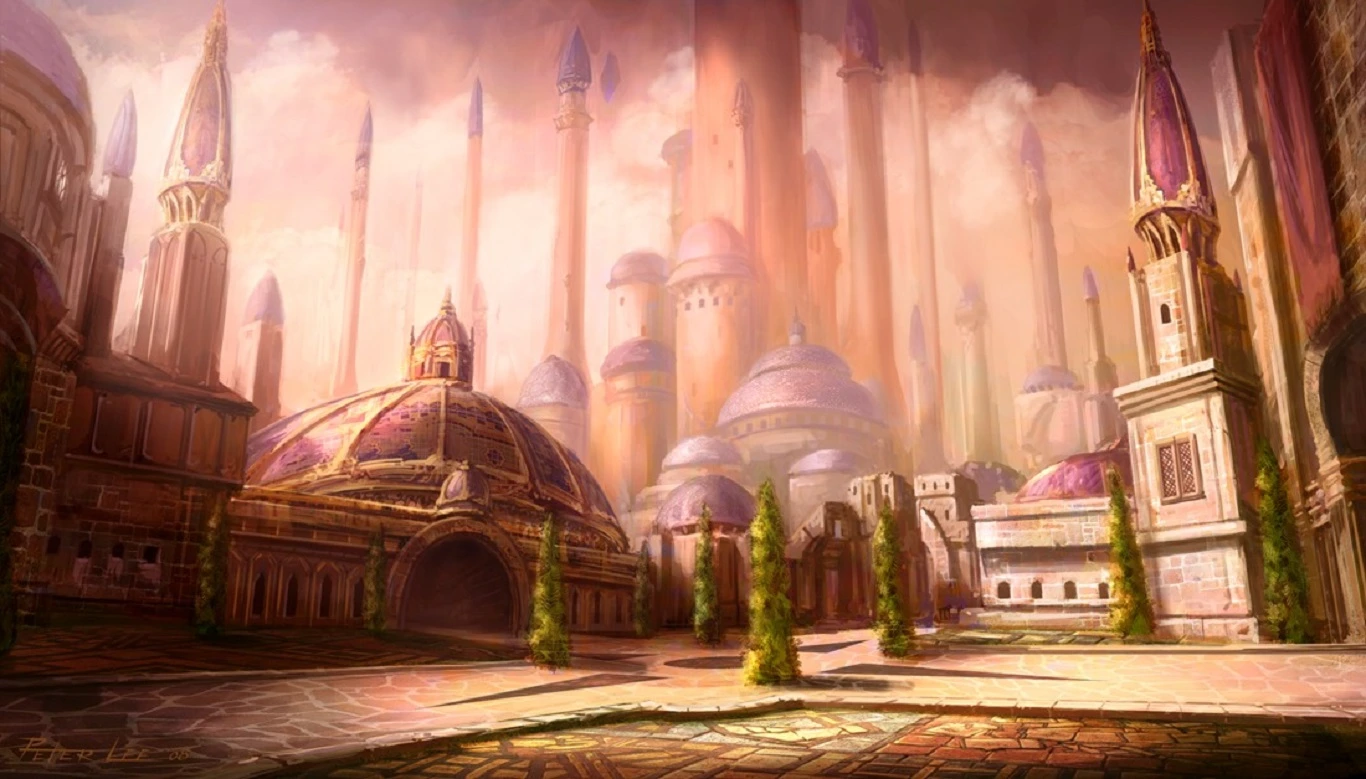
Lordaeron's capital was once the heart of the northern human kingdoms. Arthas returned from Northrend carrying Frostmourne and murdered his father in the throne room. Sylvanas Windrunner defeated her opponents and claimed the underground stronghold for the Forsaken, who continued its construction as the Undercity.
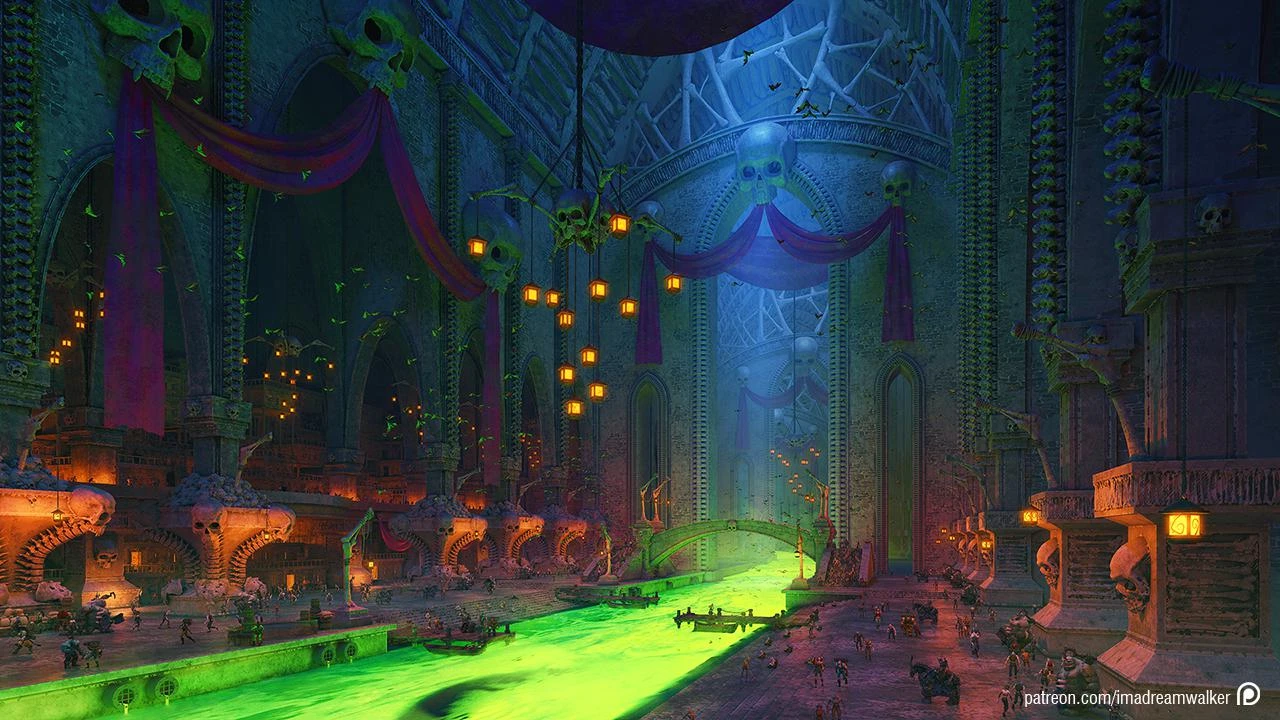
The Undercity lies beneath the ruined royal capital of Lordaeron, where the Forsaken made their home after breaking from the Scourge. Sylvanas Windrunner rules a people who retain their will and memories despite undeath, while Varimathras remains a dangerous subordinate. The city embodies both the loss of a human kingdom and the creation of an uncertain new polity.
Deathknell lay among the graveyards and small settlements of Tirisfal, in the shadow of Lordaeron's capital. When the Lich King's control weakened, Sylvanas Windrunner and others broke free. The village's new role grew directly from Lordaeron's destruction.
Brill once served the roads and farms of Tirisfal, close enough to Lordaeron's capital to share in the kingdom's settled life. The Scourge devastated the countryside and the capital beyond it. Brill was not restored to the way it had been before the catastrophe.
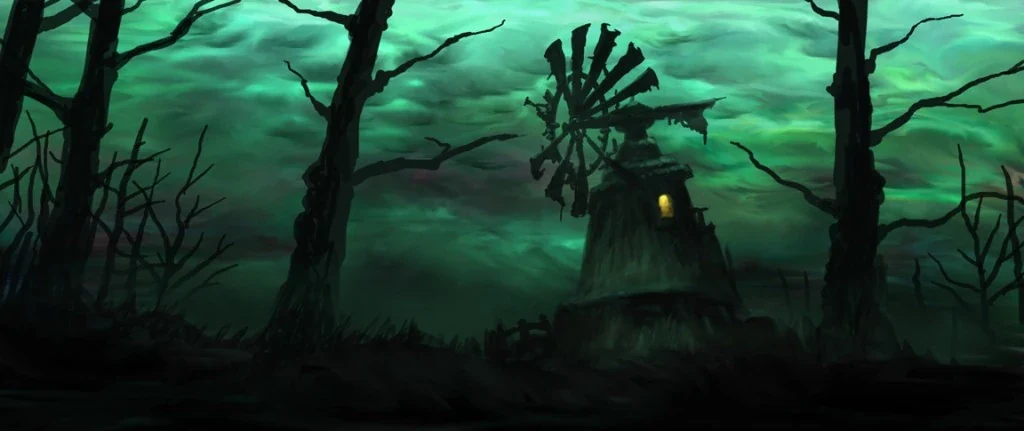
The Agamand family's prosperous mills became a tomb when the Scourge swept through Tirisfal. Workers who remained to defend the estate died alongside their employers, and some returned as Forsaken with bitter memories of that decision. Necromancy and the family's ruined crypt transformed a familiar agricultural holding into a lasting reminder of Lordaeron's collapse.
Brightwater Lake entered Forsaken history through an unusual survivor of Lordaeron's destruction. Bethor recognized that a skilled necromancer might become an important ally to Sylvanas's fledgling kingdom. Brightwater Lake thus became the setting for a choice central to the Forsaken's beginning.
Solliden Farmstead belonged to the agricultural country that sustained Lordaeron before the Third War. Undercity claimed Tirisfal as the homeland of those who had once lived and died there, but the farmers had survived the fall of the kingdom without joining Sylvanas's cause. The Royal Apothecary Society also coveted the farm's crops for its experiments.
Scarlet Monastery is the fortified religious stronghold of the Scarlet Crusade in northern Tirisfal. Its fighters began with the determination to destroy the Scourge but descended into suspicion and brutality toward outsiders. Different wings preserve the institution's scholarship, armory, graves, and central cathedral. The complex exemplifies how the trauma of Lordaeron's fall could turn righteous vows into fanaticism.
The Bulwark stands where Tirisfal Glades gives way to the Western Plaguelands, at the boundary between lands held by the Forsaken and territory devastated by the Scourge. The Argent Dawn established a presence there to confront undeath beyond the border. Orcs and other members of the order could serve beside people from rival factions because the Plaguelands threatened them all. The post became a visible sign that the struggle against the Scourge crossed ordinary political divisions.
Balnir Farmstead had once been part of Lordaeron's settled countryside, where generations of families cultivated the land beyond the capital. Snapdragons growing in its garden proved sensitive to magical corruption, attracting the attention of the Forsaken's own spellcasters. The investigation connected the fate of one farm to the survival of a new undead kingdom.
Garren's Haunt had been a working farmstead in Tirisfal before the Scourge brought ruin to Lordaeron. The abandoned farm attracted the Rot Hide gnolls, whose leader Maggot Eye became notorious around Brill. Executor Zygand placed a bounty on Maggot Eye, seeking to end the thefts and demonstrate that the new authorities in Brill would defend their people.
The gold mine called Night Web's Hollow had once been a useful part of Lordaeron's northern economy. By the time the free undead established themselves in Tirisfal, spiders had overrun the mine. Night Web's Hollow was therefore part of the Forsaken's struggle to build something from the ruins of the Scourge.
Caer Darrow's wealthy Barov family chose to support Kel'Thuzad's Cult of the Damned. Their island estates offered secrecy and shelter for the new order's necromantic work. Beneath the old keep, the cult developed Scholomance, a school devoted to the arts of death. Caer Darrow became a place where Lordaeron's own ruling families helped prepare the kingdom's destruction.
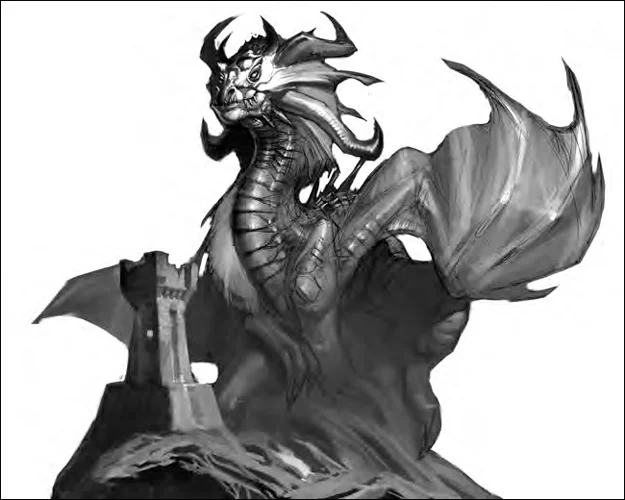
Grim Batol was once the mountain kingdom of the Wildhammer dwarves, founded after the division of the old dwarven realm. Its first great calamity came during the War of the Three Hammers, when Modgud led a Dark Iron army against it and left a curse that drove its defenders away. Centuries later the Dragonmaw orcs made the abandoned fortress a prison for Alexstrasza, using the Demon Soul to force her children into the Horde's wars. The freeing of the Dragonqueen ended that captivity, but not the weight of Grim Batol's history.
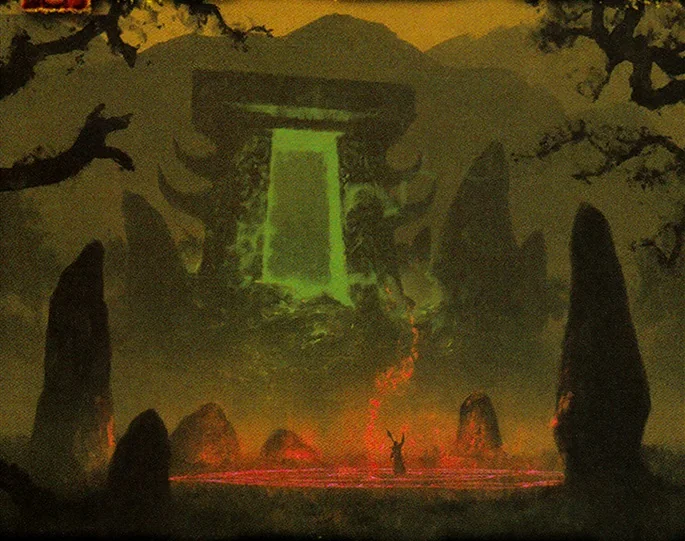
The Black Morass held the Dark Portal through which the Horde first entered Azeroth. Its swamps became the starting ground of the First War against Stormwind. When the Alliance later fought to seal the gateway, the region again became central to the fate of two worlds.
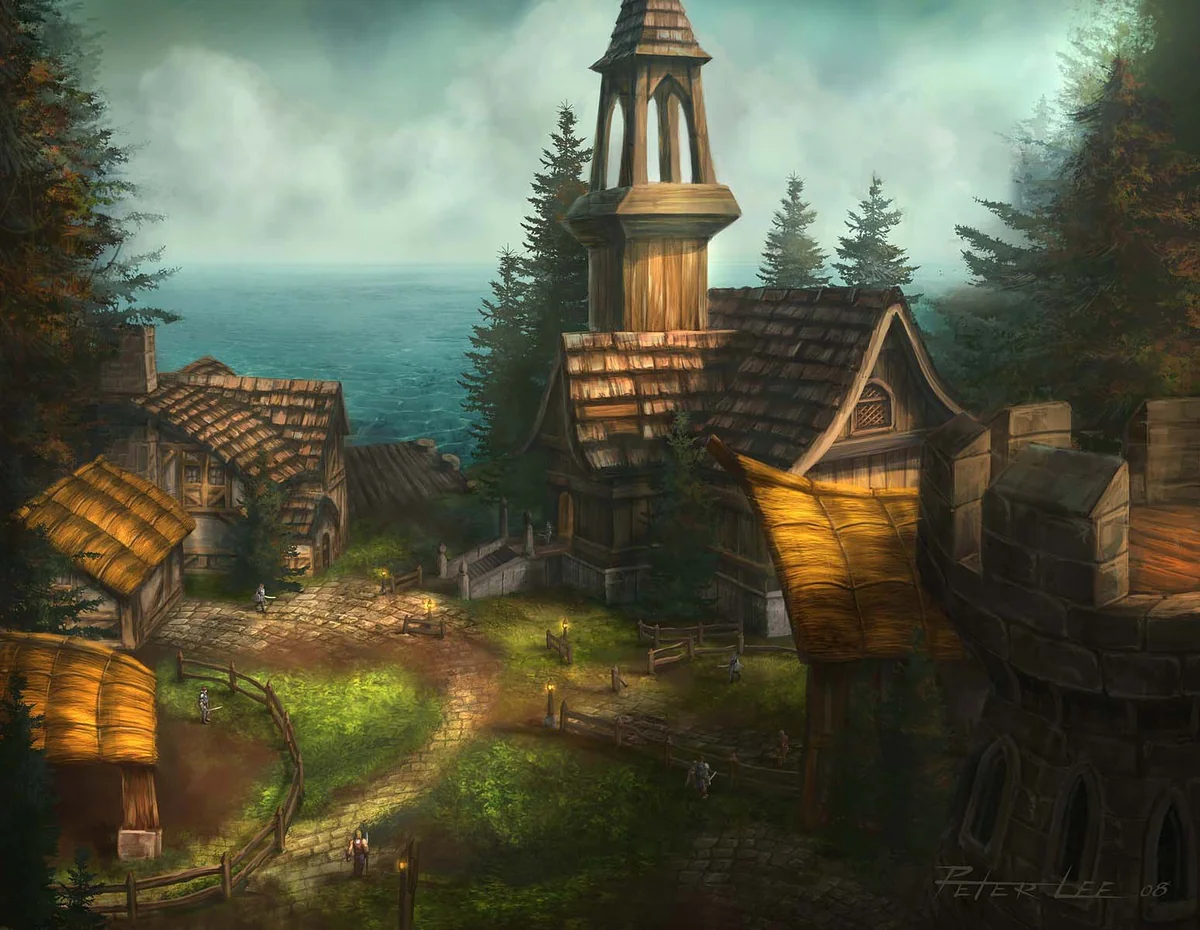
Southshore became a refuge for survivors who fled the destruction of Stormwind. Anduin Lothar led the exiles across the sea to Lordaeron, where King Terenas received them. Their arrival helped turn the fall of a southern kingdom into a warning that would unite the northern powers against the Horde.
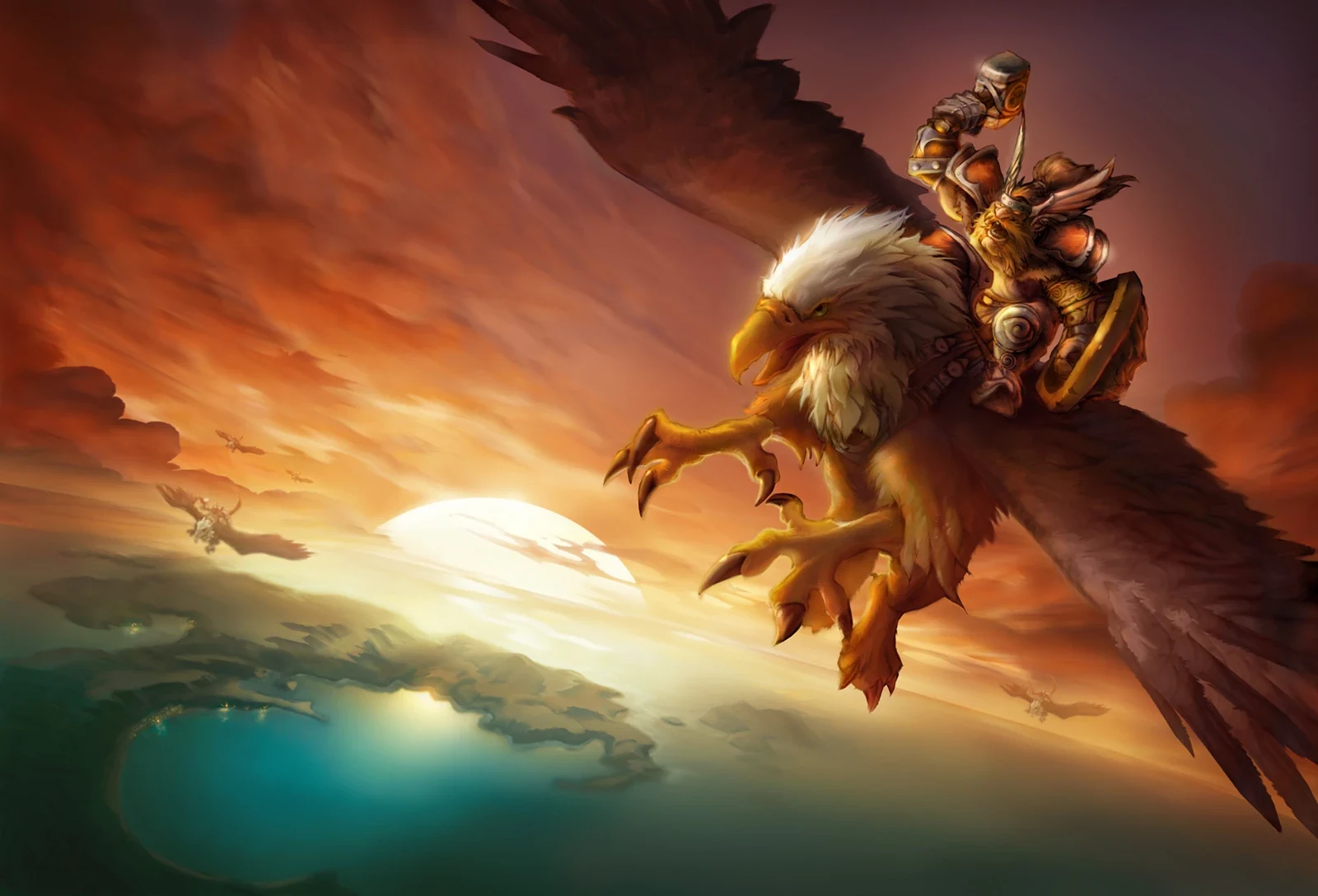
Northeron was remembered as the home region of gryphon riders who joined the Alliance's struggle against the Horde. Their enchanted Stormhammers and mastery of the skies gave the northern kingdoms a weapon against enemies approaching from above. Its precise correspondence with later maps remains uncertain.
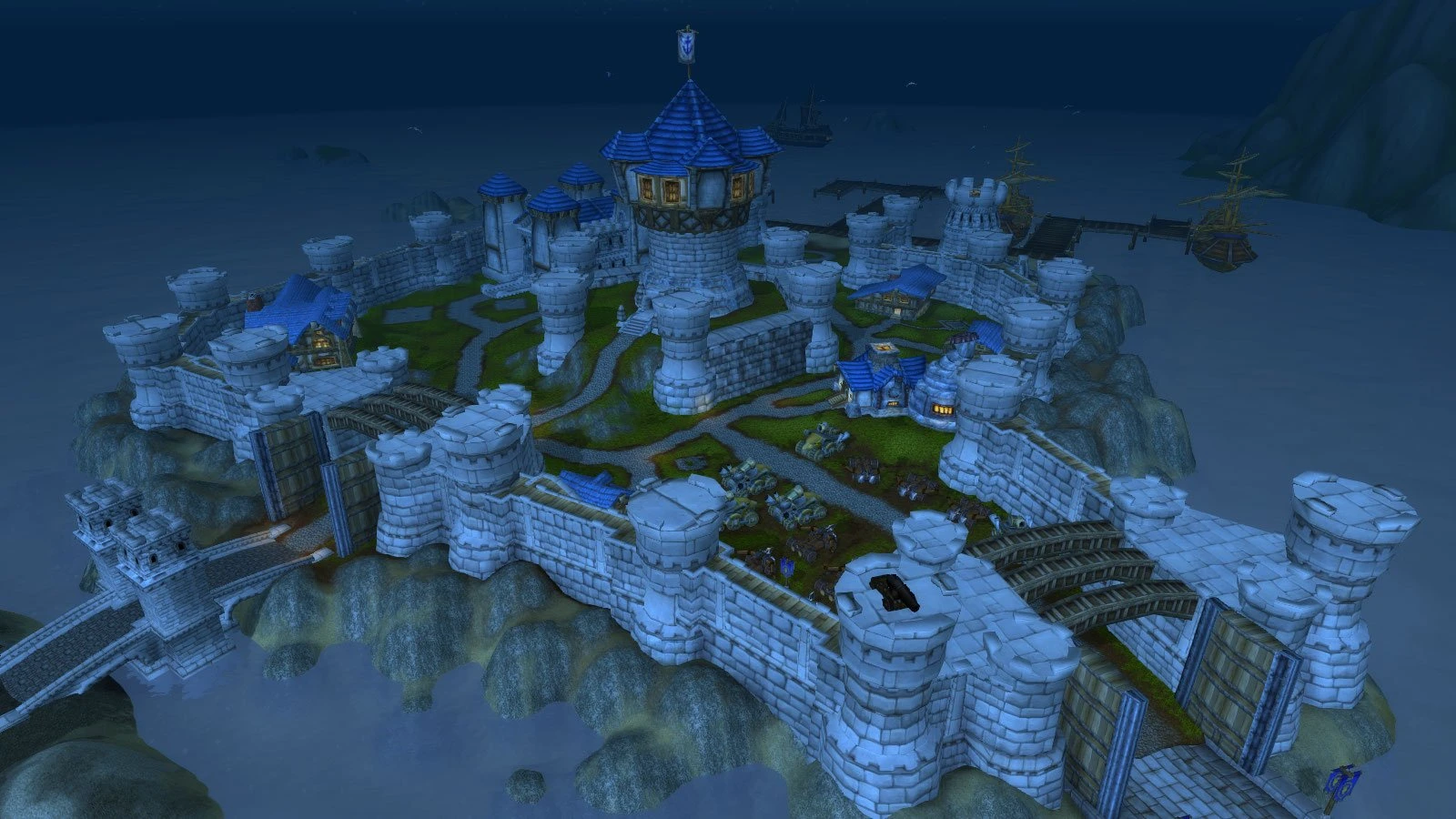
Stormwind City was rebuilt after the Old Horde destroyed the capital during the First War. Its restoration created conflict when Edwin VanCleef's Stonemasons were denied payment and became the Defias Brotherhood. The young king and Bolvar Fordragon now face a court secretly manipulated by Onyxia, disguised as Katrana Prestor.
Quel'Thalas began when high elf exiles traveled north from the lands of the night elves and founded a kingdom around the Sunwell. During the Second War the high elves joined the Alliance against the Horde, sending rangers and other forces into the conflict. The destruction shattered high elf society and left survivors to mourn a homeland they could no longer preserve as it had been.
The Tomb of Sargeras drew Gul'dan away from the Horde during the Second War. His quest ended in death after he entered its forbidden depths. Illidan Stormrage later entered the tomb, took the Eye of Sargeras, and carried its dangerous power into the struggles following the Third War.
Blackrock Spire remained an orcish stronghold even after the Old Horde lost the Second War. Rend Blackhand used it to assert a rival claim to the Horde’s legacy, while the Dark Iron dwarves contested the mountain. Nefarian then bent the surviving orcs toward his own designs, binding an old military defeat to the schemes of the black dragonflight.
The Darkspear are a jungle-troll people whose later history was shaped by displacement, Sen’jin’s leadership, and an alliance with Thrall. They belong to the greater Gurubashi-descended world but did not follow every policy of the old jungle empire. After leaving Stranglethorn they struggled for a home and settled near the new Horde in Kalimdor. Their distinct political identity emerged long after Tyr, Kith’ix, and the earliest empires.
The Echo Isles were offered to the Darkspear trolls after they joined Thrall's Horde and crossed to Kalimdor. Their new island home promised an end to displacement following Sen'jin's death. That hope collapsed when the witch doctor Zalazane used dark magic to dominate members of the tribe. Vol'jin withdrew the free survivors to Sen'jin Village on the mainland, leaving the islands as a contested homeland rather than a secure refuge.
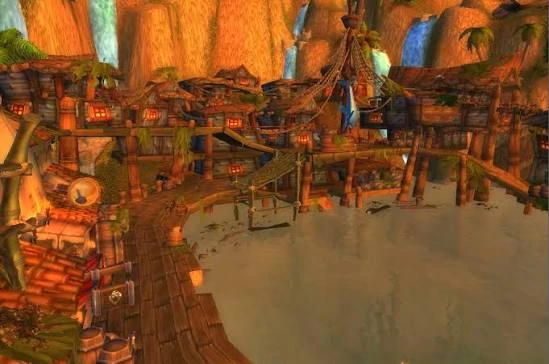
Sen'jin Village became the Darkspear trolls' mainland refuge when their first home on the Echo Isles was seized by Zalazane's dark magic. The settlement honored Sen'jin, the chieftain who died during the tribe's flight from its earlier islands. Under Vol'jin, the remaining free Darkspear held to their alliance with Thrall's Horde while facing the loss of kin still enslaved offshore. The village represented survival and continuity rather than the end of the tribe's exile.
Zul'Farrak is the surviving Sandfury troll city in Tanaris, defended by a people whose ancestors became isolated after the Sundering. Its inhabitants preserved troll customs amid growing desert hardship and hostility from outsiders. The cultic mysteries around Gahz'rilla stand beside a history of environmental change and survival. The dungeon is not a story of a new troll race appearing fully formed after a single battle.
Zul’Gurub was the Gurubashi Empire’s ancient capital and the center of a devastating religious struggle. Priests devoted to Hakkar the Soulflayer plunged their people into civil conflict and were driven into exile. Their later attempt to bring Hakkar into the world remained tied to the lost imperial city.
Strahnbrad was one of the villages threatened when Blackrock orcs raided the northern human lands before the full horror of the Scourge became clear. The defenders confronted orcish raiders who had carried violence back into lands that remembered the Second War. Strahnbrad's place in the story lies partly in what came next.
Stratholme was one of Lordaeron’s great cities before the plague and Arthas’s terrible purge brought it to ruin. The disaster was a turning point in the prince’s descent toward the Lich King. The city did not die quietly afterward: undead forces now hold its streets, and Baron Rivendare commands a powerful Scourge stronghold there. Stratholme remains both a memory of an unforgivable choice and an active danger to the Plaguelands.
Andorhal became a deadly link in the chain that destroyed Lordaeron. The town's grain stores connected it to communities across the kingdom. The Cult of the Damned corrupted that supply, allowing plague to travel along familiar roads and trade routes. When the Scourge rose, a settlement built to feed the living had helped carry death into their homes.
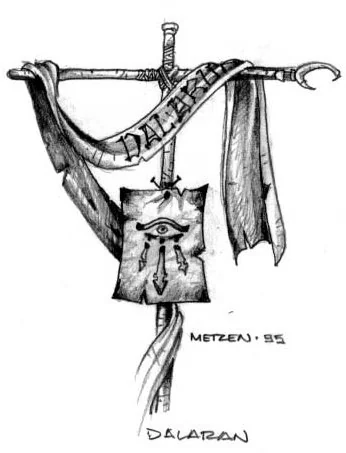
Dalaran rose from the human kingdoms' growing mastery of arcane magic and became the home of the Kirin Tor. Its scholars helped defend the Alliance, but their libraries and magical relics also drew the attention of the Horde and the Scourge. During the Third War Arthas killed Archmage Antonidas, and Kel'Thuzad used a stolen spellbook to summon Archimonde. The demon destroyed Dalaran, turning one of humanity's greatest centers of learning into a ruin.
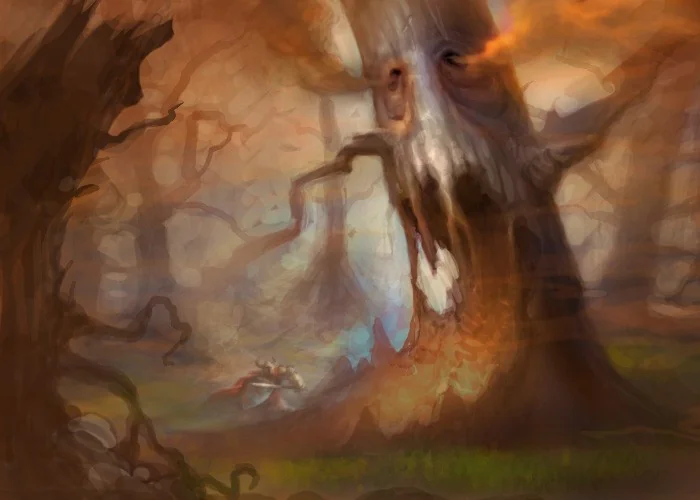
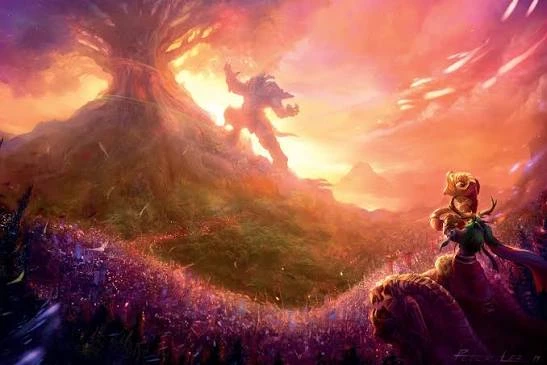
Ashenvale is an ancient night elf forest where Cenarius and the Sentinels defended nature before and during the Third War. Warsong logging led Grom Hellscream to accept Mannoroth's blood and kill Cenarius, leaving a grievance that outlasted the alliance against the Legion. The original world preserves an ongoing struggle over forest territory and sacred groves.
Mount Hyjal shelters Nordrassil and the second Well of Eternity, and its slopes witnessed the Third War's climactic defense against Archimonde. Malfurion Stormrage's call to the wisps helped destroy the demon and ended the night elves' former immortality. In WoW: Forever, routes through Darkwhisper Gorge make the recovering mountain newly accessible to adventurers. The new rebuilding conflict is Forever-specific, while the War of the Ancients and Battle of Mount Hyjal remain original-era historical foundations.
The Stonetalon Mountains preserve sacred night elf and tauren sites connected with the Oracle sought during the Third War. The Venture Company now strips timber and minerals from their valleys, opposed by local defenders around Stonetalon Peak and Sun Rock Retreat. Industrial destruction and factional mistrust threaten a landscape shaped by much older spiritual traditions.
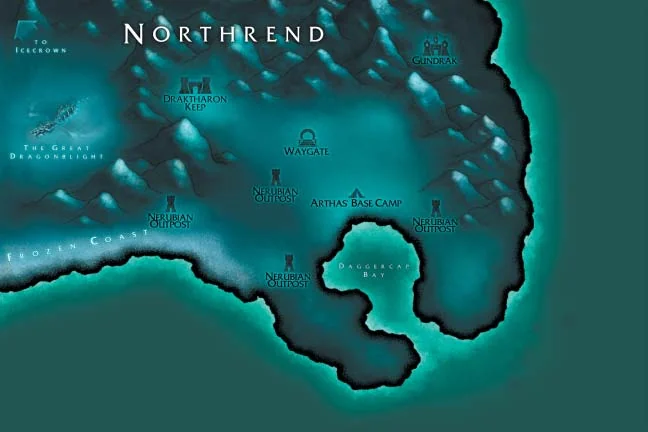
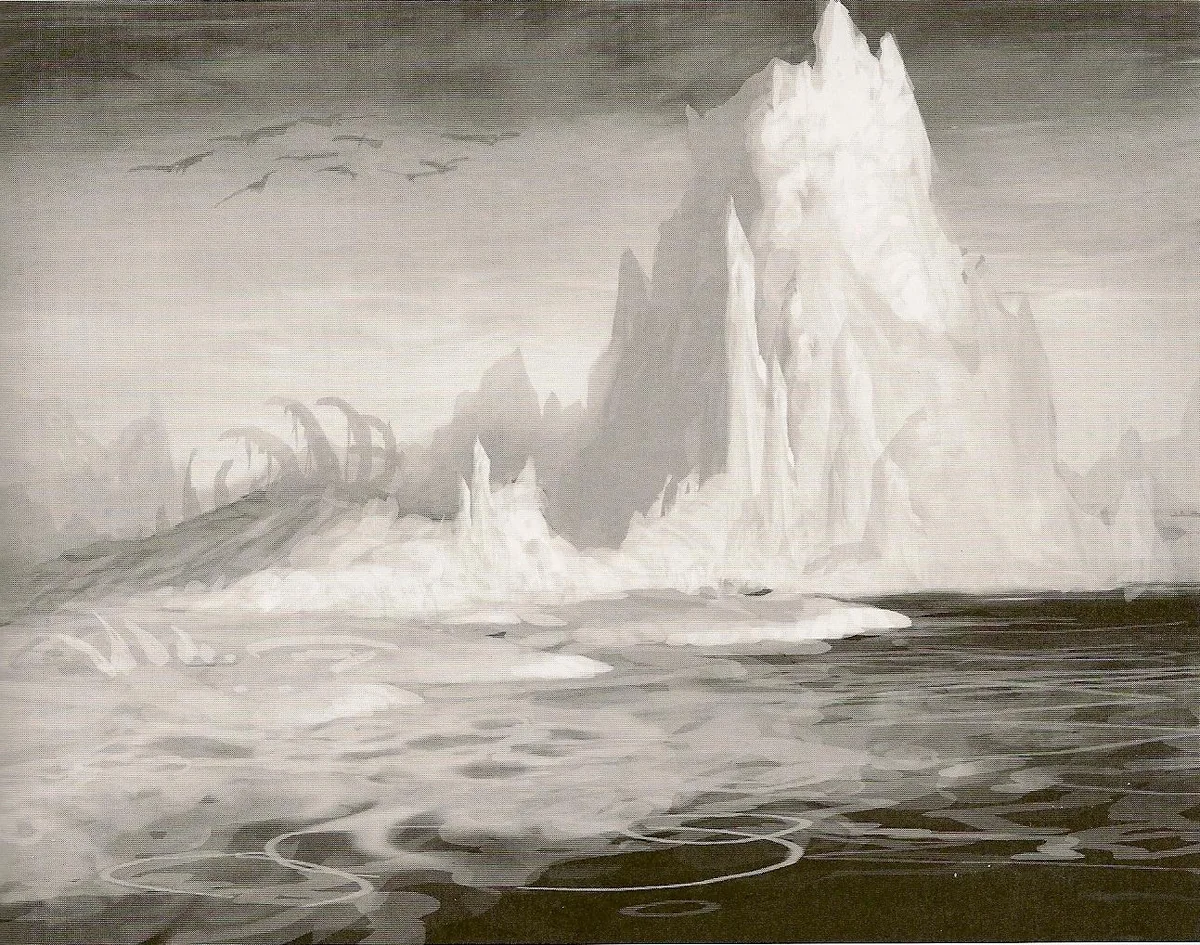
Northrend was the icy seat of the Lich King's power and the birthplace of the Scourge's campaign against the living kingdoms. Arthas followed the dreadlord Mal'Ganis there, claimed Frostmourne, and returned as a servant of the undead. Later, when Illidan threatened the Frozen Throne, Arthas crossed the continent again with Anub'arak to defend his master. The northern wars ended with Arthas taking the Helm of Domination and uniting with the Lich King.
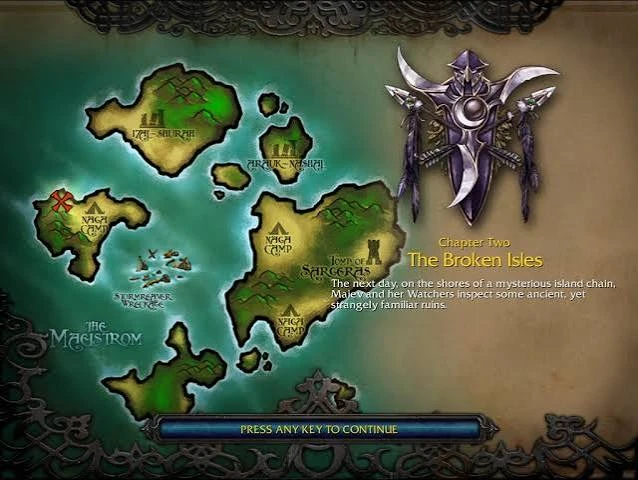
The Broken Isles were home to the Tomb of Sargeras, sought by Gul'dan during the Second War and by Illidan after the Third. The islands became a graveyard for Gul'dan's followers and later the scene of Maiev Shadowsong's pursuit of Illidan. Their significance came from the dangerous power hidden beneath the ruins.
Forbidden power drew two ambitious figures to the same ancient ruins across different wars. Gul'dan deserted the Horde during the Second War to enter Sargeras's tomb, where his expedition met its end and weakened the invasion he abandoned. Illidan later recovered the Eye of Sargeras there, only to see his assault on the Lich King disrupted at Dalaran. The tomb became a warning that demonic relics could ruin both their seekers and the causes they claimed to serve.
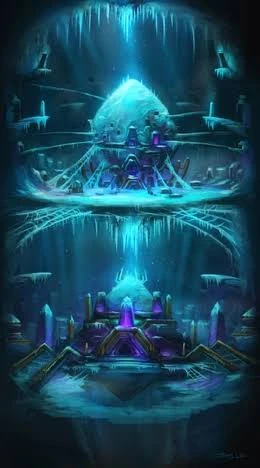
Azjol-Nerub was an ancient subterranean kingdom built by the nerubians beneath Northrend. Its people resisted the Lich King's growing dominion, but the war against the Scourge brought down their realm. The fallen king Anub'arak later returned as an undead servant of the power that had defeated him. He guided Arthas through the shattered kingdom during the race to save the Frozen Throne.
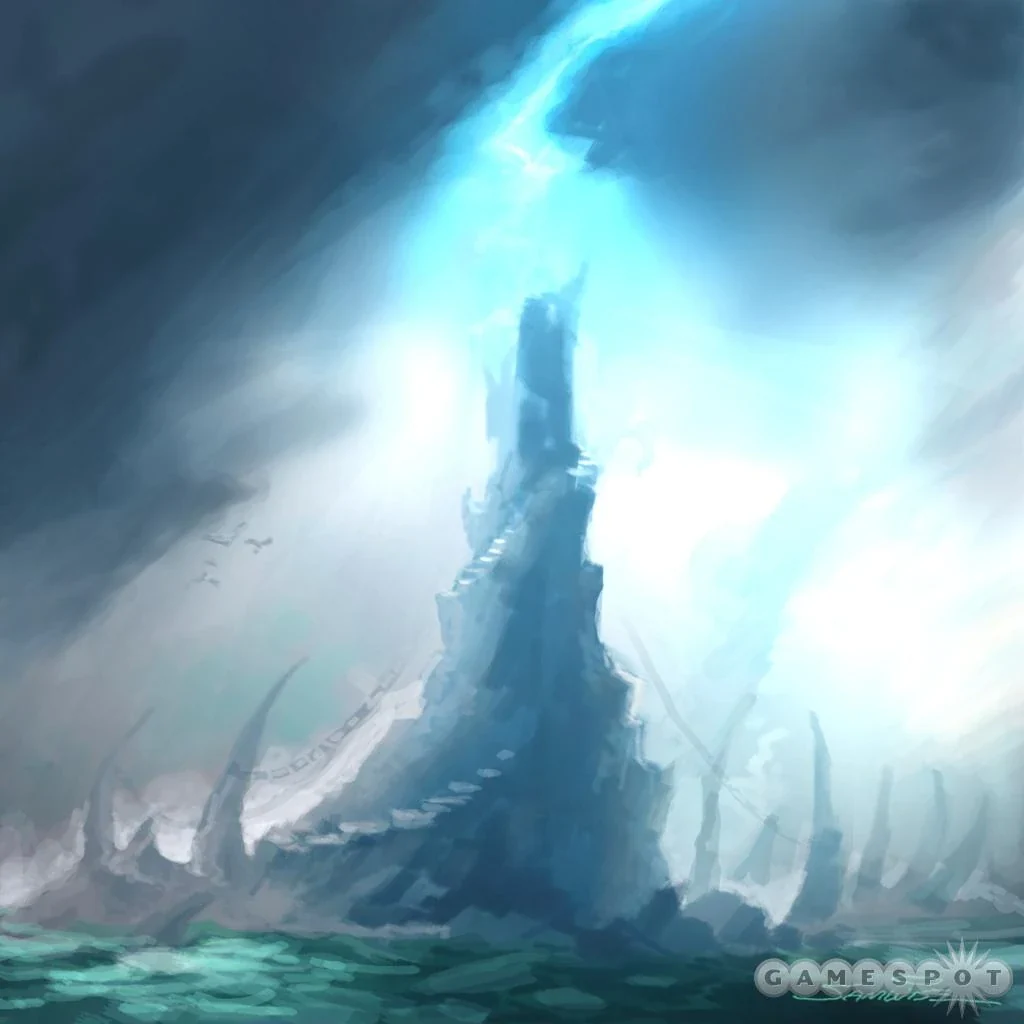
Icecrown became the seat of the Lich King's power after the Frozen Throne was placed in Northrend. When that power weakened, Arthas Menethil raced north to preserve it while Illidan Stormrage tried to destroy it. Their struggle culminated at the Frozen Throne, where Arthas took a new place in the Scourge's history.
Theramore was founded by the human refugees Jaina Proudmoore led across the sea as Lordaeron fell to the Scourge. After the alliance against the Burning Legion at Mount Hyjal, they made a new home on Kalimdor's eastern coast. Its future was nearly destroyed when Jaina's father, Admiral Daelin Proudmoore, used the settlement as the base for a campaign against Thrall's Horde. Jaina refused to support his war, leaving Theramore to survive with the memory of a painful division.
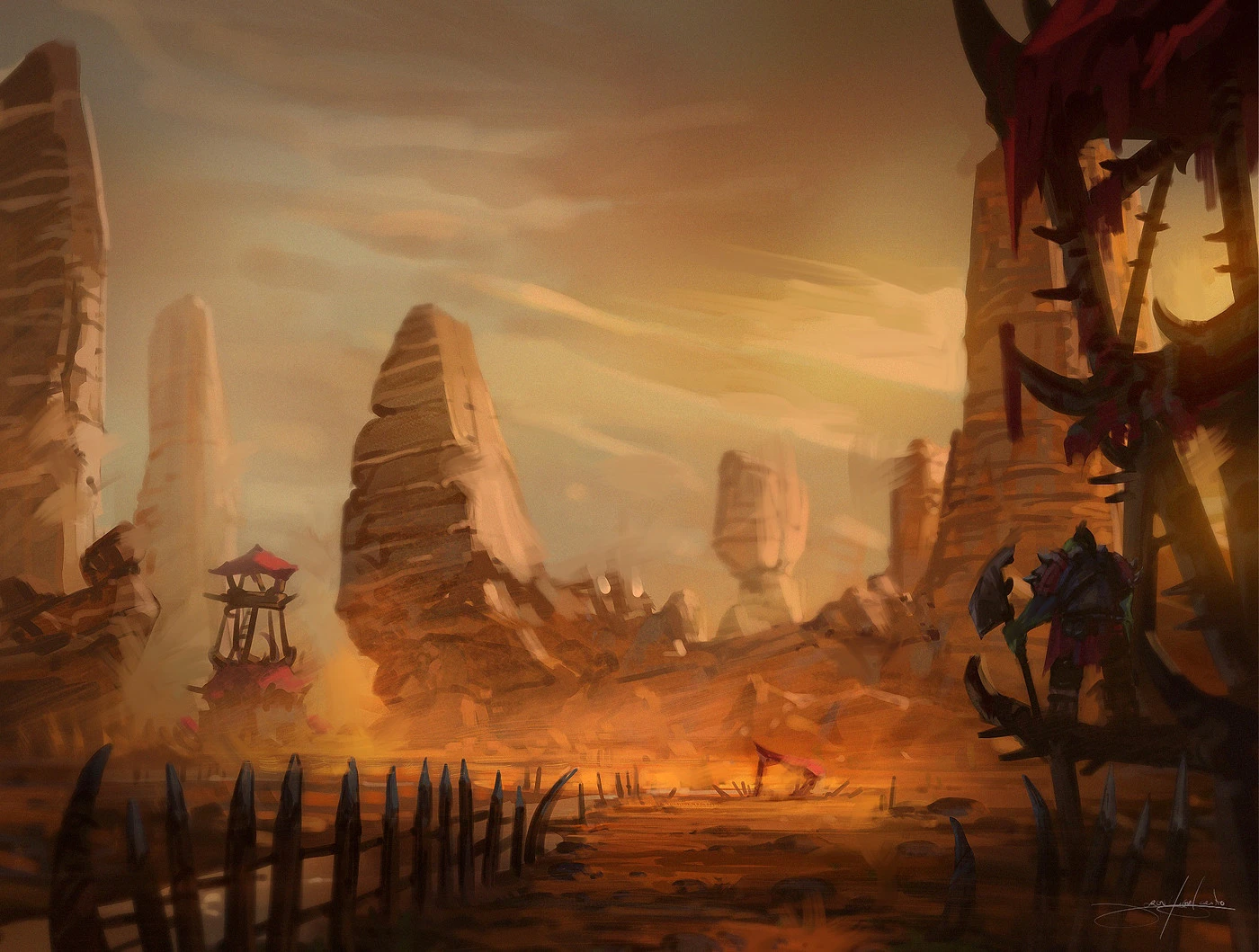
Durotar is the harsh eastern Kalimdor homeland Thrall established for the New Horde and named in memory of Durotan. The Darkspear trolls share its settlements with the orcs, while the Echo Isles, Tiragarde Keep, and the road to the Barrens recall recent conflicts. Daelin Proudmoore's assault during The Frozen Throne tested the new nation's survival.
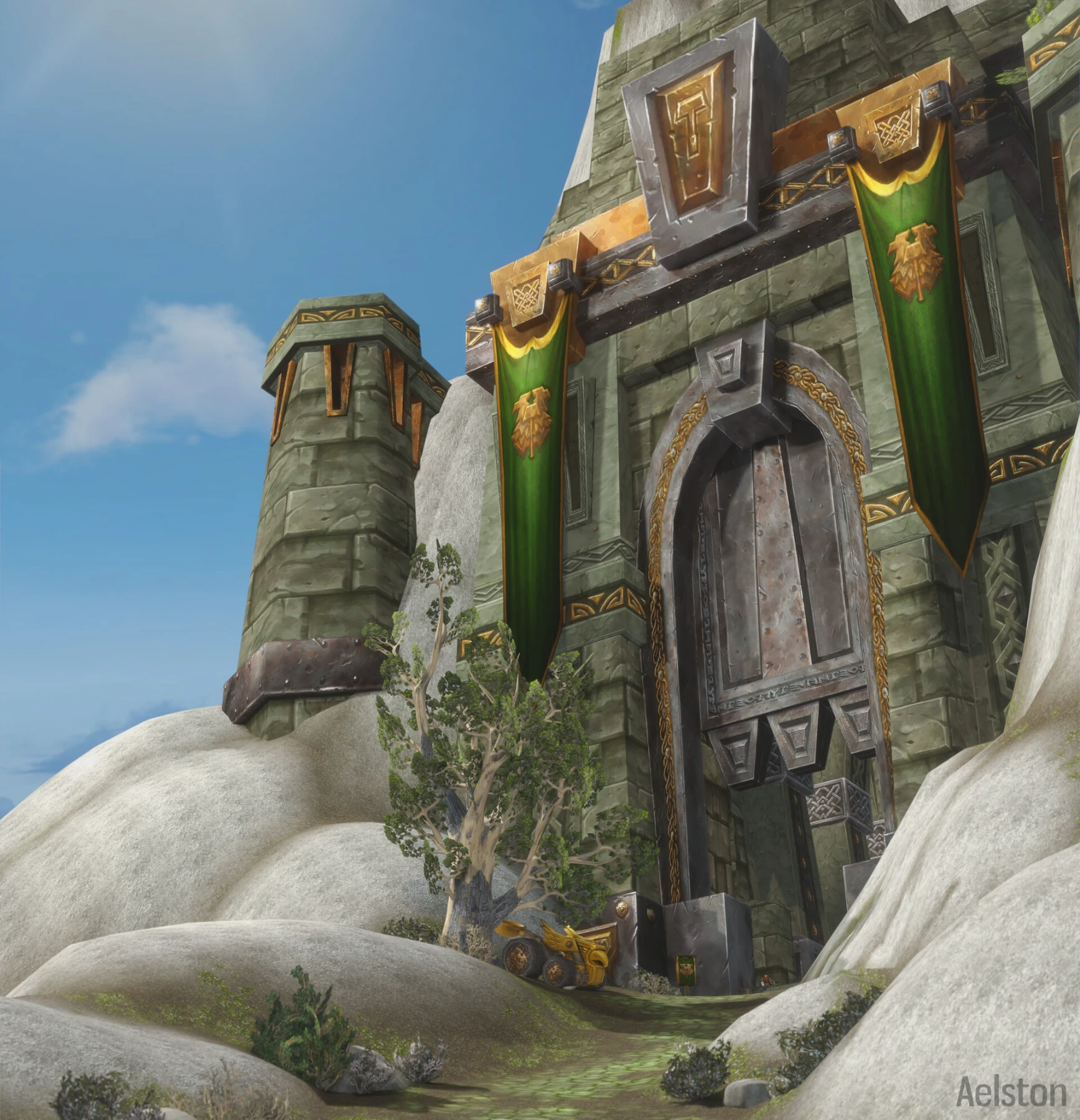
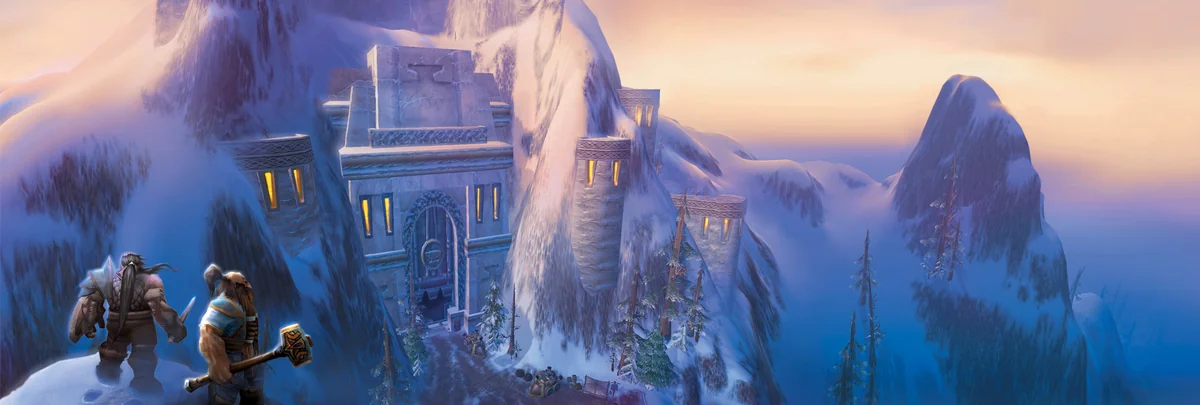
Ironforge is the fortified Bronzebeard capital that survived the War of the Three Hammers. King Magni leads a powerful Alliance city while the Explorers' League investigates buried dwarven history. Gnomeregan's displaced gnomes have found refuge inside its halls, making the great mountain fortress a home for two allied peoples.
Dun Morogh is the snowy heartland of the Bronzebeard dwarves and their great city of Ironforge. Its roads and excavations are shaped by the War of the Three Hammers, the search for ancient dwarven origins, and continued Frostmane troll and trogg hostility. Refugees from ruined Gnomeregan give the mountain kingdom a second, ongoing responsibility.
Coldridge Valley belonged to the heartland the Bronzebeard dwarves defended through the War of the Three Hammers. Thaurissan's Dark Irons returned in a powerful invasion, threatening the mountain once more. In the generations after those wars, the dwarves maintained communities throughout Dun Morogh and continued the crafts and mining traditions for which they were known.
Loch Modan is a dwarven lake-country held together by roads and the immense Stonewrought Dam. Thelsamar serves travelers between Ironforge and the northern and southern frontiers, while troggs, Dragonmaw orcs, and other forces trouble the outlying settlements. Its quarries and neighboring ruins also connect it to the dwarves' archaeological search for their past.
Thelsamar developed in Loch Modan under the protection of the Bronzebeard dwarves, whose hold on Ironforge survived the War of the Three Hammers. Loch Modan connected the mountain capital with the wider eastern lands and the approaches to the Wetlands. Thelsamar's history therefore reflects the lesser-known labor of keeping a divided kingdom connected after one civil war and through another invasion that threatened everyone who lived beyond Ironforge's gates.
The dwarves of Khaz Modan were famous for shaping stone on a scale that neighboring peoples rarely attempted. Such engineering belonged to a land repeatedly threatened by war. The dam's known history does not identify every engineer who laid its stones or a precise day when construction ended.
The Wildhammer dwarves did not begin in the Hinterlands. Although the Wildhammers killed the sorceress and defeated her armies, the darkness she brought into Grim Batol endured. The settlement's history joins the old civil war, the destruction of Grim Batol's peace, and the determination of a displaced clan to begin again.
The Hinterlands shelter the Wildhammer dwarves at Aerie Peak after their exile from Grim Batol. Ancient forest troll communities still control important ruins and passes, preserving memories of much older conflicts with elves and human kingdoms. The region's wooded isolation also conceals druidic mysteries and disputed borders.
When the Bronzebeards drove the Dark Iron clan out of Ironforge, Sorcerer-Thane Thaurissan led his followers south into the Redridge Mountains. The new city grew, but success did not soften its ruler's humiliation. The being's arrival devastated the surrounding lands, brought Blackrock Mountain into being, and destroyed Thaurissan.
Blackrock Mountain contains rival powers whose histories overlap without forming a single alliance. The Dark Iron dwarves inhabit its depths under Ragnaros's shadow, while Rend Blackhand's Dark Horde and Nefarian contend for its upper strongholds. The mountain unites the legacy of the dwarven civil war with the unfinished consequences of the Old Horde.
Shadowforge City emerged from the ruin of the Dark Iron kingdom. The Firelord's arrival raised Blackrock Mountain and placed the surviving Dark Irons under an elemental power far beyond their own sorcery. The city therefore carried the legacy of two defeats: the loss of Ironforge and the disaster brought upon the clan by its own ruler.
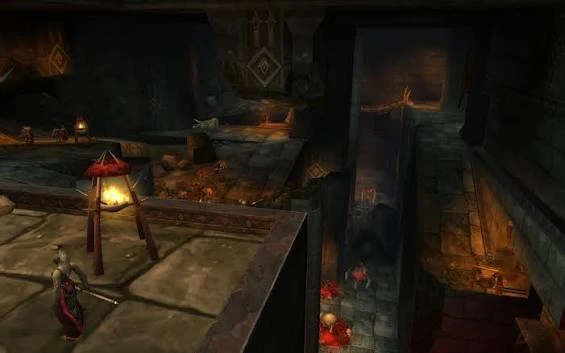
Blackrock Depths is the sprawling subterranean capital of the Dark Iron dwarves beneath Blackrock Mountain. Its history descends from the War of the Three Hammers and Thaurissan's disastrous summoning of Ragnaros. Emperor Dagran Thaurissan rules a city that lives in the shadow of elemental fire and hostile rival powers. The dungeon is a political kingdom and industrial metropolis, not merely a corridor to Molten Core.
Uldaman is a titan-forged complex buried beneath the Badlands. Its ancient chambers preserve the Discs of Norgannon and the guardians Archaedas and Ironaya, evidence of a much older ordering of Azeroth. Dwarven explorers are drawn to the place while troggs and other hostile creatures make passage difficult. The dungeon anchors the dwarves' search for their origin in material ruins.
The Badlands surround the ancient vaults of Uldaman, whose relics draw dwarven explorers searching for their origins. Dark Iron dwarves, troggs, and competing expeditions contest the harsh valleys, while the Horde maintains a foothold at Kargath. The original evidence establishes remarkable buried discoveries without fully explaining their makers.
Gnomeregan was the gnomes' brilliant underground capital before a trogg invasion and catastrophic radiation drove its citizens into exile. High Tinker Mekkatorque's people sought refuge with the dwarves of Ironforge while former leaders fought over the failed defenses. In its halls, ingenious machines still operate amid contamination and hostile occupants. The dungeon is both a lost capital and the history of a people forced from home.
The Thandol Span linked the lands of Khaz Modan with the former northern human kingdoms, making it one of the great passages between dwarf and human territories. The crossings between Arathi and the Wetlands became valuable ground because whoever held them could influence movement between regions. Even after the Horde's defeat, the bridge remained tied to the consequences of war.
Beyond them he founded a new kingdom at Grim Batol, hoping to recover what his clan had lost. The Wildhammers prospered there until Modgud's Dark Iron invasion brought sorcery and devastation into their halls. The roads through Khaz Modan mattered to the Alliance as human and dwarf forces resisted the Horde.
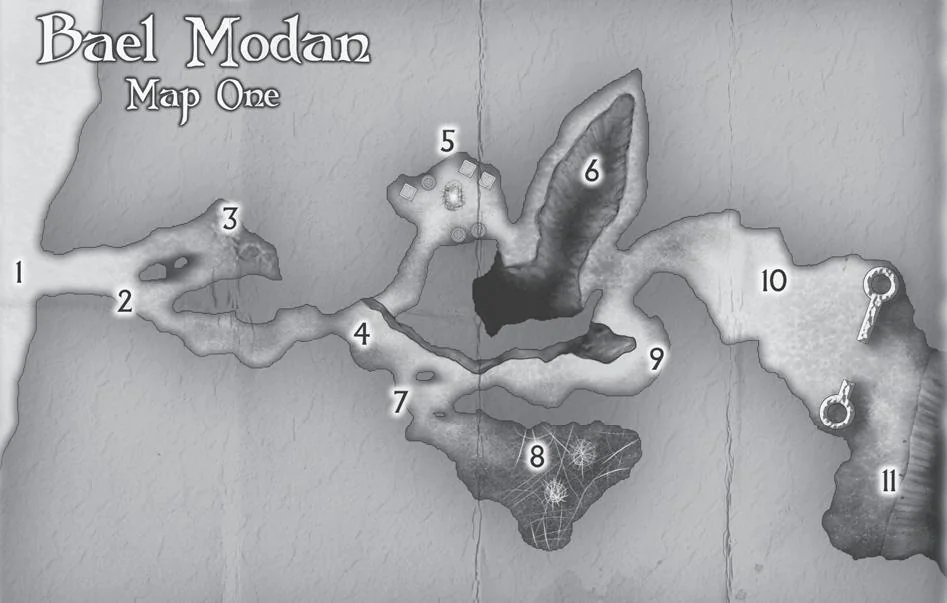
Bael Modan began as an Ironforge expedition into the southern Barrens, where dwarven excavators sought knowledge buried beneath the earth. Their digging crossed the ancestral lands of the Stonespire tauren, whose protests were ignored. Explosives and armed guards drove the dispute into violence, leaving Gann Stonespire determined to reclaim what his people had lost. The site became an example of how the search for ancient relics could collide with living claims to the land.
The Barrens are the crossroads of the young Horde, linking Durotar and Mulgore with central and southern Kalimdor. The Crossroads, Camp Taurajo, and Ratchet support trade while quilboar, centaur, and harpies occupy their own territories. Wailing Caverns and the forests along Ashenvale add druidic and postwar tensions to its vast plains.
The dwarves carried the Explorers' League's curiosity far beyond Khaz Modan. The land held living communities with their own claims, and the presence of armed dwarven diggers could not be separated from the violence that followed. The dwarves hoped that buried objects might reveal the world's ancient peoples; the tauren confronted a new struggle over lands they already knew.
Mulgore became a tauren refuge after Cairne Bloodhoof allied with Thrall against the dangers confronting his people. Thunder Bluff rises above the grasslands, while Camp Narache and Bloodhoof Village preserve tauren hunting and spiritual traditions. Grimtotem politics, quilboar threats, and foreign resource seekers complicate the new security.
Searing Gorge is a scorched reminder of the Dark Iron dwarves' disastrous summoning of Ragnaros during the War of the Three Hammers. Its mines and slag works connect directly to Shadowforge City and the struggle for Blackrock Mountain. Thorium Point belongs to a later original-game patch, not the patch 1.1 state.
Thunder Bluff is Cairne Bloodhoof's capital above the tauren grasslands of Mulgore, founded after his people escaped centaur pressure. Its rises preserve the tauren's spiritual traditions and the skills of their hunters and elders. Grimtotem dissent and the duties of the New Horde keep the city's peace politically complicated.
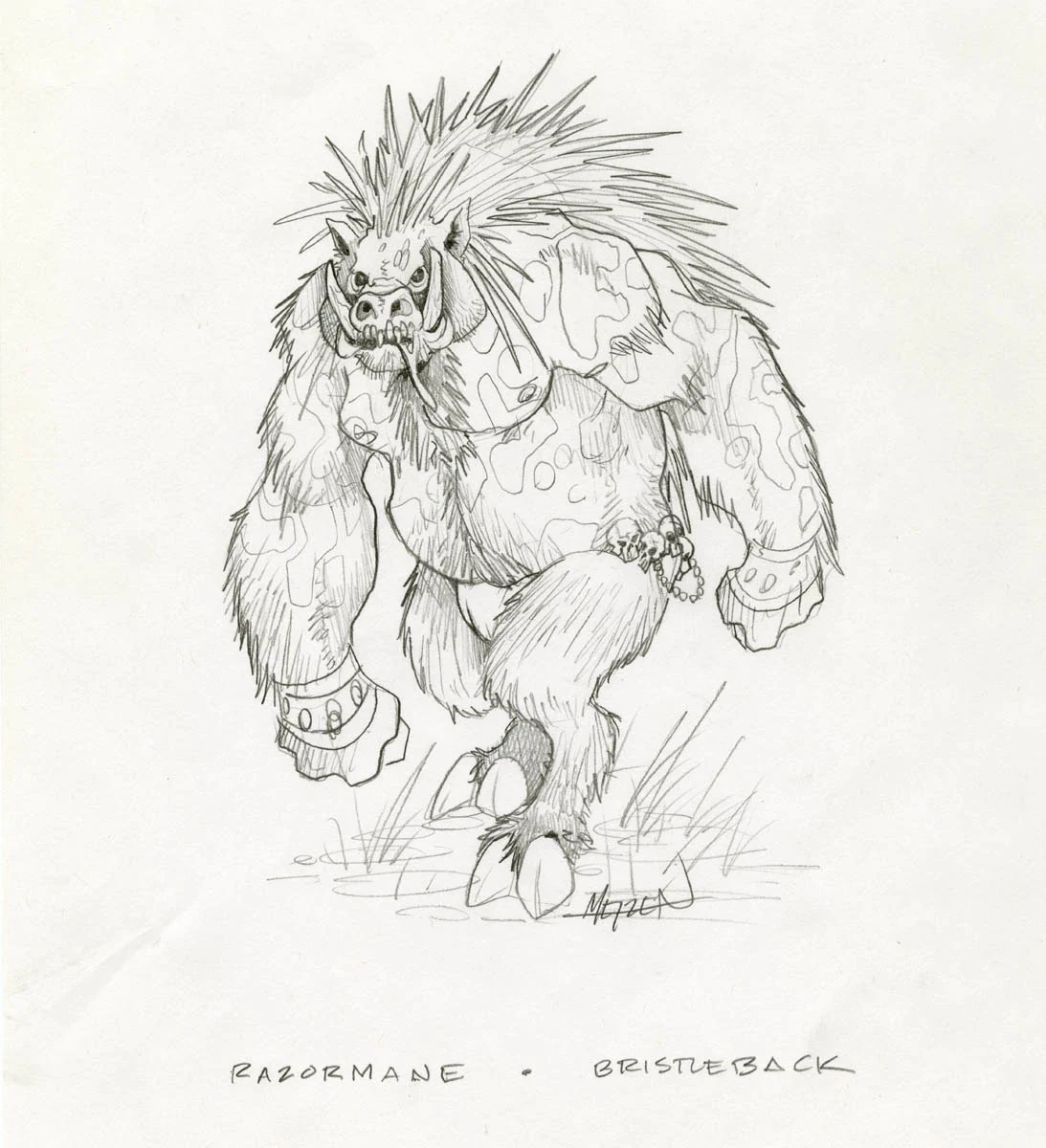
Camp Narache became a gathering place for young tauren learning the obligations of the Bloodhoof tribe in Mulgore. Its trials were shaped by the danger pressing against the southern grasslands, particularly Bristleback quilboar raids into tauren hunting country. The Rite of Strength demanded courage against those incursions, making defense of the community part of the passage into adulthood. Life at the camp reflected the tribe's effort to secure a home after years of centaur pressure and wandering.
Red Cloud Mesa belongs to the period after Cairne Bloodhoof secured a place for the tauren in Mulgore. Once Thunder Bluff and the surrounding settlements began to gather the scattered tribes, young tauren could grow within a more stable community. The quilboar and other hostile neighbors threatened the edges of Mulgore, and the old memory of centaur attacks could not be erased by settling one valley.
Bloodhoof Village grew from the tauren's effort to secure Mulgore after years of wandering. Families needed places to trade, preserve customs, care for herds, and prepare their children for a world that might finally offer some stability. Dangers persisted beyond Mulgore's safer ground, and Cairne still had to hold together tribes with differing ideas about their future.
Brambleblade Ravine became one of the first dangers the tauren had to confront after finding a measure of safety in Mulgore. Chief Hawkwind and Seer Graytongue made the danger part of the young braves' education. Cairne Bloodhoof had brought scattered tauren into Mulgore and helped found Thunder Bluff, but no alliance could end every border dispute.
The Red Rocks hold a solemn place in tauren tradition as a ground where the living honor those who have passed into the care of the Earth Mother. After Cairne Bloodhoof led his people toward safety and Thunder Bluff was founded, the tauren could finally imagine a homeland less constantly threatened by centaur raids. The Rites of the Earth Mother joined physical trials to wisdom from elders and ancestors, reminding young tauren that every victory was owed partly to the generations before them.
The tauren had wandered under the threat of centaur attacks for generations before the Third War brought them into alliance with Thrall. Freewind Post arose in Thousand Needles as part of that broader effort to hold territory. Its founding marked a change in the tauren's circumstances.
Thousand Needles is a dry maze of towering stone spires where tauren settlements cling to defensible heights. Freewind Post and the Grimtotem presence at Darkcloud Pinnacle embody tensions within tauren society, while goblin and gnomish racers gather at the Shimmering Flats.
Hunter Rise took shape in the years when the tauren finally secured a home on the mesas above Mulgore. The founding of Thunder Bluff changed the setting of that duty without ending it. Hunter Rise therefore represented an adaptation rather than a break from the past.
Elder Rise reflects one of the most important changes in tauren life after the Third War: the move from scattered, vulnerable tribes toward a permanent capital without surrendering the wisdom of the old ways. The elders and druids gathered on the rise carried traditions older than the city itself. Elder Rise also demonstrated that the new capital was more than a military sanctuary.
Spirit Rise became part of Thunder Bluff when the tauren, newly established in Mulgore, gave their spiritual traditions a permanent home. Within Spirit Rise, the Pools of Vision offered a place for meditation and spiritual instruction. Apothecary Zamah, a Forsaken alchemist, worked beneath the bluffs, receiving botanical materials sent from the Barrens for study.
The Emerald Dream is a realm bound to the natural world and the green dragonflight's ancient charge. Ysera's guardianship and the long sleep of night elven druids tied it closely to the forests of Kalimdor. Its influence touched the War of the Ancients and the rebuilding of night elf society afterward.
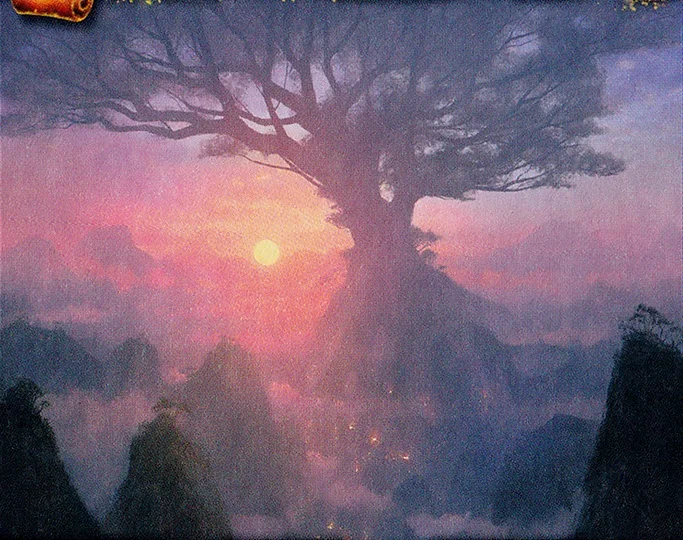
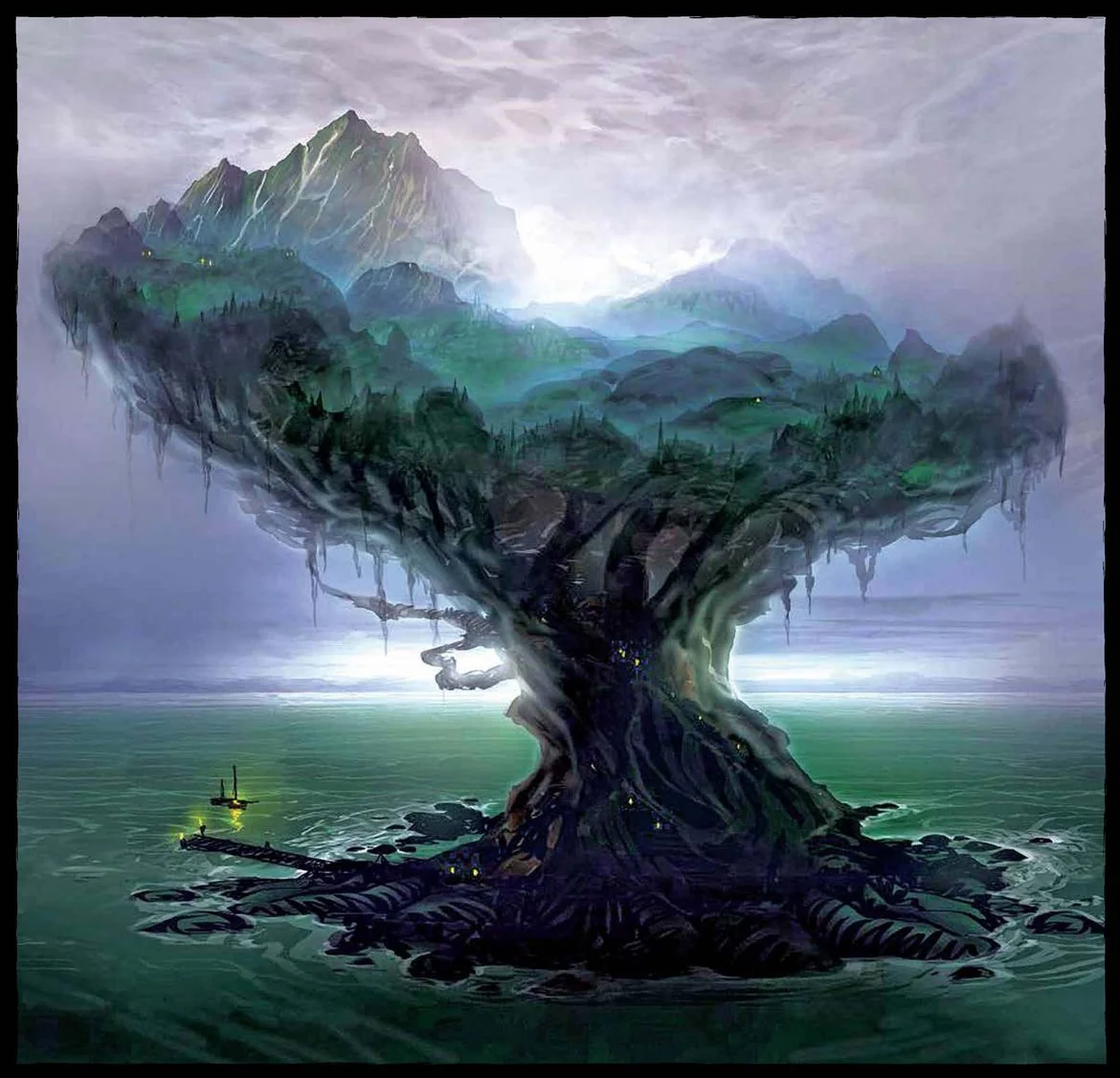
Nordrassil rose after the Sundering to guard the new Well of Eternity that Illidan had created atop Mount Hyjal. The dragon Aspects blessed the World Tree, tying the night elves to the Emerald Dream and granting them extraordinary longevity. During the Third War, Archimonde sought the power beneath its roots. Malfurion's plan destroyed the demon but sacrificed the enchantments that had protected the kaldorei for thousands of years.
The Horde's dragon roosts during the Second War were symbols of an alliance that had never been freely made. Orc handlers tried to turn creatures of extraordinary power into reliable military mounts. Alexstrasza's later liberation at Grim Batol destroyed the foundation of that forced service.
The Temple of Atal'Hakkar lies partially submerged in the Swamp of Sorrows. Exiled trolls of the Atal'ai cult built it to honor the blood god Hakkar, whose worship threatened other troll peoples. Dragonkin and the eerie depths of the Sunken Temple complicate their dark rituals. The dungeon combines religious conflict, forgotten architecture, and the danger of awakening a destructive power.
Chillwind Point offered a strategic foothold near the Western Plaguelands, where resistance to the Scourge demanded secure approaches to its strongholds. The Argent Dawn's presence connected this border position to the wider struggle against the undead. Its importance came from the peril of the surrounding country and the need to sustain that campaign.
Light's Hope Chapel became a refuge for those who would not surrender the Eastern Plaguelands to the Scourge. The chapel became associated with a resistance that sought allies rather than new enemies. The chapel's importance came from the fall of institutions that had once made ordinary worship safe.
The Eastern Plaguelands encompass ruined Stratholme and the surrounding countryside destroyed during the Third War. The Scarlet Crusade and Argent Dawn fight the Scourge by very different means, while memories of Darrowshire and other fallen communities haunt the roads. The launch world remains an unsettled battlefield, not a province already healed.
The Western Plaguelands were once fertile lands supplying Lordaeron until the Cult of the Damned used infected grain to spread the Scourge's plague. Andorhal and Scholomance embody the destruction and the necromancy that followed. The Forsaken, Scarlet Crusade, Argent Dawn, and surviving Alliance defenders contest a country not yet reclaimed.
The defense of Ashenvale changed after the Burning Legion's defeat at Mount Hyjal. Maestra's Post became connected with a small effort against the Cult of the Dark Strand. The outpost's story shows a less celebrated aftermath of the Third War.
Long before the high elves raised Quel'Thalas, Zul'Aman was the heartland of a forest-troll civilization. Orgrim Doomhammer's promised war against the elves drew Zul'jin and several forest-troll groups into the Horde's campaign. Revantusk, Firetree, Smolderthorn, Witherbark, Vilebranch, and other tribes inhabit distinct places and sometimes fight on opposing sides. The playable Zul'Aman raid and its bosses belong to a later expansion and cannot be described as a campaign already underway at WoW launch.
Elwynn Forest is Stormwind's agricultural and military heartland, rebuilt after the First War devastated the old kingdom. Northshire Abbey and Goldshire stand amid farms, mines, and roads on which the capital depends. By the original World of Warcraft opening, Defias bandits, kobolds, gnolls, and murlocs reveal how thinly Stormwind's restored authority is spread.
Westfall was once the breadbasket of Stormwind, but war, neglected farms, and the Defias rebellion left it impoverished. Edwin VanCleef's former stonemasons established a stronghold in the Deadmines beneath Moonbrook. In the original world state, Gryan Stoutmantle's People's Militia struggles to defend Sentinel Hill while Stormwind's authorities fail to restore effective control.
The Redridge Mountains guard the eastern approaches to Stormwind, with Lakeshire on the shores of Lake Everstill. Blackrock orcs entrenched at Stonewatch and gnoll bands threaten its roads and settlements. Magistrate Solomon's appeals for reinforcements illustrate the difficulty of defending even prosperous border communities in the original WoW era.
The once-brighter southern woods of Stormwind have become a haunted frontier known as Duskwood. Darkshire survives through the Night Watch while Raven Hill's dead, worgen, and other horrors threaten the countryside. The Scythe of Elune, the Dark Riders, and the mystery of the spreading darkness connect the region to forces far older than its present human settlements.
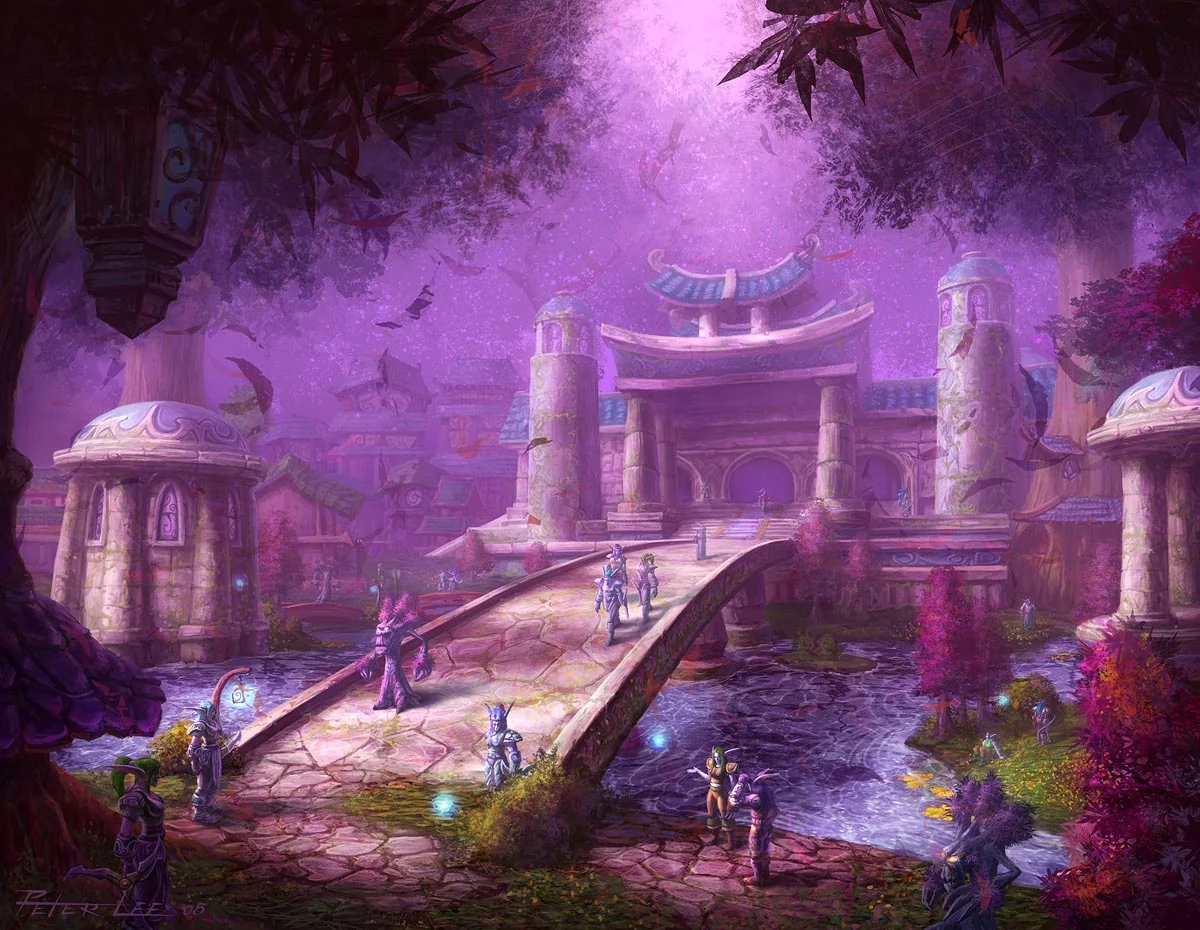
Teldrassil is the enormous World Tree raised after the Battle of Mount Hyjal to shelter the night elves' new homeland. Fandral Staghelm supported its growth, but the tree did not restore the immortality lost at Nordrassil. Darnassus, Dolanaar, and Shadowglen exist amid growing evidence that corruption troubles this new refuge.
Darkshore preserves remnants of the pre-Sundering kaldorei empire along Kalimdor's battered northwest coast. Auberdine links Teldrassil with the mainland, but ruined cities, corrupted furbolgs, naga, and cultists make the shore dangerous. Its ruins and Master's Glaive connect local exploration to ancient elven greatness and unresolved mysteries older than human history.
Silverpine Forest lies between ruined Lordaeron and the lands nearer Gilneas, contested by the Forsaken, surviving humans, and other forces. The Sepulcher anchors Sylvanas's southern frontier while Shadowfang Keep shelters Arugal and his worgen. Its abandoned farms and divided communities demonstrate how the Third War transformed a once-protected human woodland.
Hillsbrad's peaceful fields conceal the history of one of the fiercest battlegrounds of the Second War. Southshore shelters surviving Alliance-aligned humans while Forsaken forces hold Tarren Mill. Durnholde Keep and the contested roads preserve memories of orcish captivity, human resistance, and the fractured political order after Lordaeron's fall.
The Arathi Highlands were the center of the ancient human empire of Arathor, from which later human kingdoms emerged. Stromgarde retains the old capital's name but has fallen into a struggle among its remnants, the Syndicate, and ogres. Refuge Pointe and Hammerfall reveal how much the region's alliances and loyalties have changed since the Second War.
Desolace is a scarred western Kalimdor land where rival centaur clans fight amid Highborne ruins and old sacred places. The centaur trace their beginnings to Zaetar and Princess Theradras, whose connection lies beneath Maraudon's caves. At the original launch-state boundary the surrounding land and its conflicts may be described, but Maraudon must not be presented as an accessible patch 1.1 dungeon.
Felwood was once part of northern Kalimdor's living forests before the Burning Legion poisoned it during the Third War. Tichondrius used the Skull of Gul'dan to spread demonic corruption, and Illidan consumed the artifact's power while defeating him. The original world still bears the mark of that struggle in its poisoned wildlife, satyrs, and struggling defenders of the forest.
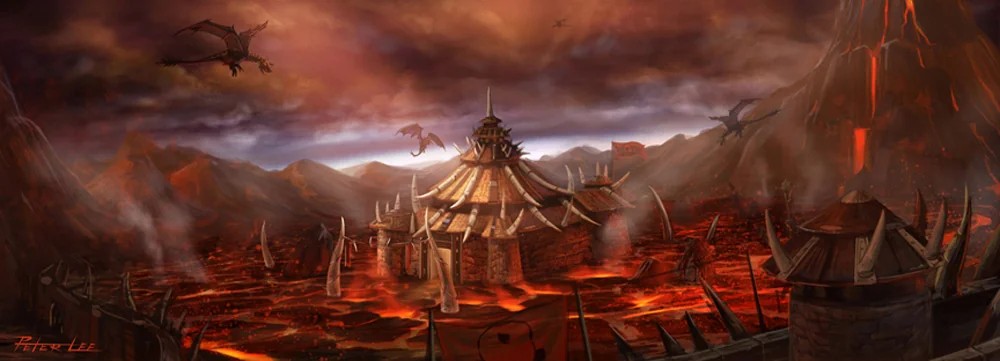
The Burning Steppes were remade when the Dark Iron sorcerer-thane summoned Ragnaros and raised Blackrock Mountain in the aftermath of the War of the Three Hammers. Later the Old Horde used the mountain as a military stronghold. In original WoW the surrounding region remains divided among hostile Blackrock orcs, ogres, black dragons, and Dark Iron powers.
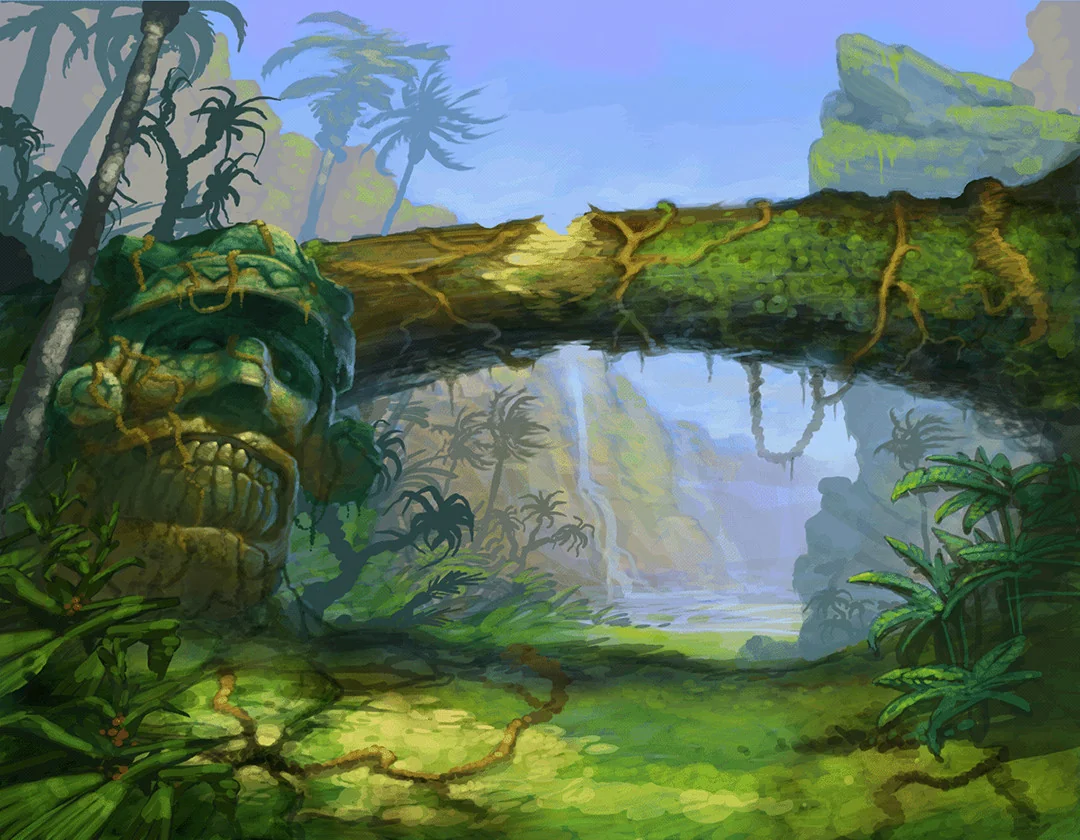
Stranglethorn Vale is an ancient Gurubashi troll homeland whose ruins outlast the old jungle empire. By the original World of Warcraft opening, rival troll communities, goblin traders at Booty Bay, Horde interests at Grom'gol, and human expeditions all share the dangerous peninsula. Its landscape preserves the tension between deep troll history and newer attempts to exploit the jungle.
The Wetlands link Khaz Modan to the northern Eastern Kingdoms through Menethil Harbor and fragile mountain crossings. Grim Batol recalls both the Wildhammer dwarves' lost capital and the Dragonmaw clan's enslavement of the red Dragon Aspect Alexstrasza. Dwarven expeditions and the surviving threats of the Second War make the marsh a living historical frontier.
The Alterac Mountains preserve the wreckage of a human kingdom disgraced by King Aiden Perenolde's betrayal of the Alliance during the Second War. Crushridge ogres occupy the ruined capital while the Syndicate seeks power among former nobles and outlaws. Dalaran's devastated site and the neighboring Frostwolf–Stormpike contest add further layers of unresolved history.
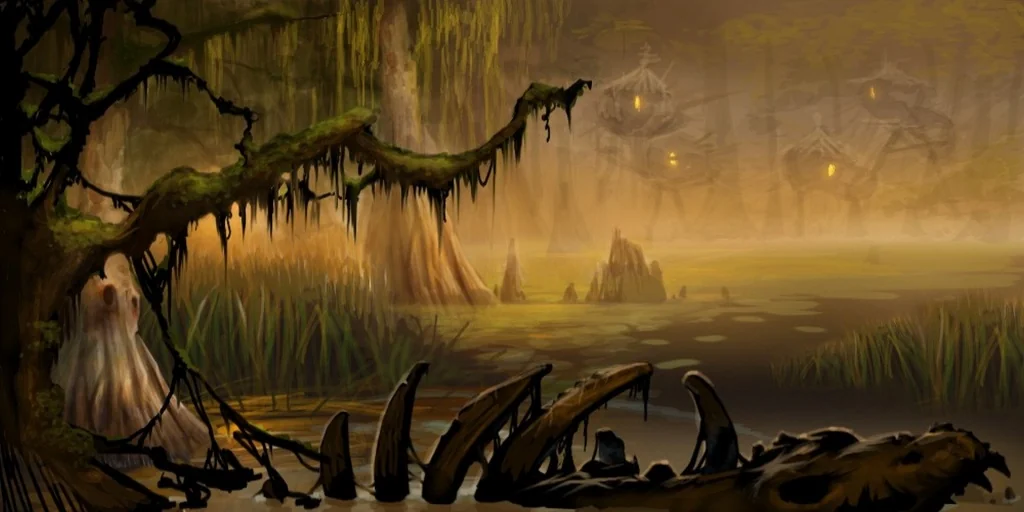
The Swamp of Sorrows is a remnant of the southern marshlands through which the original orcish Horde entered Azeroth. Stonard preserves that military history, while the Atal'ai trolls, the Temple of Atal'Hakkar, and its green-dragon guardians reflect deeper conflicts. Displaced draenei communities add another consequence of the wars between Draenor and Azeroth.
The Blasted Lands were ruined by the creation and destruction of the Dark Portal and the wars that followed. Nethergarde Keep watches the portal's remains while demons and Dreadmaul ogres threaten the surrounding wasteland. At patch 1.1 the portal is a historical monument, not a playable gateway to the shattered remains of Draenor.
Deadwind Pass is dominated by Karazhan, the abandoned tower of the Guardian Medivh. His corruption by Sargeras and role in opening the Dark Portal connect the haunted landscape directly to the First War.
Dustwallow Marsh became the site of Jaina Proudmoore's Theramore settlement after the Third War. Daelin Proudmoore's attack on Thrall's Horde tested the peace, forcing Jaina to choose against her father's campaign. Brackenwall, dragonkin, and Onyxia's hidden lair add competing powers to the marshland border.
Feralas shelters ancient Highborne ruins at Eldre'Thalas, a reminder of the civilization shattered by the Sundering. Shandris Feathermoon's forces, Horde outposts, and Gordunni ogres now share the forested region. Dire Maul's history predates the original game, but the playable dungeon was not present in patch 1.1.
Tanaris is a desert of Sandfury troll history, goblin trade, and ancient secrets. Zul'Farrak preserves a living troll stronghold while Gadgetzan and pirate camps draw merchants and raiders to dangerous routes. The Caverns of Time and the gates toward Uldum were mysterious original-world landmarks, not yet playable later-expansion destinations.
Azshara's ruined coastline recalls the Highborne empire and the Sundering that destroyed the old night elf capital. Naga and haunted ruins remain along the coast, while Azuregos and rival scouts reflect continuing interest in the area's magical heritage. Later goblin rebuilding and additional revelations about Queen Azshara are outside the launch-world account.
Un'Goro Crater is an isolated jungle rich in giant beasts, strange crystals, and ancient machinery. The Marshal expedition tries to understand the pylons and creatures without possessing a complete explanation of their origins. Its unusual vitality and unexplained constructs connect the zone to the deepest mysteries of southern Kalimdor.
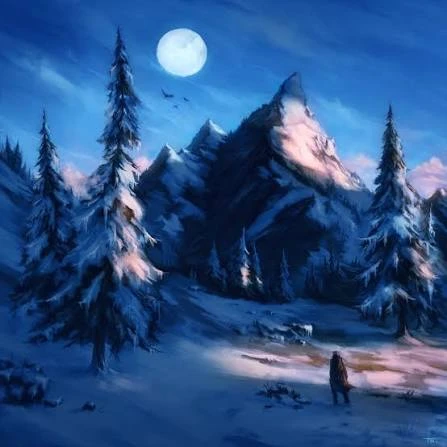
Winterspring is a remote northern Kalimdor wilderness where furbolg tribes, old elven ruins, and dragons survive among snowbound valleys. Timbermaw Hold guards a passage between the mountains, while Winterfall corruption and demonic threats recall damage left by the Third War. Everlook offers limited commerce in an otherwise dangerous region.
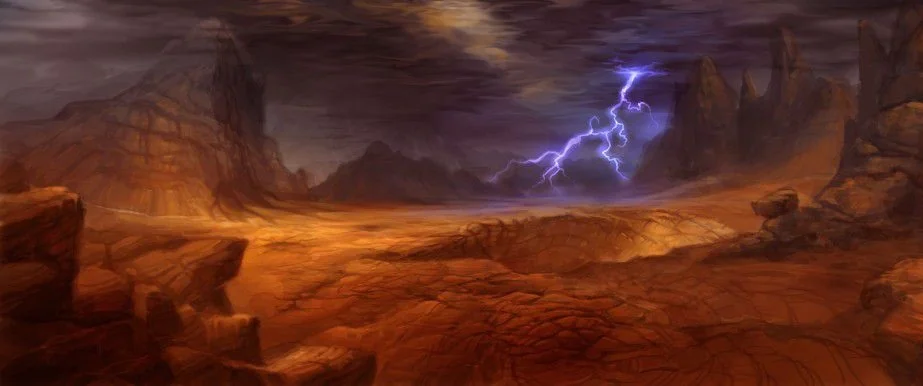
Silithus is the desert outside sealed Ahn'Qiraj, where silithid hives warn of the unresolved qiraji threat. Memories of the War of the Shifting Sands and deserted settlements predate the original world's opening. Cenarion Hold and the Ahn'Qiraj raid campaigns were added after patch 1.1 and must not appear as launch-state events.
Moonglade is a secluded druidic sanctuary in northern Kalimdor, centered on Nighthaven and Lake Elune'ara. The Cenarion Circle brings together night elf and tauren practitioners devoted to the balance of nature, even while surrounding regions struggle after the Third War. Its peace reflects deliberate guardianship rather than absence of history.
Orgrimmar is the capital Thrall raised in Durotar and named for Orgrim Doomhammer. Orcs, Darkspear trolls, and other allies made it the center of a New Horde seeking an honorable life after exile and war. Its walls recall the struggle against Daelin Proudmoore and the need to defend a fragile new nation.
Darnassus was founded within Teldrassil after the night elves sacrificed their former immortality during the Battle of Mount Hyjal. The new World Tree was disputed among druids and lacked the blessings of Nordrassil. Tyrande, the Sentinels, and Fandral's druidic followers now grapple with the future of an ancient people in a newly mortal age.
Riverglades lies between Redridge, the Burning Steppes, the Badlands, and the Swamp of Sorrows, on land previously inaccessible to adventurers. Its open plains and waterways have become a contested frontier for human knights, independent ogres, goblin traders, and the Twilight's Hammer. WoW: Forever makes this region playable without making its newly written history part of the original 2004 lore. The zone's central question is whether its divided communities can survive the threats that once united their enemies.
Shen’dralas is a newly accessible Forever region reached through the Valley of Bones south of Desolace. Its story returns to the highborne Shen'dralar, the ruin of Eldre'Thalas, and the surviving power struggles around Dire Maul. Centaur clans and neighboring tauren peoples help shape the land beyond the old city. The new zone must be distinguished from the historic Shen'dralar people and from Dire Maul's later patch-1.3 dungeon availability.
Zephras Isle is the skybound homeland of the Skyborne, a new people introduced by WoW: Forever. Their ancestry is linked by Forever's account to Highborne rebels who escaped Eldre'Thalas after the War of the Ancients. Wind spirits sustained an island refuge in Skywall, but those benefactors have vanished and the pylons that anchor the homeland are failing. The Windshapers, High Order, and Al'Aketh now struggle over its uncertain future.
Beneath Ironforge lies the Hall of Thanes, a resting place for dwarf monarchs and ancestral memory. Intruders suspected of belonging to the Dark Iron clan have broken into its sacred passages. The new Forever dungeon makes the Bronzebeard kingdom confront old rivalries beneath its own capital. Its specific adventure is a 2026 addition, not a documented event of the original 2004 game.
The ruined human capital above the Undercity is the setting for a new Forever dungeon. Forsaken explorers are trying to reclaim relics and memories left behind when Lordaeron fell to the Scourge. A necromancer is gathering power amid haunted streets and shattered chambers. This instance is distinct from the older geographic Ruins of Lordaeron record and its Third War history.
Near the Wetlands' Whelgar's Excavation, an unfamiliar mist and strange lights have begun to trouble the hills. Beyond the dig lies a place seemingly caught outside ordinary time, defended by titan constructs and dangerous wildlife. The Explorers' League has reason to investigate the mystery, although its cause is still unknown. Forever's dungeon extends the region's established archaeological history without retroactively placing its new discoveries in the patch 1.1 world.
The rebuilt City of Dalaran is threatened by magical failures inside its own warded streets. In Forever, adventurers earn the Kirin Tor's trust, enter through the sewers, and investigate errant constructs and spells. This is a new instance within the separate Forever timeline, not proof that Dalaran stood fully restored in original patch 1.1. Its older history begins with the city's arcane scholarship and its devastation during the Third War.
A submerged troll city off Stranglethorn Vale has risen from the sea in WoW: Forever. Its exposed streets suggest an older settlement lost beneath the coast, but its precise ancient name and the circumstances of its sinking are not yet securely documented. Naga and pirates occupy the new adventure's surrounding conflict. The dungeon belongs to Forever's added history and must not be confused with Zul'Gurub or the earlier Gurubashi capital.
Krol’dok Stronghold is a fortified site in the Riverglades and the setting of a Forever five-player dungeon. The older history of ogres in Azeroth extends back to the orcish Horde and to later clans that carved out holdings after the Second War. The approach and the instanced stronghold should be linked but separately identified in game data.
Alcaz Prison lies on Alcaz Island off Dustwallow Marsh, a place already associated with rumors about missing King Varian Wrynn. Forever opens the sealed prison as a dungeon and places the Defias Brotherhood and naga in conflict within it. Its walls hold clues to a familiar political disappearance, but the complete explanation remains unrevealed. This new scenario must not be mistaken for a later comic-book account of Varian's fate.
Behind a long-sealed Azshara gate lies Blackmaw Hold, a large furbolg city imperiled by spreading corruption. The Blackmaw clan is fighting to survive through twisting tunnels and groves. The dungeon turns a nearly hidden settlement into an important new high-level destination in WoW: Forever. Its corruption is established as a danger, but its ultimate source has not been securely documented.
Shaper's Terrace overlooks Un'Goro Crater from the northern hills, where titan structures stand above a seemingly primeval wilderness. Its mysteries involve ancient mechanisms and the power crystals scattered across the basin. Forever turns an old suggestion of titan intervention into a new high-level dungeon. The exact identity of its builders and the workings of its chambers remain subjects for direct research rather than later-lore assumptions.
Ragefire Chasm opens in the volcanic caverns beneath Orgrimmar. The fiery fissures harbor dangerous creatures and the cultic influence of the Searing Blade. Their presence makes the Horde capital vulnerable from inside its own foundations. The dungeon is one of the early threats faced by citizens of Thrall's new city.
Wailing Caverns is an underground waterway beneath the Barrens, discovered by the druid Naralex. He hoped to return life to the dry savannah by connecting its springs to the Emerald Dream. His sleep instead became trapped in nightmare, twisting the caverns and his followers into the Druids of the Fang. The dungeon preserves a failed attempt to heal a wounded landscape.
The Deadmines began as a rich mining complex beneath Westfall, but became the headquarters of the Defias Brotherhood. Edwin VanCleef and his followers turned the abandoned tunnels into workshops and a hidden shipbuilding operation. Their rise grew from the bitter aftermath of Stormwind's rebuilding and the failure to pay the stonemasons. The dungeon brings Westfall's poverty and political anger underground.
Shadowfang Keep stands above Pyrewood Village in southern Silverpine Forest. The wizard Arugal summoned worgen to fight the Scourge, but the creatures escaped his control and helped destroy the keep's old household. Arugal came to regard the beasts as his children and made the haunted fortress his refuge. Its story is one of desperate wartime magic that traded one terror for another.
Blackfathom Deeps lies beneath the Zoram Strand of Ashenvale, amid sunken remnants of night elf antiquity. The Twilight's Hammer has made the corrupted waterways a center of dark worship. At its deepest reaches lurks the hydra Aku'mai. The dungeon links the ruins of a once-sacred coast with the cult's effort to nurture a monstrous power.
The Stockade is Stormwind's prison, built within the capital it is meant to protect. The inmates include dangerous criminals, rebels and figures whose violence has spilled out of the kingdom's wider unrest. When the prison falls into disorder, a failure of control inside the walls mirrors trouble in the countryside. This is the original-era prison rather than the later redesigned dungeon.
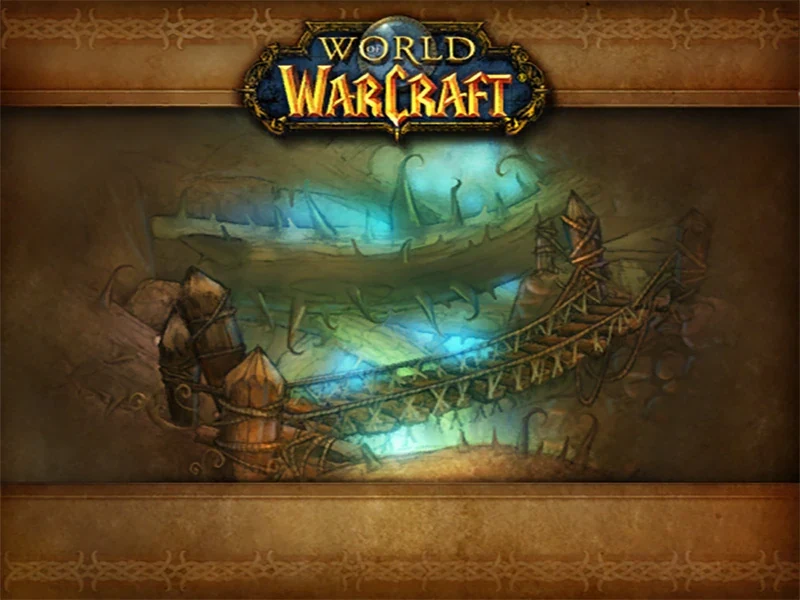
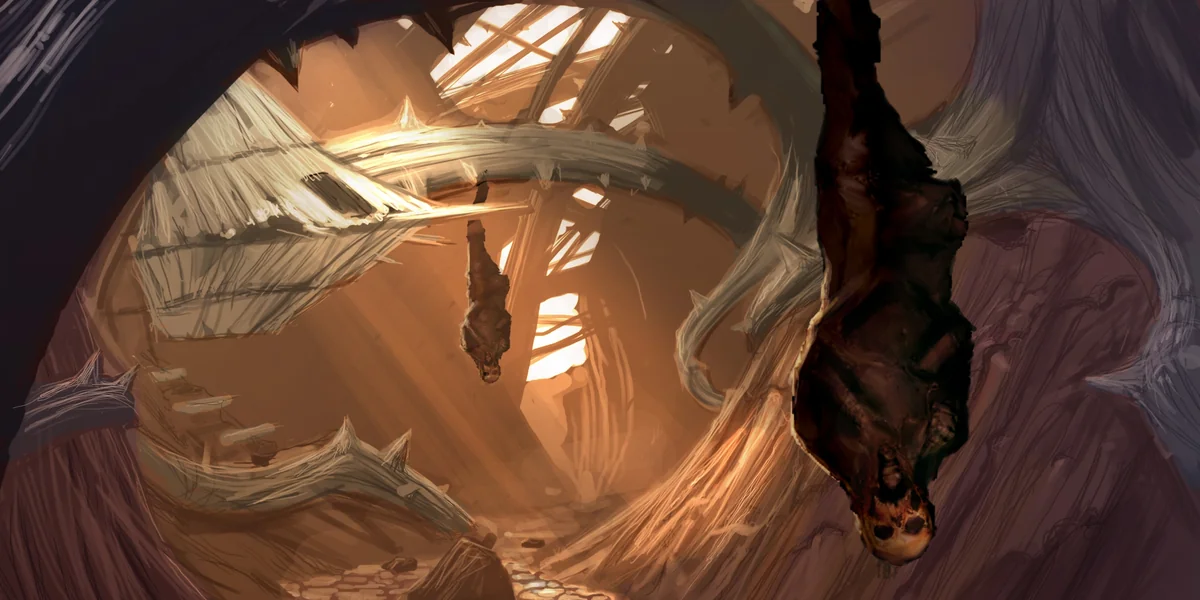
Razorfen Kraul is a maze of giant thorn growths in the southern Barrens, dominated by quilboar. The tribe's spiritual life recalls the demigod Agamaggan, whose blood and death shaped the thorn-ridden land in ancient wars. Under Charlga Razorflank, the kraul has become hostile to many surrounding peoples. The dungeon's story joins ancient sacrifice with modern territorial fear.
Razorfen Downs lies amid southern Barrens thornlands and quilboar burial grounds. The deathly magic of the Scourge, particularly the lich Amnennar the Coldbringer, has defiled its ancestral resting places. Quilboar struggling to protect their traditions are drawn into a conflict greater than their local rivalries. The dungeon's tragedy is the corruption of a sacred place devoted to the dead.
Maraudon is a cavern sanctuary within Desolace, associated with the earth elemental princess Theradras and the keeper Zaetar. Their union gave rise to the centaur, whose conflict with the tauren shaped much of the surrounding region. The site mixes sacred groves, stone passages and the consequences of an ancient tragedy. It was added as a playable dungeon in patch 1.2, after the original patch 1.1 world snapshot.
Dire Maul is the ruined Highborne city of Eldre'Thalas hidden in Feralas. The surviving Shen'dralar retain a fraught relationship with arcane power, while ogres and demons occupy different wings of its once-grand complexes. Its fall is inseparable from the Sundering and the decline of Highborne society. The playable dungeon was introduced in patch 1.3, although its underlying lore predates the original WoW launch.
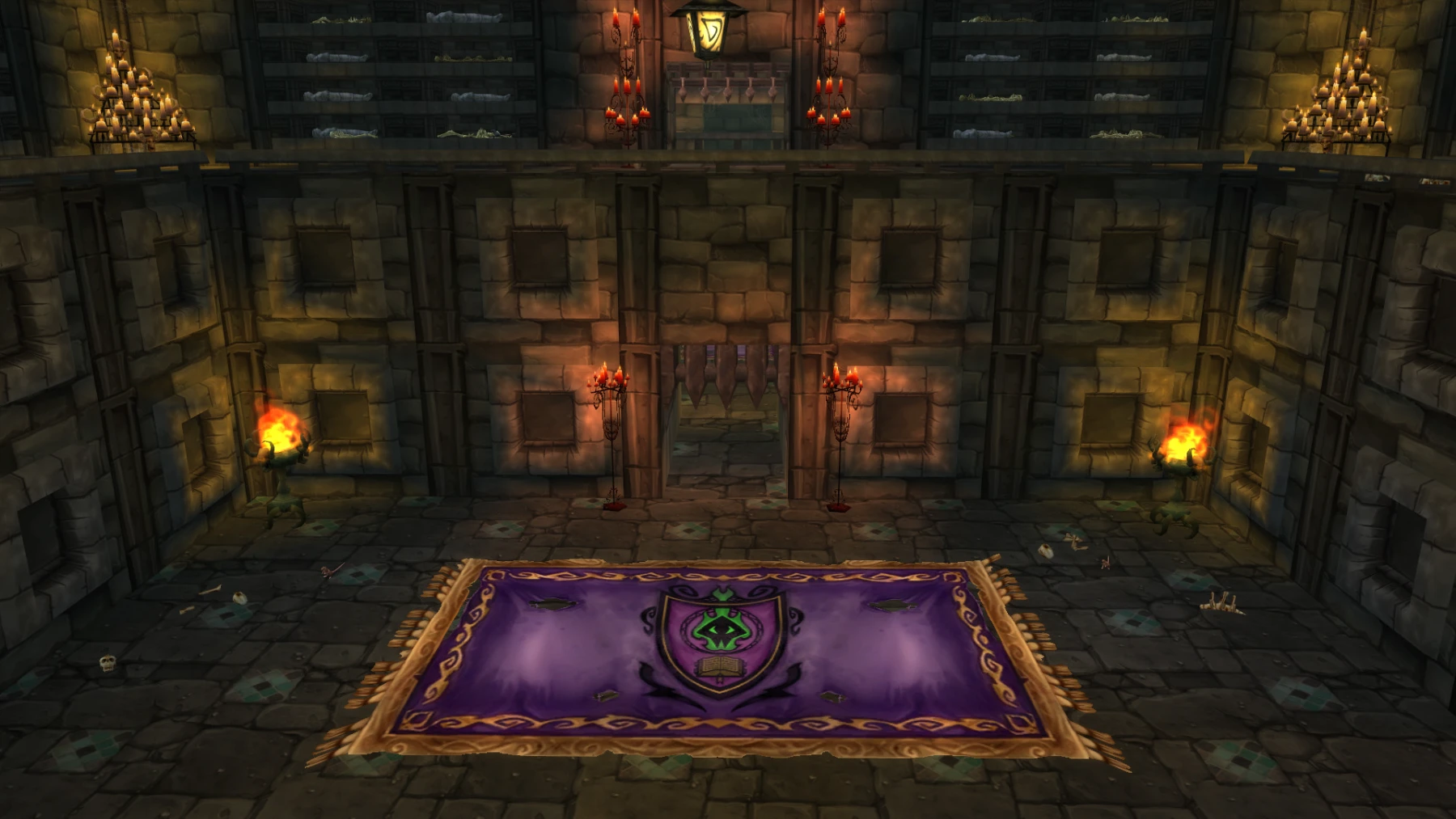
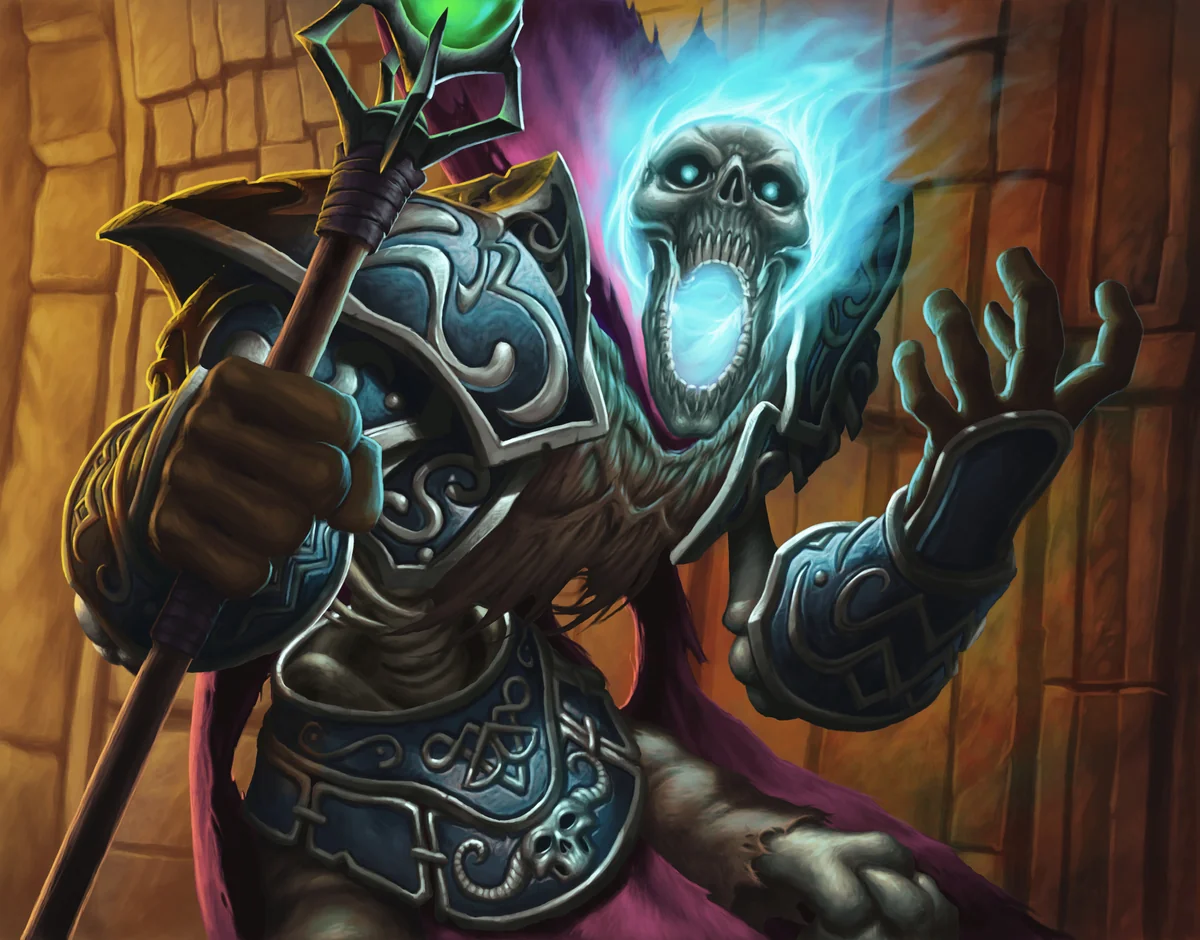
Beneath the island keep of Caer Darrow lies Scholomance, a school established by the Cult of the Damned to teach necromancy. The Barov family surrendered its estate in a bargain meant to secure power beyond death, and the result became a fortress of horror. Darkmaster Gandling governs the school, while Ras Frostwhisper and other servants of the Scourge remain within. Scholomance shows how Lordaeron was undermined from within before its armies fell.
The Scarlet Monastery's graveyard belonged to an institution transformed by the fall of Lordaeron. Its leaders sought to fight the undead, but they also became consumed by the fear that anyone outside their ranks might be corrupted. A place meant to honor the dead now stood inside a fortress of zealots waging a harsh war against both the Scourge and those they distrusted.
The Scarlet Monastery’s library was once part of Lordaeron’s religious and scholarly life. After the Scourge destroyed the kingdom, the Scarlet Crusade turned the monastery into a fortress of militant faith. Knowledge and teaching became intertwined with an increasingly intolerant campaign, guarded in the library by Arcanist Doan.
The Scarlet Monastery's armory grew in importance after the Crusade converted a place of worship and learning into a military fortress. Training soldiers within the monastery allowed the Crusade to organize its campaigns while keeping its forces apart from outsiders it regarded with suspicion. Where the institution had once cultivated religious learning, its leaders now prepared warriors for a conflict they understood as a test of purity as well as survival.
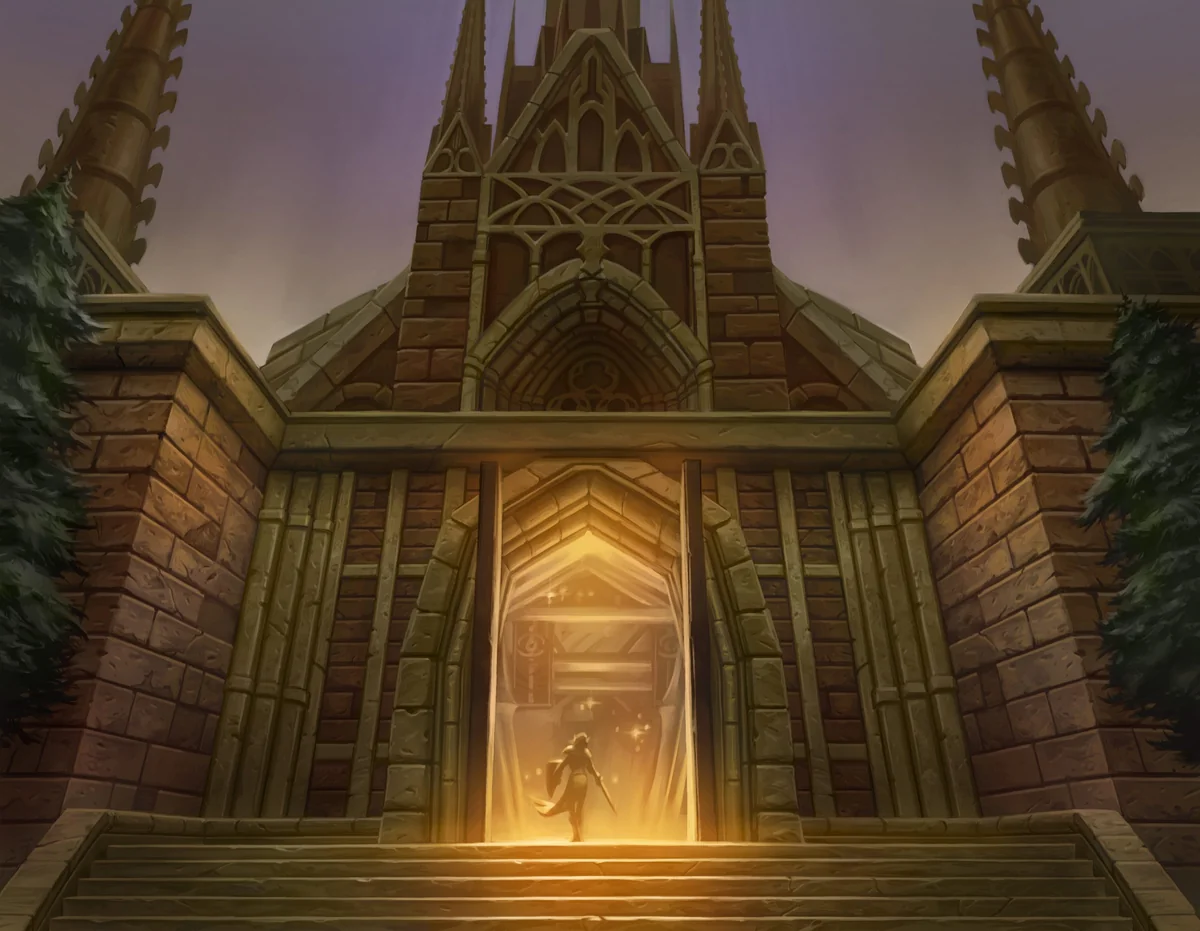
Lordaeron’s surviving faithful sought sanctuary after the Scourge destroyed their kingdom. The Scarlet Crusade made the monastery’s cathedral the spiritual heart of its war against undeath, but its conviction hardened into persecution. Scarlet Commander Mograine and High Inquisitor Whitemane embodied a movement that increasingly mistook suspicion for righteousness.
Eldre'Thalas rose in ancient Feralas as a city of the Highborne, built to preserve arcane knowledge and the power of Queen Azshara's empire. The satyr Alzzin the Wildshaper became associated with the twisting of the plant life there, turning an ancient place of learning into hostile overgrowth. Eldre'Thalas had survived a world-ending catastrophe but failed to preserve the society that built it.
The western halls of Eldre'Thalas preserve the most troubling legacy of the Shen'dralar Highborne. The Shen'dralar imprisoned the creature Immol'thar behind magical pylons and siphoned its energy. The west wing tells the story of a civilization that survived the collapse of its empire but not the habits that had made that collapse possible.
The northern quarter of Eldre'Thalas passed from Highborne hands to the Gordok ogres long after the old elven empire had broken apart. Gordok power depended on strength, guards and competition within its own ranks. Its walls had survived the Sundering, but survival could not keep the same people in control forever.
The lower spire sheltered the surviving soldiers of the Old Horde after their defeat. Blackrock warriors and their allies sustained Rend Blackhand’s rival command amid conflict with the Dark Iron dwarves. Nefarian’s growing influence drew these old military remnants into the black dragonflight’s designs for Blackrock Mountain.
The upper halls of Blackrock Spire are held by forces that refuse to accept the end of the old Horde. Rend Blackhand claims to be warchief, commanding renegade orcs, ogres and forest trolls beneath the protection of Nefarian’s black dragonflight. General Drakkisath defends the heights with dragonspawn forces. The fortress reveals an unfinished struggle for Blackrock Mountain and a dangerous rival to Thrall’s new Horde.
Beneath Blackrock Mountain, a dwarven feud left behind a realm of living fire and bondage. Thaurissan's attempt to strike back at the rival clans brought Ragnaros into Azeroth and transformed the surrounding lands in catastrophe. The surviving Dark Irons became subjects of the elemental power their ruler had unleashed. Molten Core endures as the heart of a disaster in which a quest for vengeance destroyed the victors' freedom as well as their enemies' peace.
Onyxia's hidden refuge belonged to the schemes of Deathwing's surviving children. Disputes over reconstruction, divided loyalties, and threats beyond the capital created opportunities for a dragon who wished to weaken human rule without announcing her presence. Like her brother Nefarian at Blackrock Mountain, she pursued the power of the black flight through mortal conflicts.
Blackwing Lair occupies the heights of Blackrock Mountain, where the black dragon Nefarian pursues experiments and schemes above the Dark Horde. Rend Blackhand's surviving orcs and the fortress's other occupants form part of the political setting around his seat. The raid deepens the mystery of the black dragonflight's ambitions. Its playable release came in patch 1.6, not the original 1.1 world.
The Ruins of Ahn'Qiraj form part of the ancient qiraji city beyond Silithus's sealed Scarab Wall. The War of the Shifting Sands left this civilization enclosed after a desperate struggle involving night elves and dragons. The ruins retain the memory of that war and the ongoing danger beneath the desert. The raid opened in patch 1.9; its gates are still sealed in the original 1.1 snapshot.
The Temple of Ahn'Qiraj lies at the center of the imprisoned qiraji realm beyond Silithus. C'Thun's influence makes the ancient city a place of profound menace, tied to the Old Gods and the War of the Shifting Sands. The dragonflights and night elves once labored to keep this danger behind the Scarab Wall. The raid was not playable until patch 1.9, well after the frozen 1.1 world state.
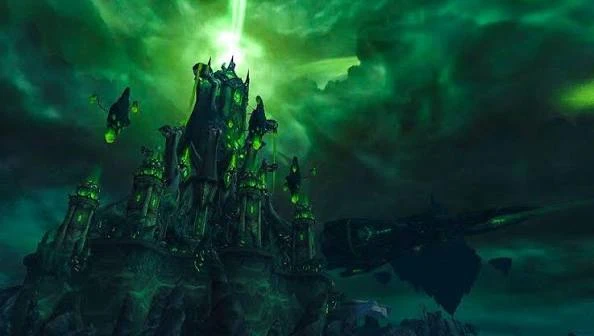
Naxxramas is a flying Scourge necropolis associated with the lich Kel'Thuzad. From the skies above the Plaguelands it symbolizes the organized power of the undead army after Lordaeron's collapse. The citadel houses terrifying necromantic forces and elite servants of the Lich King. The original raid arrived in patch 1.11, not patch 1.1.
Barrow Deeps is a new ten-player Forever raid connected to Shen’dralas and its burial landscapes. Its setting builds upon the old history of the Shen'dralar, Eldre'Thalas and the region's centaur conflicts. The official preview establishes the raid's existence without a complete, verified account of its ancient purpose or every inhabitant. Its story belongs to the Forever time bubble, not to the patch 1.1 dungeon roster.
Hyjal Summit is a new Forever raid set in the aftermath of the Third War's defense of Nordrassil. The mountain carries the memory of Archimonde's defeat and the sacrifice of the wisps. Forever opens new conflicts in a landscape still recovering from that battle.
Northshire Abbey belongs to the long rebuilding of Stormwind after the First War. The Church of the Holy Light offered a source of continuity for a kingdom whose royal family, soldiers, and ordinary townsfolk had endured exile. The costs of rebuilding helped fuel bitterness among the Stonemasons, and threats survived beyond the city's authority.
The roads through Elwynn bound Stormwind's capital to the farms and timberlands that sustained it. The First War destroyed Stormwind and sent refugees north under Anduin Lothar. The settlement's history is therefore part of Stormwind's survival rather than a tale of a great local battle.
The Tower of Azora became a center of arcane activity in Elwynn, where magical study survived within the kingdom of Stormwind's recovered lands. The tower's sharpest rivalry was with the Tower of Ilgalar in Redridge, whose sorcerer Morganth became an enemy of Azora's master. The tower also reflected the difficult place of magic in human history.
Stormwind's rebuilding demanded more than soldiers to guard its walls. The camp's importance grew from its position near the eastern road toward Redridge. Stormwind's history had been transformed by the First War and by the struggle to restore the realm after its destruction.
Moonbrook was once a human settlement tied to Westfall’s fertile farms and the roads toward Stormwind. The Defias Brotherhood turned abandoned buildings and underground workings into a center of its rebellion. Moonbrook carries the clearest scars of the collapse of a working community into a revolutionary stronghold.
Sentinel Hill emerged as a defensive center in Westfall after the western farmlands of Stormwind suffered repeated losses and abandonment. As gangs and harvest machinery threatened families and roads, scattered residents needed protection beyond what the distant city could easily provide. The hill's history is inseparable from the question of what happens after a kingdom is rebuilt on paper.
Westfall's farms once helped feed Stormwind, and the Furlbrow family's pumpkin fields belonged to that older prosperity. The Defias Brotherhood took advantage of the unrest. The family's loss was one small part of a larger failure.
Jangolode began as a working mine serving Stormwind’s economy. After the kingdom denied payment to its builders, Edwin VanCleef transformed the Stonemasons’ grievance into the Defias Brotherhood’s rebellion. The mine became one of the places where Westfall’s productive labor and infrastructure were turned against the crown.
Lakeshire grew along the roads protecting Stormwind’s eastern frontier. The First and Second Wars left the Redridge Mountains exposed to lingering Blackrock orc forces, and Stonewatch Keep was lost. The town’s struggle shows how the restoration of a kingdom’s capital did not immediately secure the homes and roads beyond it.
Stonewatch Keep was built to defend the kingdom of Stormwind's eastern approaches, guarding the passage through the Redridge Mountains near Lakeshire. The warlock Morganth joined the assault but later turned against his orcish partners, assembling gnoll followers beneath his own power. The Blackrock clan nonetheless retained the captured keep under Gath'Ilzogg and his lieutenants.
Darkshire was once Grand Hamlet, a settlement of human farmers and merchants in the wooded lands south of Stormwind. As undead gathered around cemeteries and worgen appeared in the woods, Darkshire’s Night Watch became an essential local institution. The town survives by remaining stubbornly human in a landscape that seems to reject human settlement.
Raven Hill grew as a human settlement in the forests once known as Brightwood, south of Stormwind. As darkness settled over the region, the old roads grew unsafe and the boundary between life and death became uncertain. The village's abandonment was one part of the wider collapse of safety in Duskwood.
The cemetery at Raven Hill was established for the dead of a human settlement in old Brightwood. When unnatural darkness overtook the region, the cemetery became a focus of necromantic disturbance. Its earliest purpose was ordinary and humane; its later terror came from the corruption of that purpose.
Twilight Grove became one of the places where the boundary between Azeroth and the Emerald Dream lay unusually close. The grove's great tree and moonwell carried that older druidic presence into lands later governed by human kingdoms. The grove preserved a connection between human-held lands and the older world of kaldorei magic, natural spirits, and dragons.
The Yorgen Farmstead once belonged to the settled countryside of Brightwood, before shadow and violence transformed the region into Duskwood. A frightened wanderer named Jitters had discovered the Scythe of Elune near Roland's Doom. Sven returned to find his family gone and began seeking answers.
Booty Bay took shape around a sheltered port at the southern tip of Stranglethorn, far from the direct rule of human kings. Stranglethorn’s older history belonged to the Gurubashi troll empire, whose ruins and successors remained in the interior. Under Baron Revilgaz and the Blackwater Raiders, the port is a haven for transactions that more orderly kingdoms would find uncomfortable.
Grom'gol Base Camp became a Horde foothold on the northern coast of Stranglethorn, within a region whose jungles and ruins reflected the long decline of the troll empires. The Darkspear trolls brought knowledge of Stranglethorn and of the rivalries among jungle tribes. Unlike the orcish strongholds founded to conquer Stormwind in the First War, it belonged to an alliance that included the trolls whose ancestral home lay within the jungle.
The arena in Stranglethorn was built in the shadow of the Gurubashi Empire, whose authority once spread across great reaches of southern Azeroth. Old accounts speak of contests in which bloodshed was not a possibility but an expectation, and champions sought recognition before their rivals. In later times, opportunists used the old stadium for their own contests, prizes, and wagers.
Zul'Kunda was a troll settlement in northern Stranglethorn, part of the lands that had once belonged to the broad Gurubashi world. The Bloodscalp trolls claimed strongholds amid the northern ruins, competing with other tribes and resisting intruders. Zul'Kunda's history is therefore not the founding of a new civilization in the shadow of human exploration.
The Vile Reef lies off Stranglethorn, where the sea connects the jungle to histories older than the coastal settlements. Azshara and her surviving followers became the naga, a people of the deep who carried aspects of the old Highborne world into the oceans. Not every stone beneath the reef can be assigned to a named king or a recorded battle.
Stonard arose during the Horde's first campaigns in Azeroth, when the orcs pushed into the swamps south of Stormwind and sought a foothold beyond the Dark Portal. Stormwind eventually fell, and the conflict spread across the sea into the Second War. Not every stronghold of the old campaigns belonged to that new beginning.
The Harborage was a refuge in the Swamp of Sorrows associated with the Broken, a people descended from the draenei whose lives had been disrupted by the wars of Draenor. Not every survivor could return to a lost homeland, and some struggled to live beyond the authority of the orcish clans that had destroyed their communities. Its history connects a quiet camp in Azeroth to the destruction of draenei society on Draenor.
The Atal’ai fled to the Swamp of Sorrows after their devotion to Hakkar helped tear apart the Gurubashi Empire. They raised a temple to summon the blood god, but the green dragonflight sank the sanctuary beneath the swamp. The Pool of Tears became part of a centuries-long struggle to contain a forbidden cult that refused to die.
The Dark Portal was opened through the machinations of Medivh and Gul’dan, joining Draenor to Azeroth. The Second War broadened the conflict into a struggle across Lordaeron and Khaz Modan. The structure remains a landmark of the moment Azeroth’s history ceased to be confined to one world.
Nethergarde Keep was founded to guard the southern kingdom against another invasion through the Dark Portal. Its garrison watched a wasteland scarred by demonic and orcish power, while the Alliance tried to understand a threat that conventional walls had never been built to contain. Whatever became of the gateway, the keep stood at the edge of a place where the world's boundaries had once been broken.
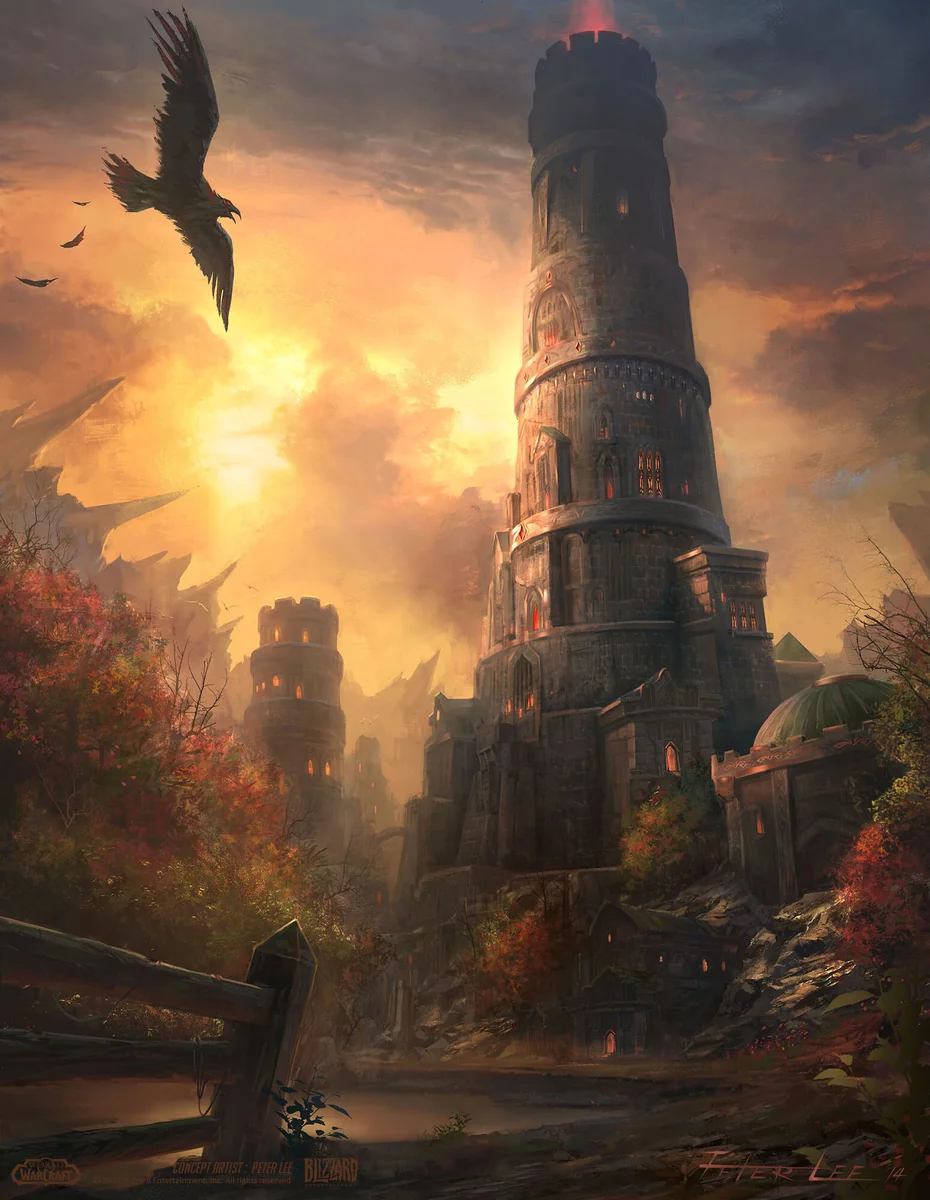
An isolated tower in Deadwind Pass became the center of a catastrophe when its master, Medivh, helped open the Dark Portal. The Guardian of Tirisfal had inherited extraordinary magical duties while bearing Sargeras's hidden corruption, a danger eventually uncovered by Khadgar and Lothar. Medivh's death could not undo the invasion or remove the dread surrounding his former home. Karazhan remained a monument to the disastrous power of a protector who became the means of Azeroth's betrayal.
The dwarven kingdoms of Khaz Modan were shaped by mountains, workshops and hard-won routes through dangerous country. During the wars with the Horde, Khaz Modan's occupied settlements and mountain passes showed how vulnerable a kingdom could be if its roads were seized. War changed the scale of the distances its ships needed to bridge, and the settlement helped scattered allies remain in contact after the destruction of much of the old human north.
Dun Modr guarded the Thandol Span, the road linking Khaz Modan to the northern kingdoms. Dark Iron attacks revived the ancient divisions of the dwarven clans and threatened a crossing vital to trade and reinforcement. The defenders faced a shattered bridge, fallen soldiers, and a struggle to hold the northern frontier.
Whelgar's Excavation Site was established in the Wetlands by dwarves investigating the ancient past of Khaz Modan. The Wetlands had been contested during the Second War, when the orcs pushed through Khaz Modan and threatened the routes linking the dwarves to their Alliance allies. The Bronzebeards had defended Ironforge against powerful enemies, but a people who remembered the War of the Three Hammers also wanted to learn who they had been before those divisions.
Stromgarde stands on ground once occupied by Strom, capital of the first great human empire of Arathor. The city remained important through the Troll Wars and the later rise of the Alliance of Lordaeron. No single faction in the original world has truly inherited all the authority of ancient Arathor.
Hammerfall began as a place of confinement rather than a free settlement. The old arrangement could not last. Arathi was no peaceful homeland waiting to be claimed.
Stromgarde's soldiers descended from one of the oldest human powers, the kingdom that had grown around the city of Strom. After the great wars, Stromgarde was beset by internal enemies and foreign opportunists. The refuge was not another kingdom founded in safety.
The Witherbark belonged to the forest trolls whose ancestors had contested the northern Eastern Kingdoms long before the human kingdoms rose to power. The defeat of the Horde did not settle their disputes with the human kingdoms. Witherbark Village represents the smaller struggles that continued after the great war leaders had withdrawn.
Tarren Mill began as a human settlement within the broad agricultural lands of Hillsbrad, where roads and fields linked northern villages to the larger kingdoms of Lordaeron and Alterac. Lordaeron fell to the Scourge, and many who had lived under its crown died or were raised into undeath. Human settlement, war and the rise of the Forsaken all shaped the valley's loyalties.
Durnholde Keep became a notorious center of the Alliance’s post-Second War internment system. Aedelas Blackmoore held the young Thrall there, trying to shape an enslaved orc into an instrument of his ambitions. Thrall’s escape and later campaign to free the camps turned the fortress into an early chapter of the New Horde’s birth.
The Hillsbrad fields once supplied farms and villages of southern Lordaeron with crops and livestock. The Scourge destroyed Lordaeron's royal order, and the Forsaken later claimed independence from the Lich King's power. Hillsbrad's history follows the changing meaning of familiar land: first the heart of a kingdom's rural life, then a route for invaders, and finally a place where former neighbors became political enemies.
Pyrewood Village survived the undead catastrophe in Silverpine only to fall under a different curse. Arugal’s worgen turned ordinary villagers into beasts after nightfall, while human life resumed with daylight. The settlement reveals the consequences of a desperate magical defense that its creator could not control.
Ambermill grew within the northern human lands that were devastated by the Scourge during the Third War. Dalaran, the great city of the Kirin Tor, had itself fallen to Arthas and the Burning Legion's forces. Silverpine therefore became a place where rival survivors of the same catastrophe could see each other as enemies.
Fenris Keep once defended Lordaeron from an island in Lordamere Lake. The Scourge emptied the fortress, and Thule Ravenclaw took it over with necromantically animated Rot Hide gnolls. The Forsaken traced the magic behind those creatures as they fought to prevent the Scourge from consolidating its hold on Silverpine.
Hearthglen lay within Lordaeron's northern lands, where village life once depended upon the security provided by the king's soldiers and the Knights of the Silver Hand. Plagued grain and the Cult of the Damned turned ordinary supply routes into weapons, and Prince Arthas fought to keep undead forces from overwhelming the town. Religious and military movements arose from the ruins, but they did not all follow the same principles that had guided the Silver Hand.
Uther the Lightbringer helped establish the Knights of the Silver Hand and became one of Lordaeron's most honored defenders. After Arthas claimed Frostmourne and returned as a death knight, he murdered his father and led the Scourge against Lordaeron. Uther was buried in the Western Plaguelands, a region devastated by the very Scourge he had tried to stop.
Darrowshire was a small human village of Lordaeron, remembered for the terrible stand made by its defenders against the Scourge. The village fell amid the Third War’s devastation, and its dead were left troubled by the manner of their deaths. Darrowshire shows how a single village can preserve the moral history of a war.
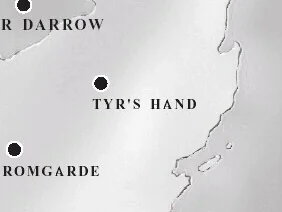
Tyr's Hand belonged to the eastern lands of Lordaeron before the Scourge tore the human kingdom apart. Tyr's Hand became part of the Crusade's attempt to preserve an armed human presence in the shattered kingdom. Tyr's Hand inherited the memory of human rule and religious devotion, but its later history was shaped by what those ideals became in the hands of desperate zealots.
Corin's Crossing belonged to the network of roads and settlements that once connected the farms and towns of eastern Lordaeron. Arthas's pursuit of the plague ended not in restored order but in his surrender to Frostmourne. Its fate shows why the collapse of Lordaeron was more complete than the fall of one capital.
Jintha'alor was a stronghold of the Vilebranch trolls in the Hinterlands, where the forest tribes carried on histories older than the human kingdoms around them. Jintha'alor became a center of that independence, but also of hostility toward outsiders. From these places the trolls preserved customs, defended territory and resisted the political changes brought by the Alliance and Horde.
Shadra'alor grew from the religious traditions of the forest trolls, whose settlements in the Hinterlands long predated the arrival of many younger kingdoms. The city was associated with Shadra, the spider loa revered by some of the forest trolls. Shadra'alor's history is therefore more than the story of a contested settlement.
Alterac's capital fell after Lord Perenolde betrayed the Alliance during the Second War. His decision to aid the Horde brought punishment upon the mountain kingdom and ended its independence. The ruined city later became contested ground for the Syndicate and ogres, both claiming what remained of Alterac's power.
Dalaran rose as a center of arcane learning and a power within the northern human kingdoms. Arthas led the undead against the city while Archmage Antonidas and the defenders attempted to hold it. Dalaran's ruin marked the failure of magical learning alone to protect a civilization.
Kharanos grew along the roads of Dun Morogh beneath the protection of Ironforge, within a homeland shaped by a much older struggle for the mountains. Kharanos became one of the places where their practical skills met: forges, workshops, and brewing traditions supported the surrounding settlements. The town's part in history was less dramatic than the defense of Ironforge, but no less connected to it.
Anvilmar bears the name of the high king whose death brought the old dwarven unity to an end. The Wildhammers founded a new capital at Grim Batol, while the Dark Irons established the city of Thaurissan in the south. The name Anvilmar thus belongs to a memory of what existed before those divisions hardened.
The Valley of Trials stands in Durotar, the harsh land Thrall chose for the New Horde after the Third War. The Horde’s survivors had escaped internment in the Eastern Kingdoms, crossed the sea and fought alongside new allies against the Burning Legion. The valley reflects a change in orcish history from conquest abroad to the difficult work of founding a homeland.
Razor Hill grew as the orcs established Durotar after the Third War. Its harsh land demanded new roads, stores and defenses, while hostile forces challenged the fledgling nation. Its beginnings were tied to Thrall's attempt to transform the orcs' political life.
Tiragarde Keep owes its presence on the coast of Durotar to the conflict between Thrall's New Horde and Admiral Daelin Proudmoore. The admiral brought Kul Tiran forces across the sea to attack the new orcish nation. Tiragarde belonged to that bitter aftermath of the Third War, when allies against the Legion could still become enemies over the wrongs of earlier generations.
Skull Rock's danger arose from a conflict within orcish history that the founding of Durotar could not immediately resolve. Places hidden from Orgrimmar's authority offered them refuge, and the caverns of Skull Rock became associated with hostile adepts and dangerous summons. The cavern's history belongs to the aftermath of the old Horde's corruption.
The Crossroads grew where central Kalimdor’s roads meet, linking the new orcish lands of Durotar with Mulgore, Ashenvale and the southern Barrens. After the Third War, the Horde’s orcish, tauren and troll allies needed a durable connection across dry and contested countryside. The settlement embodies the Horde’s attempt to become a stable confederation.
Ratchet grew on the coast of the Barrens as a goblin port where commerce could thrive despite the rivalries of Kalimdor. The rise of Thrall's Horde made the Barrens central to a new political order. The port's history is not the founding of a grand kingdom.
Camp Taurajo arose as the tauren and their new Horde allies made the Barrens part of the wider world surrounding Durotar and Mulgore. Travelers, hunters, and warriors needed places to gather before crossing the open country, and the young alliance relied on connections between peoples who had once been separated by distance and danger. Its place in history is therefore tied to the founding of the New Horde in Kalimdor.
Jaina Proudmoore’s refugees founded Theramore on Kalimdor after the fall of Lordaeron. Her decision to preserve peace with Thrall did not remove the danger of renewed war. Northwatch Hold arose as a coastal defense for the human settlement, embodying the unsettled military frontier left by Daelin Proudmoore’s campaign.
Naralex sought to renew the Barrens by connecting its hidden springs to the Emerald Dream. The attempt brought new oases, but his meditation became trapped in the Emerald Nightmare, corrupting the waters and several of his followers. The Stagnant Oasis carries the consequences of an effort to heal the land that instead brought new suffering.
Astranaar arose beside Ashenvale’s lakes as a stronghold of night-elven life in a forest protected for thousands of years after the Sundering. The Third War carried the Burning Legion and invading orcs into those woods. Astranaar serves as a center of resistance and continuity.
The Horde's settlement of northern Kalimdor began amid a war against the Burning Legion, but the end of that war did not settle the question of land. Thrall's New Horde still needed wood, roads and defended approaches after it established Durotar. The battle against Archimonde had shown that orcs and night elves could cooperate against a common enemy.
Zoram was once a night-elven settlement on the coast of ancient Kalimdor. The Sundering destroyed the city and broke the temple lands around it, leaving ruins that later drew naga, satyrs and the Twilight's Hammer. The coast's troubled history reaches from the War of the Ancients to the cults that followed.
Satyrnaar's history reaches back to the War of the Ancients, when high elven magic and the ambitions of Queen Azshara opened the way for the Burning Legion. The satyrs occupied Satyrnaar as one of the sites from which they could sustain their dark rites. When sentinels and their allies investigated the tower, the trail led beyond a single hidden chamber.
Demon Fall Canyon is remembered as the place where Grom Hellscream confronted the pit lord Mannoroth. Thrall helped Grom break from that influence, and together they faced the demon who had helped corrupt the orcs in the first place. The canyon marks a turning point in the founding story of the New Horde.
The Warsong clan came to Ashenvale after the orcs of Thrall's Horde crossed the sea to Kalimdor. The dispute escalated as Grom's fighters continued to seek resources in the face of resistance. Thrall ultimately fought to release Grom from Mannoroth's influence, and Grom sacrificed his life destroying the pit lord.
The coasts of Darkshore had once belonged to a far larger kaldorei world. Over the long years that followed, the kaldorei centered their guardianship upon northern Kalimdor and the forests surrounding Hyjal. Auberdine developed as a port through which these separated lands could communicate.
Bashal’Aran prospered as one of Queen Azshara’s favored Highborne settlements, ruled with Ameth’Aran by Athrikus Narassin. The Sundering destroyed that world, but Narassin’s magic left the mage Asterion imprisoned behind a moonstone seal. The ruined town preserves both the ambitions of the old empire and the cruelty that survived its fall.
Ameth’Aran was one of the great Highborne towns favored by Azshara and governed by Athrikus Narassin. The destruction of the Well of Eternity ruined it alongside the rest of the ancient empire. Stone tablets and restless spirits preserved a history of magical privilege, catastrophe, and the imprisonment of Asterion.
A vast weapon is embedded in the remains of a being of enormous size at the Master’s Glaive. By the original game era, the Twilight’s Hammer had taken an interest in the monument and the power it might represent. The glaive is important as a mystery rather than as proof of every later account of titans and Old Gods.
The Tower of Althalaxx became the center of a struggle that linked the fallen Highborne to a more recent warlock cult. Sentinel Elissa Starbreeze grew concerned when Balthule Shadowstrike failed to return from an investigation of the tower. The Dark Strand's presence was a reminder of an ancient danger that had survived the Sundering: magic used without regard for the lives consumed by it.
Shadowglen grew within Teldrassil, the world tree raised after the Third War. Settlements within the tree became places where the next generation would learn the customs of its people in a changed world. Shadowglen thus began with an act of rebuilding after victory and loss.
Dolanaar was established on Teldrassil, a home the night elves created only after the Third War shattered their ancient confidence. Teldrassil's growth made settlement possible, but its creation was controversial among the night elves' own druids. The new tree did not automatically restore the blessings of the old one, and corruption troubled parts of the emerging homeland.
Night elven barrow dens were created for druids whose duties carried them into long sleep within the Emerald Dream. Ban'ethil was established on Teldrassil after the night elves undertook the immense task of building a new homeland in the wake of the Third War. The Gnarlpine furbolgs eventually seized the den, profaning a sanctuary intended for dreaming druids.
The Gnarlpine furbolgs had lived beside the night elves before Teldrassil’s corruption damaged their communities. Ursal the Mauler used fel moss to drive his tribe into violent madness, turning them against former allies and threatening Starbreeze Village. Gnarlpine Hold became a refuge for the corrupted tribe and a sign of the World Tree’s troubled founding.
Sun Rock Retreat was established in the Stonetalon Mountains as the tauren looked beyond the security of Mulgore. The Stonetalon passes linked the Barrens with wooded highlands contested by several peoples. The tauren were no longer only fleeing attacks; they were helping defend a wider region alongside allies whose ambitions did not always match their own.
The Venture Company's search for profit brought its crews into the forests and mountains of Kalimdor. The machines and camps that followed were not part of a settlement movement seeking refuge from war. The dispute grew from a pattern that followed the end of the Third War: new powers and private ventures sought opportunities in regions already inhabited by others.
The Charred Vale was once a living forest in the Stonetalon Mountains. Violence between the company and the treants left damage far beyond the paths of the cutting crews, and destructive elemental forces spread into the ruined ground. Druids and defenders from nearby tauren settlements sought to heal what remained, but the valley's suffering could not be undone in a single season.
Jaedenar was built into ancient night-elven ruins in the forest that became Felwood. The council’s warlocks survived the downfall of the old Horde and the Third War, gathering in protected chambers and the underground Shadow Hold. Jaedenar embodies a danger that Thrall’s victory could not immediately erase: the institutions of demonic service still existed beyond the new Horde’s control.
Shadow Hold became the Shadow Council's hidden stronghold in Felwood after the old orcish warlock conspiracy survived the collapse of the Horde it had once manipulated. In the corrupted lands of northern Kalimdor, the surviving conspiracy occupied Jaedenar and extended its power beneath the ground. Druids of the Emerald Circle investigated Jaedenar, while Arko'narin Starshade and the paladin Trey Lightforge became entangled with the cult's cruelty.
The Burning Legion’s invasion poisoned the ancient forests of Felwood. Even after Archimonde fell, demonic corruption remained in the soil, wildlife, and trees. Druids of the Cenarion Circle established the Emerald Sanctuary to begin the long work of healing damage that victory in battle could not undo.
The goblins of the Steamwheedle Cartel established Everlook high in Winterspring, a land far removed from the warm ports where most merchants preferred to bargain. Everlook's rise followed the goblins' familiar calculation: trade need not wait for peace or comfortable conditions. The settlement also marked the northern reach of the cartel's commercial network.
Long before mortal travelers entered Winterspring's mountains, the blue dragonflight had guarded the practice and balance of arcane magic. Haleh and other blue dragons guarded its passages and maintained a presence far from cities where mortal magi studied the arts that Malygos was charged to oversee. The continued presence of blue dragonkin in the north reflected a duty that survived terrible personal loss.
Darkwhisper Gorge cuts through dangerous mountains near Mount Hyjal and Winterspring. The path’s significance was heightened by the Battle of Mount Hyjal and the long druidic concern for Nordrassil. WoW: Forever opens a new way through the gorge, but that accessibility belongs to the 2026 gameplay layer.
The night elves' druidic traditions were shaped by Cenarius and by the long effort to defend Kalimdor from forces that threatened the living world. The War of the Ancients and the Sundering changed the night elves' civilization, but they did not break the duty that bound the druids to the forests. After the Legion's defeat at Mount Hyjal, the night elves faced an uncertain future without the old blessing of immortality.
Feathermoon Stronghold anchored the Sentinels' defense of Feralas under Shandris Feathermoon. Its watchful garrison faced dangers among the ruins of the old night-elven empire, from ogres to other powers occupying abandoned cities. The stronghold represented the kaldorei's determination to defend their forests and surviving communities rather than recreate Azshara's vanished imperial order.
Camp Mojache developed as a tauren station in Feralas, far from the grasslands of Mulgore. Ancient Highborne ruins stood among thick forests, while ogres and other powers contested roads and sacred places. A people repeatedly driven from one campsite to another could now plan for guarded routes and enduring outposts.
Isildien belonged to the night elves who settled and built throughout ancient Kalimdor before the Great Sundering. Feralas remained green while much of the old empire disappeared beneath the sea, but surviving walls did not guarantee the survival of the people who raised them. The older one concerns the collapse of a night elven world that had stretched far beyond any single forest.
Ravenwind was built during the long age of night elven settlement in Kalimdor, before the Great Sundering shattered the realm that had sustained its cities. Feralas remained inhabited after the catastrophe, but the ruined settlement did not regain its earlier place in elven life. The ruins connect the Highborne's vanished power with the work of those who came afterward.
The Steamwheedle Cartel built Gadgetzan as a trading center deep in Tanaris, linking desert enterprises with shipping through Steamwheedle Port. Goblin merchants made commerce possible where a human or orcish kingdom had little lasting authority. Its growth rested on contracts, engineering and guarded neutrality.
The Caverns of Time in Tanaris are associated with the bronze dragonflight and its charge to watch over the flow of time. The original era preserves the caverns as a guarded and mysterious place. The caverns represent the difference between a location’s deep historical purpose and the much later discovery of what lies within it.
The Steamwheedle Cartel established its port on the eastern coast of Tanaris to connect the desert trade with ships crossing the South Seas. The decision to maintain a harbor in Tanaris brought the cartel into conflict with the coast's less lawful inhabitants. Goblin enterprise joined its inland roads to the wider sea, creating chances for trade and new reasons for enemies to fight over shipping.
The Southsea pirates sought more than isolated ships to plunder. Men who could sail beyond the desert's edge had less reason to depend on the settlements controlling its wells and roads. Gadgetzan's traders tried to sustain commerce between the inland settlement and the South Seas, while the pirates turned the same sea lanes into hunting grounds.
Kodos were bound to the lives of the tauren long before the tribes gathered beneath Cairne Bloodhoof. Desolace was also a battleground for the centaur clans, whose raids placed constant pressure on tauren communities moving through central Kalimdor. The tauren's later alliance with Thrall and their settlement in Mulgore changed their political fortunes, not their older relationship with the land and its animals.
Sargeron belonged to an older world than the centaur wars that later shaped Desolace. Sargeron's remains became one such remnant. The ruins do not preserve a known list of rulers or a documented account of their founding.
Desolace already bore the marks of ancient ruin when the Burning Blade brought renewed demonic danger into its southern lands. The Burning Blade did not regard the defeat of the Legion at Mount Hyjal as an end to demonic service. Against these practices stood tauren and other defenders who understood that the enemy could re-enter a land without marching in a vast army.
The Darkspear trolls followed Thrall to Kalimdor after losing their island home to enemies from the sea. As the Darkspear established communities across Kalimdor, Shadowprey Village arose on the coast of Desolace. Shadowprey's history therefore belongs to the rebuilding of a people rather than to the founding of a great kingdom.
Gnome and goblin engineers turned the dry bed of the Shimmering Flats into a contest of speed. Rival workshops established the Mirage Raceway to decide whose inventions could endure the fiercest tests. Their competition brought a new, mechanical kind of rivalry to the edge of Thousand Needles.
Long before tauren riders learned to master the skies, the wyverns of Highperch nested above the canyons of Thousand Needles. As the New Horde grew, its wind riders needed more wyverns than their trainers could readily provide. Another tauren, Pao'ka Swiftmountain, came to Highperch while accompanying Motega Firemane in the study of local creatures.
Brackenwall Village grew out of the New Horde's struggle to establish itself in Kalimdor. The ogres had their own history of clan rule and internal conflict. The settlement belongs to the period after the Third War, when the Horde was establishing new communities while threats from the outside tested its alliances.
The Wyrmbog became a threat to the Stonemaul ogres after the black dragonflight spread through southern Dustwallow Marsh. The Stonemaul had already lost their former village and taken refuge at Brackenwall under the leadership of Mok'Morokk. The Wyrmbog revealed how the consequences of Onyxia's influence reached far beyond her plots in Stormwind.
Alcaz Island lies off the coast of Dustwallow Marsh and is associated with a guarded prison complex. The abduction of King Varian Wrynn forms part of the original-era intrigue surrounding the Defias Brotherhood and the manipulation of Stormwind. Alcaz turns a remote marshland island into a link between the politics of a human kingdom and the dangerous coast of Kalimdor.
Marshal's Refuge developed from an expedition into Un'Goro Crater, a place where strange creatures and older mysteries challenged every assumption explorers brought from the outside world. Its wildlife, unusual terrain and ancient features demanded close observation rather than simple conquest. After great empires fell and armies crossed continents, explorers still entered places whose past was only partly understood.
Fire Plume Ridge rises at the center of Un’Goro Crater, its volcanic heat supporting dangerous elemental activity. The crater attracted researchers seeking to understand its unusual crystals, beasts and geological history. The ridge is part of Un’Goro’s history as a realm of extremes.
The Slithering Scar is an immense burrow and hive complex in Un’Goro, associated with the silithid that spread through southern Kalimdor. The silithid’s history is bound to the ancient qiraji and the conflicts of the southern deserts. The hive connects the apparent wilderness of Un’Goro to the political and military history of Silithus.
Southwind Village was an outpost of night elves in Silithus, far from the principal forests of their civilization. The War of the Shifting Sands left the southern deserts scarred and burdened the night elves with guarding threats that had once nearly overwhelmed them. Southwind marks how the silithid could destroy even small settlements beyond the fortified ruins of Ahn’Qiraj.
Hive’Zora is one of the major silithid colonies in Silithus. When the gates of Ahn’Qiraj were sealed, the wider silithid presence was not extinguished. The hive demonstrates that sealing an ancient enemy is different from eliminating every part of its power.
Hive’Ashi is a silithid colony in the sands of Silithus, one of several large networks occupied by the descendants and servants of the ancient qiraji threat. The War of the Shifting Sands culminated in the sealing of Ahn’Qiraj, but left scattered hives active throughout the southern desert. The hive is an enduring symptom of a war that could be contained without being completely ended.
Eldarath flourished in Azshara when the night elves' empire still drew power from the Well of Eternity. As Azshara's court opened the path for demonic invasion, resistance spread among the night elves and their allies. The ruins matter because they preserve both halves of the Highborne legacy.
The Temple of Arkkoran stands along Azshara’s coast, in a region shaped by the collapse of the ancient night-elven world and the spread of naga influence. The Great Sundering altered the shoreline and opened parts of the old realm to new occupation. Arkkoran forms one piece of the region’s fractured religious geography.
Shen’dar Village is one of the principal Skyborne communities on Zephras Isle. The ancient Highborne culture did not survive unchanged in Skywall. The Forever beta’s early quests place instructors, artisans and local guardians here as the Skyborne confront danger on their island.
The highlands around Shen’dar Village belong to the Skyborne island anchored in Skywall. The new settlement was not spared ordinary strife. The highlands illustrate the crisis inside the Skyborne homeland: a society sustained by elemental gifts must decide how to protect those gifts when local thieves, political tension and religious extremists exploit uncertainty.
Falaath Village occupies part of the Skyborne landscape inherited by descendants of the ancient Eldre’Thalas exiles. In the Forever beta, adventurers investigate the village for evidence of the Al’Aketh cult’s intentions. Falaath is a useful entry point to the question dividing Zephras: whom should the Skyborne trust when the powers sustaining their home appear to be disappearing?
Shadowgale Forest is home to the Nightclaw Druids, an independent druidic tradition within Skyborne society. Druidic ideals spread in the aftermath of the War of the Ancients when followers of Malfurion sought a different relationship with nature. In Forever the Nightclaw operate independently of the island’s main political factions.
Nightclaw Cavern is associated with the independent druids of Shadowgale Forest. The Forever beta preserves recorded histories of rebellion against Prince Tortheldrin’s policies at Eldre’Thalas, including a veiled figure called the Shal’nan and the spread of naturalistic practices among dissenters. The cavern is therefore a meeting point of newer Skyborne history and older druidic ideas.
Valanaar is a named community on Zephras Isle, home to merchants and tradespeople in the Skyborne beta. The shen’dorei survived for millennia because their floating island remained anchored and sustained by wind spirits. Valanaar’s markets show that the Skyborne are more than a faction divided by magic and faith.
The Skydocks connect the Skyborne community of Valanaar with movement through its elevated world. The Skyborne’s exile began after their ancestors resisted a Highborne ruler and escaped a world transformed by the Sundering. The Skydocks are part of that practical dependence on the air and its powers.
Ban’aethal is a ruined site on Zephras Isle, among the places visited as the Skyborne’s safety deteriorates. The Forever beta’s recorded encounters include unsettled elemental activity in the area. Ban’aethal preserves an important unanswered question: what fell here, and when?
Skywall is the elemental realm of air, distinct from the ordinary lands of Azeroth. Wind spirits sheltered these refugees and anchored their new island home. The Forever story begins when those protectors disappear and the island’s supports begin to fail.
Powderfuse Port is a Steamwheedle-connected harbor on the eastern coast of the Riverglades. Goblins long maintained routes through rival territories by making commerce valuable to all sides. The Powderfuse company gathers sailors and dealers whose interests do not necessarily match those of the Horde or Alliance.
Farholde Keep is an Alliance-linked position in the Riverglades, a frontier reached from Redridge and the Burning Steppes. The wider region inherits the troubles of the old Eastern Kingdoms, where human defenders face ogres and threats from the Twilight’s Hammer. Farholde’s role belongs to that newer pattern of frontier settlement and defense.
Bolder’ok is the name of an ogre clan and a locality in the Riverglades. Ogres carried their political divisions from Draenor and the old Horde into Azeroth, where many groups settled in strongholds far from the New Horde’s authority. The site is therefore a refuge built around a recent break with a dangerous cult, not simply another faceless ogre camp.
Rog’mar is a Horde-linked outpost in the Riverglades whose flights connect the frontier with Kargath, Hammerfall, Stonard and Flame Crest. The older New Horde relied on scattered outposts to move between former enemies and wild regions. Rog’mar’s confirmed identity is a frontier travel and military link.
The Valley of Bones is the approach to Shen’dralas from Desolace, connecting the new region with the centaur lands of central Kalimdor. Desolace is bound to the story of Maraudon, Princess Theradras and the centaur peoples descended from her union with Zaetar. The name is a confirmed part of the Forever area roster, but the origin of any particular bones or battle at this location has not been established and should not be invented.
The Magram Front is a named area in Shen’dralas connected by geography and name to the Magram centaur tribe of Desolace. Forever’s expansion of the territory between Desolace, Mulgore and Feralas brings those struggles nearer to surviving Highborne ruins. The client establishes the locality but not the decisive battles, commanders or outcomes associated with it.
The Summit of Eternity lies on Mount Hyjal, where the world tree Nordrassil was planted above the second Well of Eternity. At the end of the Third War, Archimonde sought the power of Nordrassil. Forever reopens the mountain as a zone recovering from that battle.
The Tainted Foothills occupy part of Mount Hyjal’s lower reaches, which the Burning Legion crossed in its final advance during the Third War. The defenders of Azeroth slowed Archimonde’s armies through alliances among humans, orcs and night elves. In Forever the foothills are a named flight destination in the recovering mountain.
The Shrine of Aviana is a named landmark on Mount Hyjal honoring Aviana, an ancient spirit associated with the wild and the skies. The Burning Legion’s first great invasion changed the fate of many of Azeroth’s ancient protectors. Forever’s new shrine location permits that tradition to be explored, but its founding date and current priesthood remain unspecified in the available map record.
Malorne’s Retreat bears the name of Malorne, the great white stag revered among the ancient powers of Kalimdor. The war against the Burning Legion cost Azeroth many guardians. Forever identifies this retreat on its new Hyjal map.
The Felblood Scar is a named area on Mount Hyjal in Forever. Fel corruption damaged forests and settlements across northern Kalimdor during the Third War. The scar’s name suggests corruption, but the precise event that formed it and the factions now controlling it need direct Forever quest verification.
Thendal Grove is a named locality within Zephras Isle in the WoW: Forever beta. The shen’dorei established a floating home in Skywall after their ancestors fled the old Highborne world of Eldre’Thalas. Their elemental benefactors are missing and the powers holding Zephras Isle together are failing.
Windsong Lake is a named locality within Zephras Isle in the WoW: Forever beta. The shen’dorei established a floating home in Skywall after their ancestors fled the old Highborne world of Eldre’Thalas. Their elemental benefactors are missing and the powers holding Zephras Isle together are failing.
Gustberry Lowlands is a named locality within Zephras Isle in the WoW: Forever beta. The shen’dorei established a floating home in Skywall after their ancestors fled the old Highborne world of Eldre’Thalas. Their elemental benefactors are missing and the powers holding Zephras Isle together are failing.
Shrine of Akir is a named locality within Zephras Isle in the WoW: Forever beta. The shen’dorei established a floating home in Skywall after their ancestors fled the old Highborne world of Eldre’Thalas. Their elemental benefactors are missing and the powers holding Zephras Isle together are failing.
Rohashi Spires is a named locality within Zephras Isle in the WoW: Forever beta. The shen’dorei established a floating home in Skywall after their ancestors fled the old Highborne world of Eldre’Thalas. Their elemental benefactors are missing and the powers holding Zephras Isle together are failing.
Thendal Village is a named locality within Zephras Isle in the WoW: Forever beta. The shen’dorei established a floating home in Skywall after their ancestors fled the old Highborne world of Eldre’Thalas. Their elemental benefactors are missing and the powers holding Zephras Isle together are failing.
Windfield Orchard is a named locality within Zephras Isle in the WoW: Forever beta. The shen’dorei established a floating home in Skywall after their ancestors fled the old Highborne world of Eldre’Thalas. Their elemental benefactors are missing and the powers holding Zephras Isle together are failing.
Shriekling Den is a named locality within Zephras Isle in the WoW: Forever beta. The shen’dorei established a floating home in Skywall after their ancestors fled the old Highborne world of Eldre’Thalas. Their elemental benefactors are missing and the powers holding Zephras Isle together are failing.
Thendal Cave is a named locality within Zephras Isle in the WoW: Forever beta. The shen’dorei established a floating home in Skywall after their ancestors fled the old Highborne world of Eldre’Thalas. Their elemental benefactors are missing and the powers holding Zephras Isle together are failing.
Bandit Hideout is a named locality within Zephras Isle in the WoW: Forever beta. The shen’dorei established a floating home in Skywall after their ancestors fled the old Highborne world of Eldre’Thalas. Their elemental benefactors are missing and the powers holding Zephras Isle together are failing.
Sanctum of Storms is a named locality within Zephras Isle in the WoW: Forever beta. The shen’dorei established a floating home in Skywall after their ancestors fled the old Highborne world of Eldre’Thalas. Their elemental benefactors are missing and the powers holding Zephras Isle together are failing.
Rise of Spirits is a named locality within Zephras Isle in the WoW: Forever beta. The shen’dorei established a floating home in Skywall after their ancestors fled the old Highborne world of Eldre’Thalas. Their elemental benefactors are missing and the powers holding Zephras Isle together are failing.
West Pylon Watchtower is a named locality within Zephras Isle in the WoW: Forever beta. The shen’dorei established a floating home in Skywall after their ancestors fled the old Highborne world of Eldre’Thalas. Their elemental benefactors are missing and the powers holding Zephras Isle together are failing.
East Pylon Watchtower is a named locality within Zephras Isle in the WoW: Forever beta. The shen’dorei established a floating home in Skywall after their ancestors fled the old Highborne world of Eldre’Thalas. Their elemental benefactors are missing and the powers holding Zephras Isle together are failing.
Windsong Standing Stones is a named locality within Zephras Isle in the WoW: Forever beta. The shen’dorei established a floating home in Skywall after their ancestors fled the old Highborne world of Eldre’Thalas. Their elemental benefactors are missing and the powers holding Zephras Isle together are failing.
Overlook Standing Stones is a named locality within Zephras Isle in the WoW: Forever beta. The shen’dorei established a floating home in Skywall after their ancestors fled the old Highborne world of Eldre’Thalas. Their elemental benefactors are missing and the powers holding Zephras Isle together are failing.
Thendal Standing Stones is a named locality within Zephras Isle in the WoW: Forever beta. The shen’dorei established a floating home in Skywall after their ancestors fled the old Highborne world of Eldre’Thalas. Their elemental benefactors are missing and the powers holding Zephras Isle together are failing.
Fairweather Stables is a named locality within Zephras Isle in the WoW: Forever beta. The shen’dorei established a floating home in Skywall after their ancestors fled the old Highborne world of Eldre’Thalas. Their elemental benefactors are missing and the powers holding Zephras Isle together are failing.
Twilight's Shroud is a named locality within Riverglades in the WoW: Forever beta. The Riverglades opened a new frontier between Redridge, the Burning Steppes, the Badlands and the Swamp of Sorrows. Outcast cavalry, goblin traders, Twilight’s Hammer dissidents, gnolls and ogres all have interests in the frontier.
Sunnyglade is a named locality within Riverglades in the WoW: Forever beta. The Riverglades opened a new frontier between Redridge, the Burning Steppes, the Badlands and the Swamp of Sorrows. Outcast cavalry, goblin traders, Twilight’s Hammer dissidents, gnolls and ogres all have interests in the frontier.
Wheeler's Grange is a named locality within Riverglades in the WoW: Forever beta. The Riverglades opened a new frontier between Redridge, the Burning Steppes, the Badlands and the Swamp of Sorrows. Outcast cavalry, goblin traders, Twilight’s Hammer dissidents, gnolls and ogres all have interests in the frontier.
Eastwind Shore is a named locality within Riverglades in the WoW: Forever beta. The Riverglades opened a new frontier between Redridge, the Burning Steppes, the Badlands and the Swamp of Sorrows. Outcast cavalry, goblin traders, Twilight’s Hammer dissidents, gnolls and ogres all have interests in the frontier.
Terral's Watch is a named locality within Riverglades in the WoW: Forever beta. The Riverglades opened a new frontier between Redridge, the Burning Steppes, the Badlands and the Swamp of Sorrows. Outcast cavalry, goblin traders, Twilight’s Hammer dissidents, gnolls and ogres all have interests in the frontier.
Windstead is a named locality within Riverglades in the WoW: Forever beta. The Riverglades opened a new frontier between Redridge, the Burning Steppes, the Badlands and the Swamp of Sorrows. Outcast cavalry, goblin traders, Twilight’s Hammer dissidents, gnolls and ogres all have interests in the frontier.
Elbrim's Farm is a named locality within Riverglades in the WoW: Forever beta. The Riverglades opened a new frontier between Redridge, the Burning Steppes, the Badlands and the Swamp of Sorrows. Outcast cavalry, goblin traders, Twilight’s Hammer dissidents, gnolls and ogres all have interests in the frontier.
Meadowsbrook is a named locality within Riverglades in the WoW: Forever beta. The Riverglades opened a new frontier between Redridge, the Burning Steppes, the Badlands and the Swamp of Sorrows. Outcast cavalry, goblin traders, Twilight’s Hammer dissidents, gnolls and ogres all have interests in the frontier.
Turner's Logging Camp is a named locality within Riverglades in the WoW: Forever beta. The Riverglades opened a new frontier between Redridge, the Burning Steppes, the Badlands and the Swamp of Sorrows. Outcast cavalry, goblin traders, Twilight’s Hammer dissidents, gnolls and ogres all have interests in the frontier.
Bristle Hills is a named locality within Riverglades in the WoW: Forever beta. The Riverglades opened a new frontier between Redridge, the Burning Steppes, the Badlands and the Swamp of Sorrows. Outcast cavalry, goblin traders, Twilight’s Hammer dissidents, gnolls and ogres all have interests in the frontier.
Southern Watch is a named locality within Riverglades in the WoW: Forever beta. The Riverglades opened a new frontier between Redridge, the Burning Steppes, the Badlands and the Swamp of Sorrows. Outcast cavalry, goblin traders, Twilight’s Hammer dissidents, gnolls and ogres all have interests in the frontier.
The Forbidding Sea is a named locality within Riverglades in the WoW: Forever beta. The Riverglades opened a new frontier between Redridge, the Burning Steppes, the Badlands and the Swamp of Sorrows. Outcast cavalry, goblin traders, Twilight’s Hammer dissidents, gnolls and ogres all have interests in the frontier.
Ashwood's Fall is a named locality within Riverglades in the WoW: Forever beta. The Riverglades opened a new frontier between Redridge, the Burning Steppes, the Badlands and the Swamp of Sorrows. Outcast cavalry, goblin traders, Twilight’s Hammer dissidents, gnolls and ogres all have interests in the frontier.
Forlorn Pit is a named locality within Riverglades in the WoW: Forever beta. The Riverglades opened a new frontier between Redridge, the Burning Steppes, the Badlands and the Swamp of Sorrows. Outcast cavalry, goblin traders, Twilight’s Hammer dissidents, gnolls and ogres all have interests in the frontier.
Outcast Hideaway is a named locality within Shen’dralas in the WoW: Forever beta. Shen’dralas occupies a hidden valley beside Desolace and Feralas, between centaur territories and remnants of the ancient Highborne world. The new region connects the memory of Eldre’Thalas and the Shen’dralar with the centaur struggles around Maraudon.
Bristleback Retreat is a named locality within Shen’dralas in the WoW: Forever beta. Shen’dralas occupies a hidden valley beside Desolace and Feralas, between centaur territories and remnants of the ancient Highborne world. The new region connects the memory of Eldre’Thalas and the Shen’dralar with the centaur struggles around Maraudon.
Evenshade's Overlook is a named locality within Shen’dralas in the WoW: Forever beta. Shen’dralas occupies a hidden valley beside Desolace and Feralas, between centaur territories and remnants of the ancient Highborne world. The new region connects the memory of Eldre’Thalas and the Shen’dralar with the centaur struggles around Maraudon.
Forlorn Gardens is a named locality within Shen’dralas in the WoW: Forever beta. Shen’dralas occupies a hidden valley beside Desolace and Feralas, between centaur territories and remnants of the ancient Highborne world. The new region connects the memory of Eldre’Thalas and the Shen’dralar with the centaur struggles around Maraudon.
Elderwild is a named locality within Mount Hyjal in the WoW: Forever beta. Mount Hyjal holds Nordrassil and the ground where Archimonde fell before Malfurion’s wisps at the end of the Third War. Forever opens the healing mountain and introduces a Guardian of Hyjal faction and an uncorrupted furbolg tribe.
Dae'gun is a named locality within Mount Hyjal in the WoW: Forever beta. Mount Hyjal holds Nordrassil and the ground where Archimonde fell before Malfurion’s wisps at the end of the Third War. Forever opens the healing mountain and introduces a Guardian of Hyjal faction and an uncorrupted furbolg tribe.
Mourning's Rest is a named locality within Mount Hyjal in the WoW: Forever beta. Mount Hyjal holds Nordrassil and the ground where Archimonde fell before Malfurion’s wisps at the end of the Third War. Forever opens the healing mountain and introduces a Guardian of Hyjal faction and an uncorrupted furbolg tribe.
Cradle of Tranquility is a named locality within Mount Hyjal in the WoW: Forever beta. Mount Hyjal holds Nordrassil and the ground where Archimonde fell before Malfurion’s wisps at the end of the Third War. Forever opens the healing mountain and introduces a Guardian of Hyjal faction and an uncorrupted furbolg tribe.
Ironband's Excavation Site grew out of the dwarves' search for traces of ancient peoples beneath Loch Modan. Prospector Ironband and his crew uncovered structures that drew them into conflict with troggs. The disruption of the dig reflects a wider pattern in dwarven archaeology: discoveries below the earth brought knowledge and danger together.
The Valley of Kings in Loch Modan commemorates the dwarven leaders Madoran Bronzebeard and Khardros Wildhammer. Their descendants erected monumental statues after the War of the Three Hammers, facing the dangerous lands to the south. The memorials turn a mountain pass into a reminder of clan division, sacrifice, and the price of the Dark Iron rebellion.
Stonemaul Ruins are what remains of the Dustwallow village where Rexxar won the allegiance of the Stonemaul ogres. The clan had joined the defense of Durotar after Rexxar defeated its cruel chief, Kor’gall. Subsequent attacks by black dragonspawn drove the ogres to Brackenwall, leaving their old settlement occupied by the Firemane brood.
Shatter Scar Vale was devastated when infernals fell into Felwood during the Burning Legion’s invasion in the Third War. The impact left craters and ruined woodland, while demonic creatures lingered after the wider invasion was defeated. Its scars make the war against Archimonde visible far from Mount Hyjal itself.
Ethel Rethor is a ruined night-elven site on Desolace’s northwestern coast. Much of its stonework stands submerged, and naga occupy the surrounding waters. The remains witness the destruction of older kaldorei settlements and the long reshaping of Kalimdor after the Sundering.
Faldir's Cove is a concealed harbor beneath the cliffs of Arathi, close to the ruins of Stromgarde. In the original world, Blackwater Raiders sheltered there after their search for treasures at the Drowned Reef met with disaster. Their stranded expedition reveals how the drowned ruins and coast of old Arathor continued to draw fortune seekers long after the kingdom's decline.
Gold Coast Quarry was once an important source of minerals and wealth for Stormwind’s western lands. When Westfall fell into disorder, the Defias Brotherhood took control of the site. Its loss illustrates how the kingdom’s economic reconstruction broke down beyond the capital after the Stonemasons’ grievance became a rebellion.
Thistlefur Village was a furbolg settlement in Ashenvale, home to a tribe increasingly hostile toward its neighbors. The arrival of the Horde and the strain on old forest communities brought the village into conflict with local Sentinels and travelers. Its history is part of the wider damage suffered by Ashenvale’s peoples after the Third War.
Outland is what remained of Draenor after Ner'zhul opened multiple portals and tore his world apart. Draenor had been the homeland of the orc clans before the Horde's invasion of Azeroth, and its wars drew Alliance forces through the Dark Portal. After the world's destruction, the pit lord Magtheridon ruled much of the shattered realm from the Black Citadel in Hellfire Peninsula. During the events of the Frozen Throne, Illidan Stormrage and his allies challenged that rule and seized the fortress.
The Black Citadel was Magtheridon's fortified seat of power in the Outland depicted by Warcraft III: The Frozen Throne. Its defenses included heavy weaponry, magically sustained barriers, guarded passages, and a throne chamber defended by powerful lieutenants. Illidan Stormrage laid siege to the citadel with Kael'thas's blood elves, Lady Vashj's naga, and Akama's draenei. After overcoming its fortifications and defeating Magtheridon, Illidan claimed the stronghold and dominion over Outland.
Before Azeroth was torn into its familiar continents, the lands of Zandalar belonged to the single great continent of ancient Kalimdor. The image is striking: a people preserving a piece of their own ancestral world while the routes to much of it vanished. Memory could become action when its keepers believed something fundamental was at risk. For a Darkspear troll adventuring beside Thrall's Horde, Zandalar is part of a remote inheritance.
When the great troll peoples expanded across ancient Kalimdor, not every community sought the warm forest or jungle. Those connections do not make Zul'Drak the seat of a ruler directing every Frostmane scouting party or Winterax warband. When Warcraft III establishes the Lich King in Northrend, the old ice-troll kingdom occupies the same continent as a growing empire of undeath. Zul'Drak is therefore a historical location in Warcraft: Forever, not a playable zone or dungeon target for the launch client.
The Writhing Deep concealed a Zukk'ash insect hive in the southern reaches of Feralas, near Woodpaw gnoll territory. Its danger became apparent during the search for Raschal, a missing courier from Feathermoon Stronghold. His trail led away from an apparent gnoll attack and into a nest capable of trapping living victims in strange pods. The discovery revealed that Feralas faced a threat extending beyond the familiar wars of its local factions.
Morgan’s Vigil is a small Alliance outpost on the southeastern edge of the Burning Steppes, standing where Stormwind’s reach fades into dragon-haunted country. Marshal Maxwell directs a search for the missing Marshal Windsor, whose intelligence about the Blackrock threat vanished with him. Helendis Riverhorn struggles against the black dragonflight gathering below the ridge, while Oralius pursues the Dark Iron dwarves with a soldier’s fury and a madman’s humor. The outpost is less a fortress than a stubborn refusal to surrender the road north.
Flame Crest is a precarious refuge among the northern rocks of the Burning Steppes, where goblins and travelers gather beneath the shadow of Blackrock Mountain. Although a Horde flight route reaches the camp, its goblin business is open to more than one allegiance. Yuka Screwspigot hunts for her missing brother Ribbly, while Ragged John holds a vital piece of Marshal Windsor’s story. The camp reveals how trade, rumor and private misfortune persist beside the armies fighting for the mountain.
Dreadmaul Rock rises above the eastern Burning Steppes as the fortified home of the Firegut ogres. Its caves, bridges and high ritual ground protect a force allied with the Blackrock clan and valuable to the region’s supply lines. The disappearance of Sha’ni Proudtusk and her scouting party exposes the violence behind the ogres’ ceremonies. Dreadmaul Rock is not merely a lair of giants but a strategic stronghold whose cruelties reach the families of soldiers far away.
Blackrock Stronghold is an orcish fortress in the northern Burning Steppes, close to the great mountain where the old Horde once made its stand. The Blackrock clan maintains a power base here outside the contested halls of Blackrock Spire. A traitor named Grark Lorkrub finds protection among its orcs after passing information about Kargath’s operations to their enemies. The stronghold reveals that the old wars did not end when the Horde’s main armies were defeated.
The Altar of Storms in the northwestern Burning Steppes is a surviving ritual site associated with the Blackrock clan. Altars of this kind were instruments of the old Horde’s magical warfare, most famously used to empower ogre-magi during the Second War. In the original world, the Burning Steppes site remains a place where dark power attracts warlocks and dangerous bargains. Its presence links the orcs’ shattered armies to the sorcery that once helped them threaten the kingdoms of the north.
Terror Wing Path cuts through the eastern Burning Steppes, where black drakes and dragonkin turn the road into a dangerous frontier. Their presence reflects the black dragonflight’s hold over the country surrounding Blackrock Mountain. Scouts from Morgan’s Vigil struggle to contain these creatures before they range farther toward the lands of Stormwind. The path is a reminder that the wars around the volcano are fought in the sky as well as among its fortresses.