Quick Overview
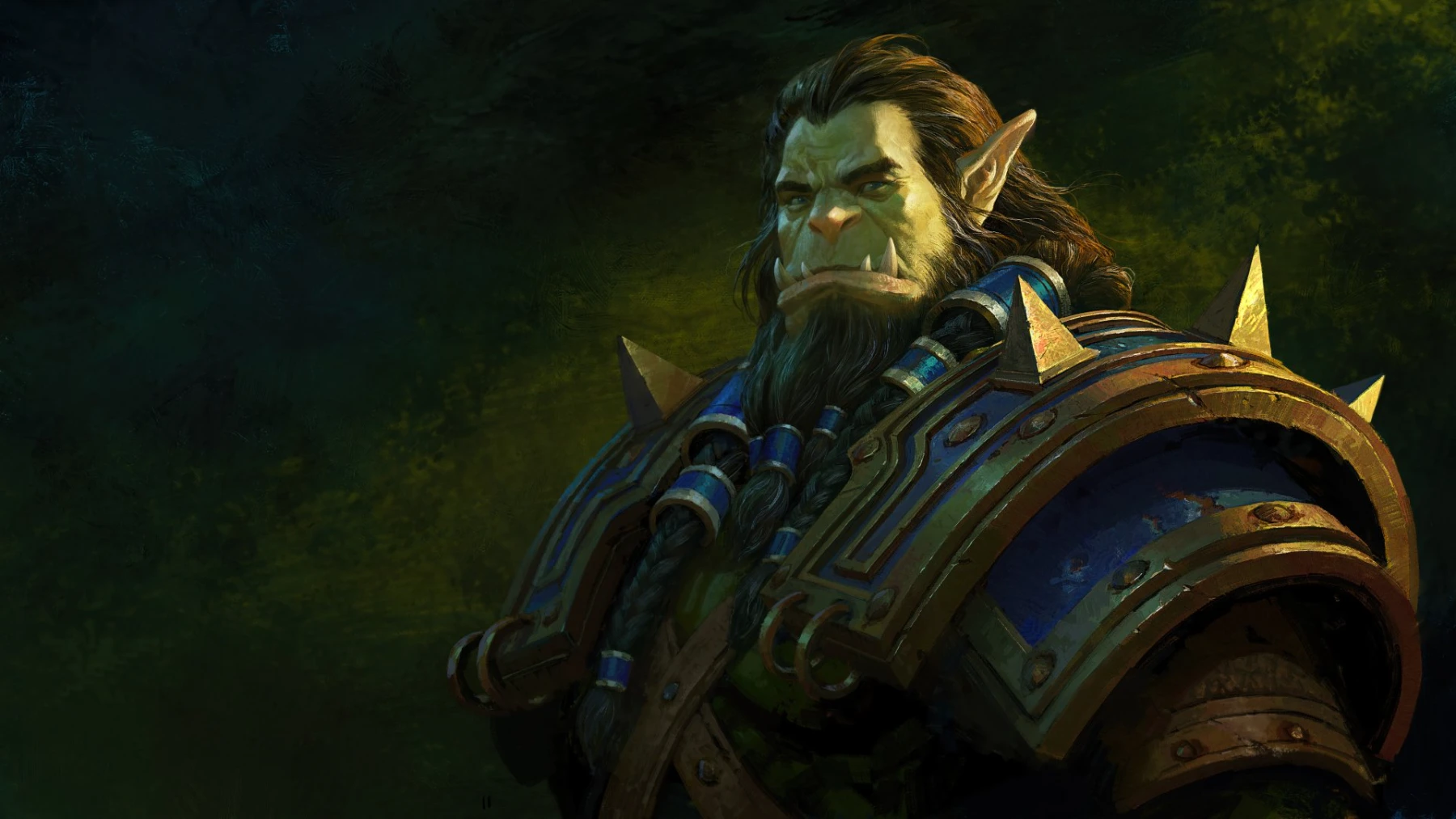
Born to Durotan and Draka of the exiled Frostwolf clan, Thrall lost his parents to Gul’dan’s assassins and grew up enslaved by Aedelas Blackmoore at Durnholde. Helped by his childhood friend Taretha Foxton, he escaped, rediscovered his heritage under Grom Hellscream and the shaman Drek’Thar, and joined Orgrim Doomhammer in freeing the imprisoned orcs; after Orgrim’s death, Thrall became Warchief. He led the New Horde across the sea, forged bonds with the Darkspear trolls and tauren, freed the orcs from the Legion’s blood curse alongside Grom, and helped defeat the Burning Legion at Mount Hyjal. At the launch of World of Warcraft, he rules from Orgrimmar, striving to defend Durotar, hold the Horde’s diverse peoples together, and preserve a fragile peace with the human survivors of Theramore.
Full History
Long before he ruled from Orgrimmar, Thrall belonged to a clan that had refused to surrender its spirit. His father, Durotan, was chieftain of the Frostwolves, one of the orcish clans of Draenor. His mother, Draka, was a formidable warrior whose resolve matched her mate's. Their people knew a life rooted in kinship, the elements, and the old teachings of the shamans. But the world into which their son would be born had already been broken by a war their clan could neither halt nor escape.
The Horde's warlocks had turned the orc clans toward conquest, and the Burning Legion had offered power at a terrible price. When the chieftains were called to drink the blood of the demon Mannoroth, Durotan refused. He did not have the strength to rescue the other clans from their choice, but neither would he bind the Frostwolves to it. The refusal placed his people under suspicion. As Draenor withered and the Horde crossed the Dark Portal into Azeroth, the Frostwolves followed in search of survival rather than glory. Gul'dan eventually cast them out. They made their refuge far to the north, among the cold heights of the Alterac Mountains.
There, in exile, Durotan and Draka's son was born. He inherited a name and a lineage in everything but the knowledge of them. Durotan, increasingly certain that Gul'dan's schemes threatened the orcs themselves, sought out his old friend Orgrim Doomhammer to expose the Shadow Council's treachery. Draka and their infant accompanied him. The warning reached Orgrim, but the family did not return to the Frostwolves. Assassins loyal to Gul'dan murdered both parents and abandoned the child. The boy who would someday remake the Horde began his life without his family, his clan, or anyone to explain why they had been taken from him.
The infant was discovered by Aedelas Blackmoore, the human officer who commanded Durnholde Keep and oversaw the captivity of defeated orcs. Blackmoore saw no orphan in need of a home. He saw a prize: an orc who could be raised speaking the language of his enemies, trained to obey a human master, and perhaps turned into an instrument of political ambition. He named the boy **Thrall**, a word meaning slave. It was intended as a description of the life the child would never be allowed to leave.
Thrall's earliest survival depended on people Blackmoore scarcely valued. The Foxton household cared for him when he was too young to endure a soldier's rations. Taretha Foxton, the young daughter of the family, grew up regarding him as something closer to a brother than a captive. As Thrall was taken away to be trained, she became his secret connection to warmth and ordinary human kindness. Their friendship survived through concealed letters, exchanged books, and the dangerous business of remembering that the creature locked behind Durnholde's walls was a person.
Blackmoore ensured that Thrall received an education, but he offered it for the wrong reasons. Tutors taught the young orc to read, write, and understand human culture. A hard-bitten veteran known as Sergeant drilled him in weapons, tactics, endurance, and the ruthless expectations of the arena. Thrall became a formidable gladiator, fighting for crowds whose cheers could never make him free. Blackmoore collected the rewards and cultivated the fantasy that a disciplined orcish champion might eventually command other orcs for him. The more Thrall learned, however, the more capable he became of recognizing the contradiction at the heart of his captivity: his human teachers had given him language and knowledge while his human master denied him dignity.
Taretha was the great exception. She showed Thrall that human cruelty was not the whole of humanity, a lesson that would outlast his hatred of Durnholde. Even so, friendship could not erase the beatings, the humiliation, or the certainty that Blackmoore would never regard him as an equal. After a brutal defeat in the arena and a savage punishment, Thrall chose escape over the life for which he had been trained. Taretha helped him get out of the fortress. He left behind the only world he remembered, carrying little beyond his hard-won skills and the hope that somewhere there were orcs who could tell him who he was.
Freedom offered Thrall no easy welcome. Much of the Old Horde had been defeated in the Second War and confined in internment camps spread across the human kingdoms. There he saw warriors who scarcely resembled the terrors of human stories. Many had sunk into a strange apathy as the demonic frenzy that once drove them ebbed away. They had lost not merely battles and leaders, but the will to imagine a future. Thrall had spent his youth dreaming of his own people; when he found many of them, they were prisoners who could barely answer that dream.
Yet the camps were not all that remained of orcish life. The Warsong clan, under Grom Hellscream, had avoided full captivity. In Grom, Thrall encountered an orc who was fierce, proud, suspicious, and unwilling to be broken. Hellscream showed him something of the Horde's courage, its traditions, and its scars. He also embodied a danger Thrall would come to understand: strength could keep a people alive without necessarily leading them away from the fury that had enslaved them. Thrall respected Grom's defiance, but he needed a heritage deeper than defiance alone.
His search brought him to the Frostwolves in the Alterac Mountains. Drek'Thar, the clan's elder shaman, revealed what Thrall had been denied all his life: the names of Durotan and Draka, the meaning of their resistance, and the place their son held among their people. For the first time, Thrall learned that his parents had stood against the corruption of the Horde. They had not been defeated because they lacked courage; they had died because their convictions threatened powerful enemies. Their story did not absolve the orcs of what they had done, but it offered Thrall a different model of what an orc might become.
Drek'Thar's teaching reached beyond history. Before Gul'dan's warlocks and the demon blood, orcish shamans had sought guidance from the spirits of the natural world. Their art depended upon a relationship with the elements, not the command of slaves. Thrall, trained to conquer opponents through force, now had to learn patience, restraint, and the humility to ask for aid. Under Drek'Thar and among the Frostwolves, he discovered a strength that Blackmoore could neither understand nor possess.
The young gladiator did not simply exchange a sword for spells. He became both a warrior and a shaman, joining the discipline of his captivity to the spiritual knowledge of his ancestors. This combination mattered. Thrall knew human fortifications, military habits, and tactics from the inside; he also came to believe that freedom would mean little if the rescued orcs remained bound to the same destructive hunger that had led them into war. What had begun as a search for his own origins widened into a question about an entire people: could the Horde recover its honor without denying its past?
There was no ready answer, and Thrall had no army with which to attempt one. But Drek'Thar had shown him an inheritance worth fighting for. The Frostwolves gave him belonging; the elements gave him another way to wield power. Thrall was still young, still marked by his human upbringing, and still learning what it meant to lead. Those very differences would soon make him a bridge between scattered clans that no single old chieftain could have united.
Orgrim Doomhammer came to the Frostwolves as a veteran of another Horde and another age. He had known Durotan, carried the burden of the Second War, and seen the ruin that followed defeat. To Thrall he was more than a famous name: he was a living witness to his father's integrity and the orcs' failures. The older warrior tested the younger one's resolve before revealing himself. Thrall's courage and mercy persuaded Orgrim that the orcs might still rally around a leader who fought for something better than vengeance.
Together with Drek'Thar, Grom Hellscream, and the free clans, Thrall and Orgrim began attacking the internment camps. Captives who had known only confinement saw their gates broken open by orcs who had not forgotten them. Camp by camp, the movement grew. Liberation was never as simple as a charge and a victory. Freed prisoners needed purpose and food; old rivalries remained; human garrisons reacted. But the sight of orcs choosing their own future gave the listless prisoners a reason to rise.
Orgrim did not live to see the work completed. During the campaign he was mortally wounded in battle. Before he died, he entrusted Thrall with the mantle of Warchief, his great hammer, and the responsibility they represented. The Doomhammer was an inheritance heavier than steel: it came from a leader whose victories had terrified kingdoms and whose decisions had helped bring his people to catastrophe. Thrall accepted it not as permission to repeat the past, but as a duty to build a different Horde. The loss also brought him closer to the father he had never known. Two men who had remembered Durotan had now placed their hopes in his son.
The campaign led Thrall back to Durnholde. He returned not as the obedient gladiator Blackmoore had fashioned, but as the leader of free orcs demanding the release of those still held in captivity. Even now Thrall attempted to avoid needless killing. He sought an end to the internment system, not a new conquest of human lands. Durnholde's commander would not understand the distinction. To Blackmoore, Thrall's freedom was a personal betrayal and the collapse of a plan he had nurtured for years.
Taretha was still inside the fortress. Thrall had urged her to leave before the confrontation, but she could not simply abandon her family or flee Blackmoore without consequence. Her friendship with Thrall had long made her vulnerable to the man who controlled both their lives. As the orcish army gathered, Blackmoore murdered her. He displayed the evidence of his cruelty before the very person he had tried to reduce to a weapon. Thrall's grief turned the final attempt at negotiation into battle.
The assault ended with Blackmoore dead at Thrall's hands. Afterward, Thrall spared those who surrendered and allowed the human survivors to depart. He called upon the earth to bring down the fortress where he had been imprisoned. Durnholde's ruin was not a happy triumph. Taretha, whose kindness had given the young orc reason to believe in people beyond the walls, was gone. In freeing others, Thrall had been unable to save the friend who had first helped free him. His future relations with humanity would forever carry that contradiction: one human had enslaved him, another had loved him as family.
With the camps dismantled, Thrall led a growing Horde that was free but homeless. Its warriors could defeat isolated garrisons; they could not live forever as a wandering army in lands that feared them. A new homeland would require something no orcish warchief had ever securely given his people on Azeroth: an existence not founded upon taking a human kingdom by force.
Thrall's struggle was not the only one in Lordaeron that questioned the old division between human and orc. The veteran Eitrigg, once a warrior of the old Horde, had withdrawn from the wars and lived apart from his people. Tirion Fordring, a paladin of the Silver Hand, encountered him near Hearthglen. Their first meeting ended in combat; their later actions bound them through an unexpected debt of honor. Eitrigg had spared Tirion's life, and Tirion refused to abandon him when human soldiers came to make him a prisoner.
For that refusal Tirion lost his standing in the Silver Hand and faced exile. Eitrigg was taken toward execution in Stratholme. Thrall, still leading the newly liberated Horde through Lordaeron, mounted an attack intended to save the captive orc. In the ensuing disorder Tirion reached Eitrigg and brought him out of the city. Thrall found the two together and recognized the extraordinary risk the human paladin had taken for an enemy. He offered Eitrigg a place among the orcs who had rediscovered their ancestral traditions, and he allowed Tirion to leave in peace.
The episode mattered to the Horde's future because it was another proof that honor was not the property of any single race. Taretha had taught Thrall that through friendship. Tirion and Eitrigg had reached it through a hard bargain of duty, gratitude, and sacrifice. Eitrigg would later be counted among the experienced voices near the Warchief in Orgrimmar; the friendship between the old orc and the exiled paladin endured beyond the wars that had made them enemies.
As a new disaster gathered in the Eastern Kingdoms, Thrall was visited by visions and the enigmatic figure of a prophet. The stranger was Medivh, returned to warn the mortal races that the Burning Legion was coming. Thrall did not know all that lay behind the warning. He did know that the orcs' old masters had once made a weapon of his people, and that remaining where the coming invasion would strike offered little hope. The decision to follow Medivh would become one of the defining gambles of his leadership.
Thrall rallied his followers, freed remaining orcs, and gathered the means to cross the Great Sea. The ships that took them west were seized from human control; the exodus did not erase the mistrust between the races. But the Horde's purpose was no longer to invade another kingdom. They sailed toward Kalimdor, a continent unfamiliar to most of the refugees, because the alternative was to await destruction amid the ruins of the old wars.
The voyage itself altered the Horde. When storms forced the fleet onto islands in the sea, Thrall's orcs encountered the Darkspear trolls, led by Sen'jin. The trolls were beset by hostile forces and the servants of a sea witch; the orcs helped them resist. Sen'jin did not survive the struggle, but the alliance endured. His people, later led by his son Vol'jin, would travel with Thrall toward Kalimdor. The displaced orcs were beginning to become something larger than an orcish army. They had gained allies who, like them, needed the freedom to live.
Landfall in Kalimdor did not end the danger. Storms had scattered the ships, supplies were scarce, and the continent's inhabitants had their own wars. In the Barrens, Thrall encountered Cairne Bloodhoof and the tauren, whose communities suffered repeated attacks by centaur marauders. The two leaders recognized the value of cooperation. Thrall offered protection to people who had no obligation to trust the strangers; Cairne helped the orcs find their way through a hostile land. Each saw in the other a concern for kin, land, and the spirits of the world. Their friendship laid the foundation for the tauren's place in the new Horde.
Thrall's followers were not united in judgment. Grom Hellscream and the Warsong clan had little patience for the slow work of settling and diplomacy. When the Warsong were sent north for lumber, they clashed with the night elves in Ashenvale and threatened a forest whose defenders held it sacred. Under pressure, Grom's forces again embraced demonic blood and received terrible power at a terrible price. They killed Cenarius, one of the great guardians of the forest. It was a victory that deepened the very enslavement Thrall had dedicated his life to ending.
The disaster confronted Thrall with a bitter truth. A Horde capable of building friendships with the tauren and Darkspear could still inflict devastation upon those it did not understand. Grom was a brother-in-arms and one of the men who had made liberation possible; he was also capable of dragging his warriors back into the Legion's grasp. Thrall could not simply celebrate the courage of the Warsong or dismiss what they had done. He had to save them from their bondage while facing the consequences of their actions.
Deep in the Stonetalon Mountains, Thrall and Cairne sought the oracle who might explain the chaos spreading across Kalimdor. There they encountered Jaina Proudmoore, leader of human refugees who had also followed Medivh's warning. Old fears nearly brought the two parties to blows. Medivh intervened and revealed the greater danger: the Burning Legion intended to consume the world, and the orcs and humans would have to cooperate if either hoped to survive. Thrall's experience of Taretha had never made him blind to human hostility, but it had taught him that an individual could be judged by actions rather than ancestry. Jaina offered him the chance to put that belief into practice as a leader.
With Jaina's help, Thrall fought through the corrupted Warsong and reached Grom. The blood curse could be broken; the orc who had first taught Thrall the pride of the clans was not beyond rescue. Freed of the Legion's immediate control, Grom confronted Mannoroth alongside Thrall. The pit lord was one of the demons whose blood had bound the old Horde to a disastrous destiny. Thrall's power was not enough to defeat him. Grom struck the fatal blow, but the demon's death also cost him his life.
Grom had committed grievous wrongs, and he died freeing the orcs from a bondage he had helped perpetuate. Thrall mourned him without needing to pretend that the road to redemption had been clean. The destruction of Mannoroth broke the Legion's direct blood curse, but no single battle could heal every wound the Old Horde had left in the world. That harder work would belong to the survivors.
The Burning Legion continued its advance toward Mount Hyjal and the World Tree. For a time, the differences between the Horde, Jaina's human survivors, and the night elves had to yield to the threat facing them all. Thrall brought his warriors to the defense, fighting as part of a coalition whose members had bitter reasons to distrust one another. They delayed Archimonde's advance long enough for the night elves' leaders to complete their plan. At Hyjal, the Legion's general was destroyed.
The victory did not make the three peoples one nation. Humans still remembered the invasions of the First and Second Wars. Night elves had seen their sacred woods ravaged and Cenarius slain. Orcs remembered the camps and the fear that had hardened into punishment of an entire race. The alliance had been real, but it was forged under extraordinary danger and could not by itself settle every grievance. Thrall carried that knowledge south. If the Horde meant to remain on Kalimdor, it needed a place to call its own, as well as the strength and restraint to keep it.
Thrall led the orcs toward Kalimdor's eastern coast, where a harsh and dry land offered a difficult kind of refuge. He named it **Durotar**, in memory of the father whose principles had cost him his life. There he founded **Orgrimmar**, honoring Orgrim Doomhammer, the warchief who had passed his burden to a younger generation. In those names Thrall placed two legacies side by side: the resolve to resist corruption and the determination to lead the orcs out of defeat.
Building a nation proved different from winning a battle. Settlers needed food, water, timber, safe roads, and defensible homes. The Horde now included the Darkspear trolls and the Bloodhoof tauren, peoples whose needs and customs were not identical to those of the orcs. Thrall had to learn how to govern a coalition rather than simply command warriors. Scouts such as Nazgrel helped hold the frontier; Cairne's friendship gave the new nation a trusted ally in Mulgore; Vol'jin's trolls sought security of their own. Every success was shadowed by the fact that the people of Kalimdor had not asked for an orcish capital to be built beside them.
Thrall sought a workable peace with Jaina and the survivors living at Theramore. Their alliance against the Legion had earned a measure of respect, but it had not healed the generations of fear between humans and orcs. The settlement remained precarious, dependent on decisions made by people who might remember only the worst of the past. Soon, that weakness was tested by an older enemy with a powerful fleet.
Lord Admiral Daelin Proudmoore arrived in Kalimdor with the conviction that orcs could never be trusted. He had lost much to the Horde in the earlier wars, and he would not accept that Thrall's people might now be different. His forces struck at the fledgling settlements and drove the Darkspear from their homes on the Echo Isles. For Thrall, the attacks threatened to destroy the new nation before its walls and alliances could truly hold. Worse, the invaders were human. The fragile understanding reached with Jaina suddenly appeared vulnerable to the anger of her own father.
During this crisis a wandering beastmaster, Rexxar, entered the Horde's service. With Rokhan and other allies, he carried messages, investigated attacks, and helped the scattered settlements endure. The fighting drew in Cairne and Vol'jin as well, reminding Thrall that the Horde's future depended on relationships built since the exodus. Daelin took control of Theramore and pushed Jaina toward an impossible choice. She could support the father she loved in a war of destruction against Thrall, or refuse a campaign she believed would plunge both peoples back into disaster.
Jaina would not lend her strength to her father's war. Thrall's coalition fought to stop Daelin's forces, and Rexxar helped bring the struggle into Theramore itself. Daelin was killed. The victory preserved Durotar, but there was no joy in the death of Jaina's father, nor any reason to suppose every human would forgive the Horde for it. Thrall and Jaina's willingness to cooperate had survived a terrible test; the peace between their communities remained frail. The orcs had secured their homeland, though not the unquestioned right to live there unchallenged.
By the opening of *World of Warcraft*, Thrall rules from Orgrimmar as Warchief of the Horde. The slave trained to amuse spectators now commands an alliance of orcs, Darkspear trolls, and tauren; the Forsaken of Lordaeron have also joined the Horde in an uneasy alignment of interests. His authority rests upon his victories, but also upon the judgment that won him friends from peoples once separated by fear. He carries Orgrim's hammer and is counted among the strongest living orcish warriors and shamans.
The new homeland is neither peaceful nor secure. The Barrens connect allies and enemies through long and vulnerable roads. Night elves and Warsong orcs remain at odds over Ashenvale's forests. Durotar's dry country offers little comfort to settlers whose ambitions are larger than the land's easy bounty. The Forsaken bring a new partnership whose methods and ambitions do not always sit comfortably beside Thrall's ideals. Theramore stands across the sea approaches as a reminder that personal trust between leaders is not the same as trust between nations. For Thrall, even ordinary border disputes bear the weight of wars that came before them.
He is not a man untouched by anger. He has killed his former master, mourned friends lost to cruelty and war, and seen allies unleash destruction in the name of survival. He knows that noble intentions cannot erase the suffering the Horde has caused. Yet he has also witnessed the opposite possibilities: a human girl willing to risk everything for an orc child, a shaman willing to teach the son of an exiled chieftain, and peoples who chose to stand together when the Legion came for them all.
Thrall's greatest achievement at this moment is not that he has made the Horde innocent. He has made it possible for the Horde to be something other than the weapon Gul'dan and the demons intended. Durotar is no paradise, and Orgrimmar is not the end of the story. They are a beginning—one that will endure only if Thrall and those who follow him can protect their freedom without surrendering to the hatred that once destroyed their world.
The Living Archive · Subject Chronicle
Through History
Explore documented turning points and follow their connections. The complete account remains in Full History above.
Further Reading
A research reference supplied with this article.