
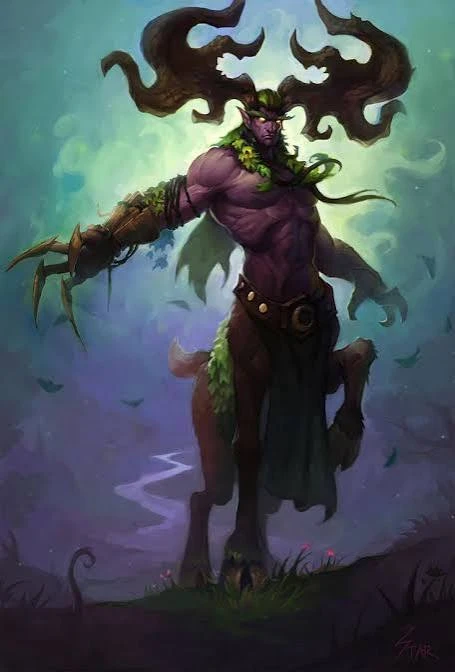
Quick Overview
Cenarius, the demigod of the forests, helped teach Malfurion Stormrage the ways of druidism and defended Kalimdor during the War of the Ancients. When Grom Hellscream's Warsong clan began cutting Ashenvale's timber, Cenarius opposed them. Empowered by Mannoroth's blood, Grom and his warriors slew the forest guardian. His death deepened the wound between orcs and night elves even after both peoples helped defeat the Legion at Mount Hyjal.
Full History
Before the human kingdoms rose and before the orcish Horde crossed the Dark Portal, Cenarius was already among the beings who gave Kalimdor its sacred meaning. A demigod bound to the wilds, known in the older stories as the son of Elune and the white stag Malorne, he represented something that kings and armies could not command: the life of forests, the long patience of growing things, and the power of nature to defend itself when threatened. His children and allies, including the keepers of the grove and the dryads, moved through the woodlands as guardians of an older world.
Cenarius became especially important to the night elves during the years before the War of the Ancients. Malfurion Stormrage sought a form of understanding that the Highborne's arcane brilliance could not provide. Under Cenarius's teaching, he learned druidic arts, the language of the natural world, and a discipline rooted in listening rather than mastery. The difference became decisive when the Well of Eternity drew the Burning Legion toward Azeroth. Where the queen's court believed more power would grant control, Cenarius taught that a living world required limits, obligations, and a willingness to defend what could not defend itself.
As demons spread across ancient Kalimdor, Cenarius rallied creatures and spirits of the wild to join the resistance. The struggle brought night elves, dragons, and forest beings into a common defense against an enemy intent on consuming the world. Malfurion's growing skill as a druid gave the resistance a means of answering magic with the strength of nature itself. Cenarius was no remote observer whose wisdom could be received without risk; he took part in a war that was killing the world to which he belonged.
The destruction of the original Well ended the invasion but shattered Kalimdor. Survivors faced the grim question of how to build a civilization without repeating the mistakes that caused the Sundering. Cenarius remained an ancient teacher and protector in the forests, while the night elves placed their new lives under restraints meant to keep dangerous arcane excess from returning. His influence could be seen wherever druids sheltered groves, defended the wilds, and treated the natural order as a responsibility rather than a resource waiting to be claimed.
When Thrall brought the Horde to Kalimdor during the Third War, the orcs desperately needed timber, shelter, and a homeland. Grom Hellscream and the Warsong clan entered Ashenvale to cut lumber and establish their position. To the orcs, the forest promised supplies they had been denied for generations. To the night elves and Cenarius, armed strangers were tearing apart ancient sacred ground. The clash began before either side fully understood the other's history. The defenders struck at the invaders, and the orcs answered with the violence they had learned in earlier wars.
Cenarius confronted the Warsong and proved a danger they could not easily overcome. Mannoroth then offered Grom the chance to drink again from the demonic power that had once corrupted the Horde. Grom accepted the blood, and the Warsong gained the strength to slay the demigod. Cenarius's death was both a military crime and a spiritual wound to Ashenvale. He had been a teacher of Malfurion and a symbol of the forests' own will; his killers were men who had fled one world in search of freedom only to accept the same demonic chains again.
The War of the Ancients illustrated the sort of help Cenarius could offer that ordinary rulers could not. Dragons, ancient creatures, and the wild inhabitants of Kalimdor did not fight on the same terms as human armies or Highborne mage-lords. They answered to bonds of place, season, and ancient obligation. Through Malfurion, Cenarius's teachings gave the resistance a way to gather the strength of the living land rather than merely matching the demons spell for spell. His influence was not the invention of every druidic tradition, but his mentorship made the young night elf a central figure in the survival of the world.
That legacy throws the conflict with the Warsong into painful relief. Grom's warriors were seeking timber because a new nation required homes and walls, a need any settlement might understand. The fatal step came when they treated the forest as material without a will of its own and answered its guardians with demonic power. Cenarius's death exposed a fundamental tension of the age: people who had survived oppression and exile could become conquerors when they encountered an older people's homeland. The Horde's later alliance with night elves against Archimonde proved such patterns were not inevitable, but it did not restore the slain demigod or close the wounds left in Ashenvale.
Keepers of the grove and dryads continue the work that Cenarius represented. They are not simply creatures placed in Ashenvale to decorate a mysterious forest; in the original stories they are living participants in the defense of its sacred places. Travelers who meet them encounter a guardianship extending beyond the life of any one hero, even a demigod. That continuity matters after Cenarius's death. The Warsong may have won a battle, but the ancient woodland is neither silent nor surrendered. Its protectors still respond to corruption, armed intruders, and the damage left by the Legion. In the original WoW landscape, the survival of these beings keeps Cenarius from becoming only an episode in Grom's history.
Grom's later death helped free the orcs from Mannoroth's curse, but it could not undo the destruction of Cenarius. Thrall's Horde and the night elves eventually stood together against Archimonde at Mount Hyjal, demonstrating that the war in Ashenvale did not make cooperation forever impossible. Yet the forests did not forget the earlier wounds. Druidic traditions continued, dryads and keepers still defended their homes, and the Warsong's need for timber remained a recurring source of conflict.
At the original World of Warcraft launch, Cenarius is not alive to welcome travelers through Ashenvale. He survives in the teachings of druids, the loyalty of forest guardians, and the hatred awakened when the woods are cut or corrupted. His legacy is inseparable from the painful question facing the Horde and the night elves: whether a people seeking a home can learn to live in a land that already belongs to a much older life. The demigod's death made that question harder; the memory of his teachings keeps it from disappearing.
The Living Archive · Subject Chronicle
Through History
Explore documented turning points and follow their connections. The complete account remains in Full History above.
No additional documented milestones are available yet. The Full History above remains the primary account.
Further Reading
A research reference supplied with this article.