
Quick Overview
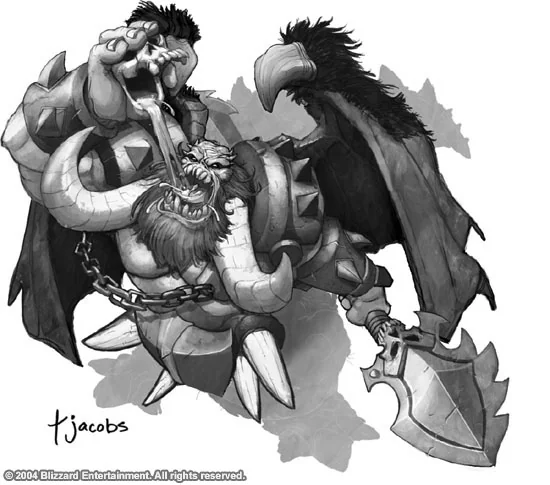
Mannoroth was the pit lord whose blood helped bind the old Horde to the Burning Legion. During the Third War his power again corrupted Grom Hellscream’s Warsong orcs, leading them to kill Cenarius in Ashenvale. Thrall sought to free Grom, who ultimately struck down Mannoroth and died in the explosion that followed. The demon’s death broke the direct blood curse, leaving its painful legacy at the heart of the new Horde’s history.
Full History
Mannoroth was a pit lord of the Burning Legion: enormous, savage, and powerful enough to make the threat of violence feel like a governing principle. Yet his influence over Azeroth did not begin with a duel or a siege. The most terrible part of his history was the way his blood entered the fate of another people. The orcs of Draenor had chieftains, clan obligations, and spiritual traditions long before they served demons. The Legion sought to turn those communities into a weapon that could be directed against worlds it wished to conquer.
Through the machinations of Kil'jaeden, Gul'dan, and the emerging Shadow Council, the orcs were drawn away from their old ways. Mannoroth's blood became an instrument of submission. When the clan leaders drank it, the physical might and violent fury it offered obscured the price: they were binding themselves more deeply to the power of the Legion. Durotan of the Frostwolves refused the draught, and his defiance became one of the fractures within the Horde that would matter long after the First War.
The corruption did not mean every orc lost all capacity for choice in every moment. It meant their society had been pushed toward brutality by forces that profited from their victories and cared nothing for their survival. Mannoroth's triumph was therefore not simply a conquered battlefield. It was the broken spiritual independence of a civilization.
The blood oath helped prepare the old Horde for war on Azeroth. Clans that had fought one another crossed the Dark Portal and carried their violence against the human kingdom of Stormwind. The war spread, kingdoms fell, and the invaders eventually suffered defeat. Throughout these upheavals the Legion's original ambition remained distinct from that of any individual chieftain. Demon masters could discard a ruined army; the orcs would have to live with the crimes and losses left behind.
Mannoroth did not need to stand visibly on every battlefield for his influence to endure. When orcs were defeated and confined in internment camps, many lost the vigor that had fueled their wars. The lethargy and spiritual emptiness of the survivors showed how thoroughly their identity had been compromised. Thrall's later effort to renew shamanism and unite the clans was not merely a change in political leadership; it was an attempt to escape the hold of the powers to which an earlier Horde had surrendered.
During the Third War, the new Horde crossed to Kalimdor. Thrall hoped to secure a future beyond the conflicts of the Eastern Kingdoms, but Grom Hellscream's Warsong clan soon found itself fighting the night elves in Ashenvale. In the forest stood Cenarius, a guardian whose connection to the living world dwarfed the concerns of newly arrived armies. The Warsong were outmatched. Mannoroth's agents offered the old answer to a desperate people: power in exchange for blood.
Grom and his warriors drank again. The renewed corruption made them formidable enough to strike down Cenarius, but their apparent victory was a reversal of Thrall's work. The same binding that had doomed the earlier Horde had returned. Mannoroth wanted the orcs to understand that even their new homeland and recovered traditions could be made instruments of his will.
Thrall refused that conclusion. With Jaina Proudmoore's help, he confronted the fel corruption and sought to recover Grom from it. The alliance with a human sorceress was itself a rejection of the old pattern of endless racial war. Thrall and Grom then went in search of Mannoroth, knowing that defeating the demon might demand more than either could survive.
Their confrontation with Mannoroth in the canyon was brief and decisive. The pit lord mocked the orcs' effort to escape a bargain written in their blood. Thrall's attack failed to end the threat. Grom, however, struck with his axe and dealt Mannoroth the mortal blow. The demon's death unleashed a violent explosion; Grom was killed as well.
The scene closed a terrible circle. The chieftain whose choice had renewed the blood curse became the warrior who broke it. Grom's final sacrifice did not erase what had happened to Cenarius or heal every injury inflicted by the Horde, but it freed the orcs from Mannoroth's direct hold. The escape was costly because the corruption had never been an abstract weakness. It had rested upon living decisions, seductions, and failures that demanded a reckoning.
By the time Thrall governs from Orgrimmar, Mannoroth is dead. He is no longer a living commander to be confronted by the Horde he once claimed as his own. The scars of his bargain persist in the history of the clans and in the stories Horde elders tell about their former masters. The Blood Curse explains why Thrall's Horde speaks so insistently of honor, why Grom can be remembered as both a perpetrator and a liberator, and why Durotan's refusal matters.
Mannoroth's biography ends not with the Legion destroyed but with one instrument of its control shattered. The wider demonic threat has not vanished from Azeroth. Yet a people once taught that power required servitude have demonstrated that the bargain can be refused—even when refusal comes at the cost of a hero's life.
The Living Archive · Subject Chronicle
Through History
Explore documented turning points and follow their connections. The complete account remains in Full History above.
Further Reading
A research reference supplied with this article.