
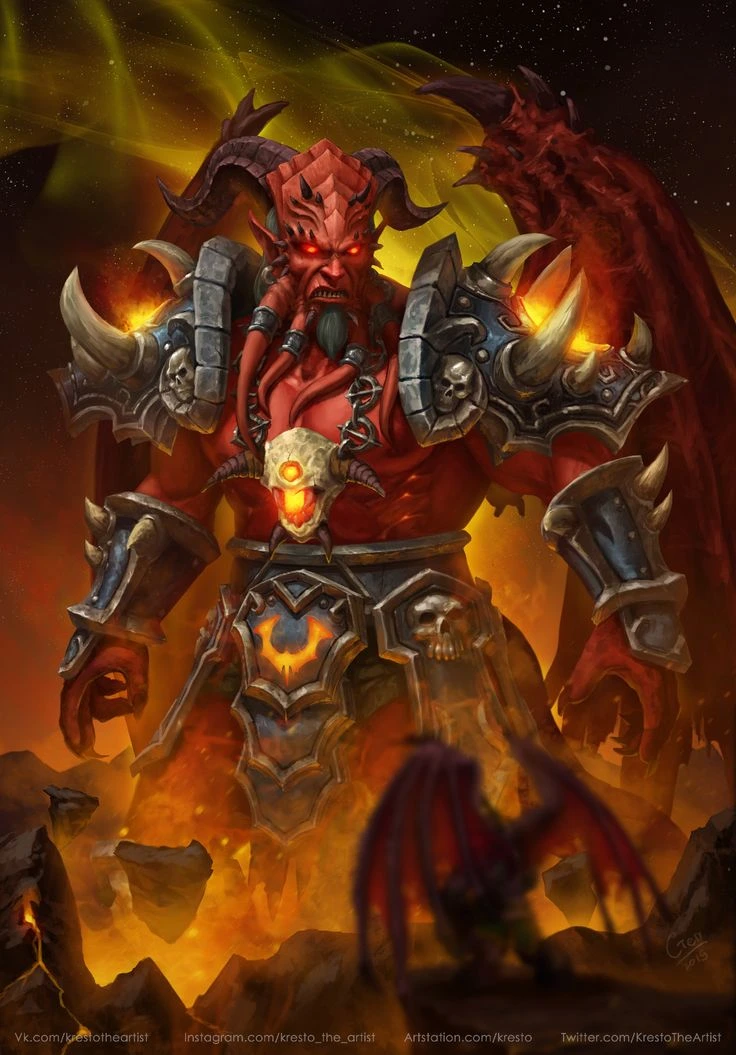
Quick Overview
Kil'jaeden the Deceiver turned the orc clans of Draenor toward the Burning Legion, working first through Ner'zhul and then through Gul'dan. After the old Horde's defeat he transformed Ner'zhul into the Lich King, hoping an undead army would prepare Azeroth for another invasion. The Scourge developed ambitions of its own, and Kil'jaeden compelled Illidan to attack the Frozen Throne. Arthas's victory at Icecrown left the demon lord's designs unfinished at the launch of World of Warcraft.
Full History
Kil'jaeden is called the Deceiver because his most destructive victories begin before a sword is drawn. In the original Warcraft histories he is one of the eredar commanders empowered by Sargeras to direct the Burning Legion. Where Archimonde prefers domination in the open, Kil'jaeden finds weakness inside a people and turns it into the means of their destruction. His power is immense, but his enduring weapon is the bargain: an offer that lets a victim imagine the coming disaster was chosen freely.
Draenor provided the demonstration that would change Azeroth. The orc clans had fierce traditions and powerful warriors, yet they were guided by shamans who understood the spirits as part of the world around them. Kil'jaeden approached this spiritual order through Ner'zhul, an elder of the Shadowmoon clan. By exploiting his authority and uncertainty, the demon pushed the clans toward hostility against the draenei. When Ner'zhul resisted the final surrender to demonic purpose, Kil'jaeden turned to Gul'dan, a pupil who desired power more than restraint.
Gul'dan organized the Shadow Council and spread demonic magic among the orcs. The Horde that emerged from this transformation was not merely a confederation of quarrelsome clans. It was a weapon designed to make war for interests hidden from many of its soldiers. Mannoroth's blood bound warriors to the cycle of rage and dependency, while warlocks displaced the older ways of shamanism. The orcs' first conquests destroyed their neighbors and poisoned their own future. When they passed into Azeroth, humans encountered a terrifying army, but the orcs themselves were already victims of the Deceiver's design.
The Horde ultimately failed to conquer Azeroth. Its infighting and Gul'dan's betrayals cost it strength at decisive moments. Kil'jaeden drew a lesson from this defeat: living soldiers could doubt, desert, or pursue private glory. The next army would require a means of removing those choices. Ner'zhul, who had defied him and then ruined Draenor by opening forbidden rifts, would be made useful again.
Kil'jaeden intercepted Ner'zhul in the Twisting Nether, destroyed his physical body, and transformed his surviving spirit into the Lich King. The spectral prisoner was sealed in ice and sent to Northrend to build a necromantic force under demonic supervision. The dreadlords watched and directed the enterprise, while Kel'Thuzad and the Cult of the Damned carried the Lich King's influence into human lands. The plague that devastated Lordaeron was therefore not a random outbreak or the ambition of a single necromancer. It grew out of Kil'jaeden's desire for an army that could destroy a kingdom from within.
The scheme worked almost beyond imagining. Arthas became the Lich King's champion, Lordaeron fell, the Sunwell was profaned, and Archimonde entered Azeroth. Then the Deceiver discovered the flaw in his design. The Lich King had learned to act for himself. His influence over Arthas and the death of key Legion agents helped weaken the force that was supposed to own him. The Scourge's master wanted freedom from the very chain Kil'jaeden had forged.
Kil'jaeden's orcish campaign illustrates a striking difference between conquering territory and corrupting a civilization. To a warrior on the battlefield, the Horde's defeat at the end of the Second War might have appeared decisive. Its chieftains fell, its armies were broken, and thousands of surviving orcs entered internment. Yet the demonic injury outlived the armies. The clan traditions that had once given the orcs a place in their own world were badly damaged. Even after Thrall led his people toward shamanism and a new homeland, the struggle against the old bloodlust remained part of Horde history. In this sense the Deceiver won something lasting even in military failure: a generation of orcs forced to rebuild moral and spiritual practices their conqueror had deliberately uprooted.
The Scourge was a second attempt to secure the same strategic goal through different means. Necromantic obedience seemed to solve the problems of an army whose leaders might disobey. But a spell of domination is still a relationship between master and servant, and Kil'jaeden's choice of Ner'zhul built resentment into the heart of his new weapon. The old shaman did not forget who had tortured him. His efforts to loosen the Legion's grip were not an act of kindness toward Azeroth, but they did expose a weakness in the Deceiver's method. Even servitude made nearly absolute could produce rebellion. The failure of the Lich King's leash and Illidan's defeat at Icecrown left the Legion with enemies it had created for its own use, a pattern echoed throughout Warcraft's original wars.
Kil'jaeden often appears in the consequences of another person's actions rather than at the point of decision. Ner'zhul speaks to spirits, Gul'dan promises power, Kel'Thuzad recruits neighbors, and Illidan pursues the Frozen Throne, but the Deceiver's pressure runs behind each stage. This distance does not make him absent; it allows him to force other peoples to bear the immediate blame and cost. By the end of The Frozen Throne, almost every major servant he used has either died, defected, or begun pursuing a separate goal. The pattern helps explain his title. A deceiver must keep persuading or compelling others to carry a burden he does not intend to carry himself. Its failure leaves the worlds he touched damaged long after each bargain breaks.
After Archimonde's defeat, Kil'jaeden pressed Illidan Stormrage to destroy the Frozen Throne. Illidan used the Eye of Sargeras and the ruined city of Dalaran in an attempt to strike at Icecrown, but Malfurion and Maiev thwarted the ritual. Later, in the Warcraft III: The Frozen Throne campaign, the Deceiver confronted Illidan again and forced him to renew the effort. Illidan marched toward Northrend with naga and blood elf allies. Arthas won the struggle at the Frozen Throne, frustrating Kil'jaeden once more. The story at this cutoff does not resolve what punishment the demon may bring against Illidan or what future campaign the Legion might attempt.
At the original WoW launch, Kil'jaeden remains the intelligence behind some of the greatest transformations in living memory. He helped turn the orc clans into a Horde, a shaman into the Lich King, and a fallen prince into a death knight. His story explains why the histories of Draenor and Lordaeron cannot be read as unrelated catastrophes. Both began with people who believed they were choosing a path to strength, never seeing clearly whose purposes their choices served.
The Living Archive · Subject Chronicle
Through History
Explore documented turning points and follow their connections. The complete account remains in Full History above.
No additional documented milestones are available yet. The Full History above remains the primary account.
Further Reading
A research reference supplied with this article.