Quick Overview
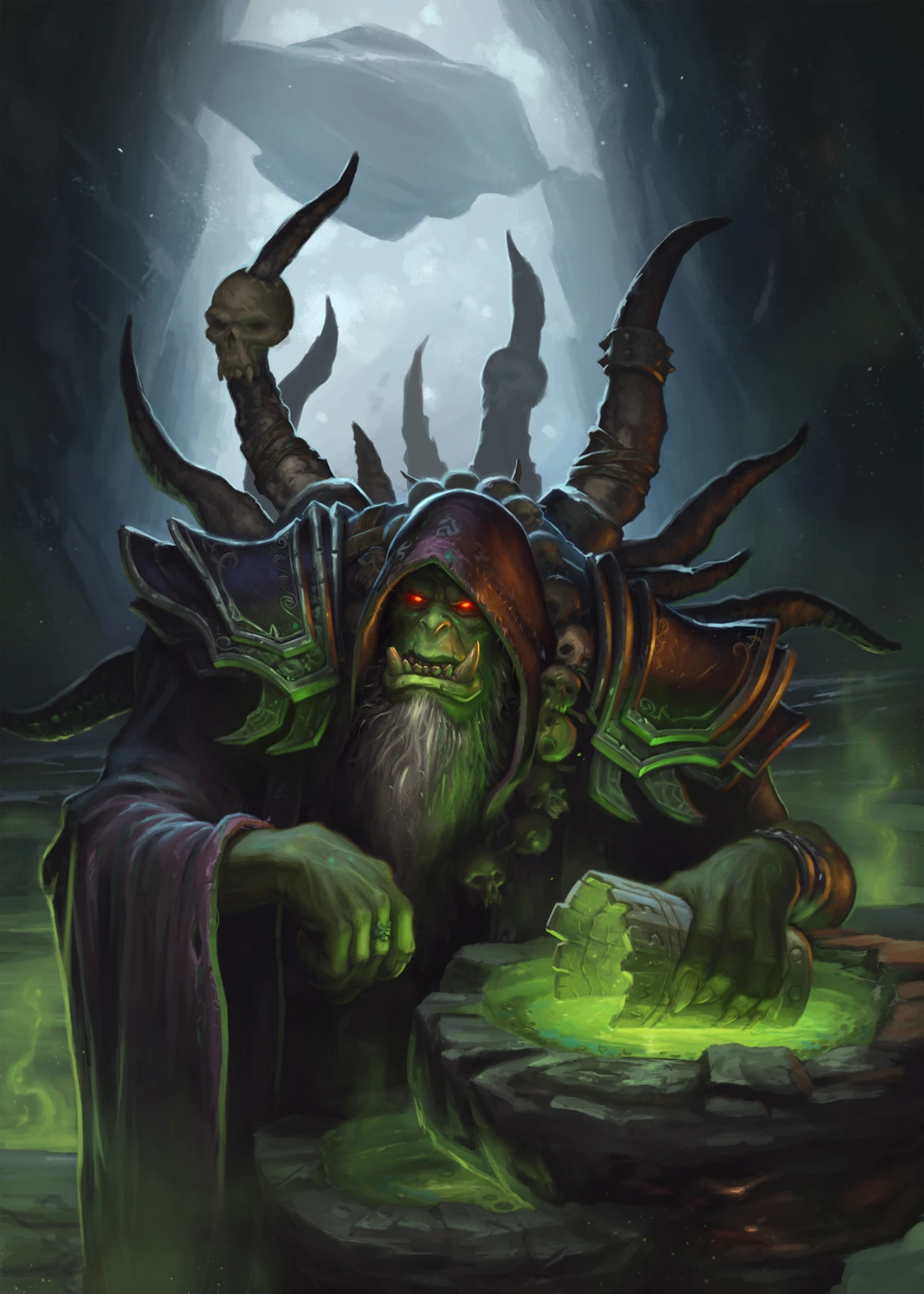
Gul'dan was the warlock who helped corrupt the orc clans, established the Shadow Council, and used Blackhand as the old Horde's public Warchief. In concert with Medivh, he helped open the Dark Portal and bring war to Stormwind. After Orgrim Doomhammer destroyed much of the Shadow Council, Gul'dan outwardly submitted but betrayed the Horde during the Second War to seek the Tomb of Sargeras. Demons in the tomb killed him. His surviving influence includes the old Horde's blood debt, the ruins of the First War, and the Skull of Gul'dan later consumed by Illidan.
Full History
Gul'dan's name appears across the history of the first three Warcraft games as a cause of disasters whose consequences continued long after his death. He was an orc of Draenor, born among a people whose clans had their own leaders, spiritual practices, and loyalties before the Burning Legion remade their future. The orcs did not begin as one nation bent upon destroying other worlds. That transformation was engineered through a combination of demonic manipulation and internal ambition, and Gul'dan became its most ruthless intermediary.
Ner'zhul, an elder shaman of the Shadowmoon clan, had been drawn into contact with forces presenting themselves through visions and spiritual authority. Gul'dan learned within that world but was eager for power that went beyond the obligations of the shamanic calling. Kil'jaeden exploited the ambitions and fears of the orcs' leaders, bringing the clans under growing demonic influence. Gul'dan chose to embrace the bargain rather than defend the older relationship between his people and their ancestral spirits. Under his influence, the warlocks supplanted many shamans as the Horde's wielders of supernatural power.
The original-era novel *Rise of the Horde* gives this transformation a personal and political shape. The Legion did not conquer the orcs solely by force. It corrupted the stories they told about their neighbors and made destruction appear necessary for survival. The draenei, who had long lived on Draenor, became targets of a campaign driven by deception and fear. Gul'dan's value to the Legion lay in his ability to turn supernatural coercion into decisions made by orc leaders, then to present those decisions as the destiny of the Horde.
Gul'dan founded and controlled the Shadow Council, a secret organization of warlocks who shaped the Horde's direction behind the appearance of ordinary clan leadership. Blackhand served as Warchief, a formidable public commander whose authority Gul'dan could exploit. Beneath him, the warlocks manipulated policy, performed dark rituals, and tried to ensure that dissenting leaders would not survive long enough to organize resistance.
The blood pact with Mannoroth brought the orcs under the Legion's corrupting influence. Not every leader accepted the bargain, and not every clan experienced corruption in the same way, but the Horde as an invading power was forged through these choices. Durotan of the Frostwolf clan became one of the figures who resisted the corruption and its consequences. Gul'dan's agents helped make him and his family targets, and the infant Thrall would inherit the consequences of that persecution.
Gul'dan also relied on other servants whose ambitions could be bound to his own. Cho'gall of the Twilight's Hammer was among his principal allies. The creation of the Stormreaver clan gave Gul'dan a more direct base of power than the hidden Council alone. His mastery of necromancy and fel sorcery allowed the Horde to field forces unlike those of its earlier clan wars. Under Gul'dan's direction, the use of magic increasingly ceased to be a bond with spirits and became a means of dominating life, death, and the will of others.
The warlock's schemes eventually reached beyond Draenor. Through contact with Medivh, the Guardian of Tirisfal corrupted by Sargeras's influence, Gul'dan participated in opening the Dark Portal between Draenor and Azeroth. The orcs crossed into the kingdom of Stormwind, beginning the First War. The invasion introduced a new power into human history, one able to strike with heavy infantry, warlocks, and a willingness to destroy populations far from Draenor's dying fields.
Gul'dan had interests beyond military victory. The Portal could deliver the Horde into a new world, but it also placed him closer to rumors of the Tomb of Sargeras and the overwhelming power he believed hidden there. His ambition was never exhausted by the conquest of Stormwind or the enlargement of the Horde. A greater master had promised him power, and Gul'dan imagined that he might eventually seize enough of it to escape subservience altogether.
The First War ended with Stormwind devastated. King Llane was murdered by Garona, who had been enmeshed in the Shadow Council's plans and coercion. Medivh was killed in Karazhan by those who uncovered his corruption, and the mental backlash struck Gul'dan, plunging him into a coma. The warlock's absence created the opportunity for a different kind of orcish leader to take command of the Horde.
Orgrim Doomhammer challenged and killed Blackhand, taking the mantle of Warchief. He learned that a secret circle of warlocks had manipulated the old Horde and moved ruthlessly against it. Much of the Shadow Council was destroyed. When Gul'dan emerged from his coma, he found that the government he had built had collapsed, and that his survival depended upon the judgment of a leader who distrusted him.
Orgrim spared Gul'dan because the warlock's knowledge and abilities could still be useful in a war against the Alliance of Lordaeron. This was a calculated bargain rather than forgiveness. Gul'dan outwardly submitted, withholding his true intentions. Under the new Warchief he remained dangerous, and his remaining followers served a larger war effort that he intended to abandon at the moment it suited him.
The Second War carried Horde armies north through the Eastern Kingdoms and brought the Alliance into conflict on a scale no one human kingdom could withstand alone. Gul'dan contributed dark magic and helped create ogre-magi using power stolen from an elven runestone, extending the Horde's supernatural strength. But the warlock's eyes remained fixed on a prize different from Doomhammer's. Where the Warchief sought strategic victory, Gul'dan sought an artifact that might make him answerable to no Warchief or demon ever again.
As the Horde approached the heart of Lordaeron, Gul'dan betrayed it. He took the Stormreaver and Twilight's Hammer forces away from the central campaign and sailed in search of the Tomb of Sargeras. The desertion weakened Doomhammer at a decisive moment and compelled the Warchief to divert troops in pursuit. It gave the Alliance time to recover and contributed to the failure of the Horde's offensive. In a sense, the movement Gul'dan had helped create was undone by the same appetite for personal power that had once made him valuable to its demonic masters.
Gul'dan raised the ancient tomb from the sea and entered it believing the prize within would place him above the forces he had served. Instead he encountered the demons and guardians that had survived in its depths. His search ended in destruction, his body torn apart far from the battlefields where thousands had died because of his earlier bargains. Those of his followers who remained were hunted by forces loyal to Doomhammer. The warlock had abandoned the Horde for godlike power and found a death that left neither an empire nor a loyal successor.
That ending did not silence his influence. The Tomb of Sargeras remained a place of dangerous memory, and the islands he had disturbed would return to the attention of later explorers and prisoners of old conflicts. The Skull of Gul'dan, preserved after his death, carried corrupted power that others would seek. Years later, Illidan Stormrage consumed its energies in Felwood and gained the strength to destroy the dreadlord Tichondrius, transforming himself into a demon in the process. The same artifact helped lead Illidan toward Gul'dan's memories and back to the Tomb of Sargeras, where the Eye he sought became a threat to entire regions of Azeroth.
At the launch of *World of Warcraft*, Gul'dan is long dead. Yet his legacy lies scattered across both continents and beyond: the shadow of the First War over Stormwind and Karazhan; the memory of the orcs' corruption and the Frostwolves' resistance; the secrecy and betrayal of the Shadow Council; and the ruined schemes of the Stormreaver and Twilight's Hammer clans. The Dark Portal once linked two worlds because Gul'dan and Medivh served plans far larger than the needs of the peoples living on either side. The Horde that Thrall now leads has defined part of its identity around rejecting the kind of dominion Gul'dan created.
He is therefore more than a villain who died searching for a magical treasure. Gul'dan represents the corruption of a society from within. He exploited authentic fears, spiritual authority, political hierarchy, and the ambitions of warriors who thought they were defending their people. The Legion offered power and he accepted it, but he also made choice after choice that converted his neighbors into instruments of another will. His betrayal of Doomhammer was the logical end of a life spent using every allegiance as a temporary ladder. The wars changed kingdoms and continents; Gul'dan cared chiefly about what new power might rise from their destruction.
The ruins and enemies left behind invite a warning that belongs to the original Warcraft era. Evil on Azeroth has often arrived through a portal with an army. It has also arrived through a trusted adviser whispering that an atrocity is necessary, that an older wisdom is weakness, or that the survival of a people depends on surrendering their freedom. Gul'dan's greatest accomplishment was persuading the orcs to mistake the road into slavery for the road into glory. His death ended the man, not the danger of believing him.
The Living Archive · Subject Chronicle
Through History
Explore documented turning points and follow their connections. The complete account remains in Full History above.
No additional documented milestones are available yet. The Full History above remains the primary account.
Further Reading
A research reference supplied with this article.