
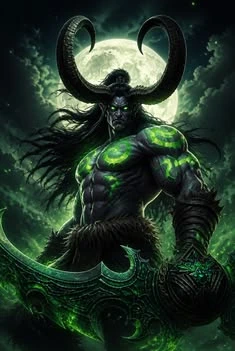
Quick Overview
Illidan, twin brother of Malfurion, sought arcane power during the War of the Ancients and created a second Well of Eternity after the Sundering, earning millennia of imprisonment. Freed by Tyrande in the Third War, he consumed the Skull of Gul'dan and defeated Tichondrius, then was banished. Pursued by Maiev, he allied with Lady Vashj's naga and Kael'thas's blood elves. Ordered by Kil'jaeden to destroy the Lich King, Illidan failed after a battle with Arthas at Icecrown. His original-era story concerns both real sacrifices and dangerous bargains; later Burning Crusade raid events are excluded.
Full History
Long before the Scourge haunted Lordaeron or the orcs crossed the Dark Portal, Illidan Stormrage lived in an empire that treated arcane magic as both a wonder and a measure of rank. The kaldorei civilization centered its power on the Well of Eternity, an immense reservoir of magical energy. Queen Azshara and the Highborne courtiers drew deeply upon its might, and Illidan possessed extraordinary talent for the very forces that shaped their society. His twin brother Malfurion followed another path, learning the ways of the natural world from Cenarius. Tyrande Whisperwind, whom both brothers loved in different ways, was drawn toward the priesthood of Elune. They had grown up close enough to imagine a shared future. The War of the Ancients would make that impossible.
Illidan's great strength was also his weakness: he could see possibilities in power that others would not touch, and he struggled to accept that some kinds of power might be too costly even when they appeared useful. Malfurion saw magic drawn recklessly from the Well as the opening through which the Burning Legion sought their world. Illidan understood the danger of the demons but did not accept the conclusion that arcane power itself should be abandoned. Their disagreement was not merely technical. It became a conflict about whether extraordinary threats entitled extraordinary people to break restraints that kept everyone else safe.
The original-era *War of the Ancients* novels weave this old struggle together with the intervention of travelers from a later age: Krasus, Rhonin, and the orc Broxigar. Their arrival alters the historical struggle that culminates in the Sundering, but the central political and personal tension remains recognizable. As Azshara's court worked with demonic invaders, Malfurion, Tyrande, and others joined the resistance. Illidan moved through those events with his own calculations, never wholly fitting the role of obedient soldier or obvious enemy.
Illidan served among the night elves fighting the Legion and learned firsthand what demonic power could do. Yet his willingness to use forbidden magic made him suspect even to those who needed every ally they could find. His ambition and conflicted loyalties also drew him toward Azshara's court during the crisis. He did not simply follow Malfurion's emerging druidic vision; he believed that mastery of the arcane could offer the kaldorei a means of survival and perhaps a new future after the war. The difference between what he intended and what his methods risked was often enormous.
During the war, Illidan's sight was destroyed by Sargeras, and he received altered vision that allowed him to perceive magic in new ways. The loss of ordinary eyes became part of the figure later generations remembered: the blindfolded spellcaster and fighter whose awareness reached beyond appearances. The change did not make him either a loyal servant of the Legion or its uncomplicated opposite. His efforts to gain power and his fury toward those who restrained him continued side by side.
When the defenders of Azeroth prevented the Legion from fully entering the world, the Well of Eternity collapsed in a catastrophe that shattered the ancient continent. Vast regions sank beneath the sea, and the survivors emerged into a world that barely resembled the one they had known. Many night elves understood the Sundering as proof that the reckless pursuit of arcane energy had nearly destroyed creation. Illidan drew a different lesson: without a source of such power, his people might someday be unable to withstand the Legion's return.
Before the original Well was lost, Illidan had preserved waters containing its power. In the aftermath of the Sundering he brought them to Mount Hyjal and poured them into a lake, creating a second Well of Eternity. To him the act could be defended as preparation for dangers still to come. To Malfurion it was a disastrous repetition of the very practice that had opened Azeroth to the demons. The new Well appeared in a place that the night elves hoped might become a refuge after their civilization's fall.
Malfurion's response was decisive. Illidan was judged too dangerous to remain free and was imprisoned beneath the earth. Maiev Shadowsong and her Watchers would devote themselves to keeping him there. While the night elves withdrew from their former dependence on arcane power and their druids entered long cycles of sleep and communion with nature, Illidan was left with time measured in millennia. The prison became the central fact of his memory of the world: he had sacrificed and fought during the great war, but his people remembered the second Well as proof that his freedom could imperil them all.
The Watchers did not disappear when the wider civilization changed. Maiev's command became part of the quiet machinery by which night elf society handled what it could not forgive. Illidan's incarceration also separated him from Tyrande and Malfurion, fixing an ancient family rivalry into something harder and more bitter. For thousands of years, the argument about his intentions could not be resolved because the person at its center was a prisoner.
The Third War brought the Burning Legion back to Azeroth. The Scourge and its demonic allies devastated the kingdoms of the Eastern Kingdoms, while demonic corruption spread into Kalimdor's forests. Tyrande, desperate for help against a threat that seemed capable of ending the night elves, entered the prison and freed Illidan despite Maiev's objections. She understood his power and believed he might be necessary. The release forced Malfurion to confront an old question he had believed was settled: could the brother he had confined be trusted to fight for the world again?
Illidan accepted the task of combating demonic forces in Felwood, but his path once again ran through forbidden power. Arthas, acting as a death knight, pointed him toward the Skull of Gul'dan, an artifact containing the warlock's immense corruption. Illidan claimed and consumed its power. The act transformed his body into a demonic form, yet it also gave him the strength to defeat the dreadlord Tichondrius and strike a devastating blow against the Legion's forces in the forest.
The outcome captured the contradiction that would define him: Illidan destroyed a terrible enemy by becoming more like the sort of being his people had fought to banish. Malfurion saw not a restored brother but an unstable danger; he banished Illidan from the forests. Tyrande's gamble had helped defeat a demon, but it had not reconciled the brothers or healed the old wounds. Illidan went into exile with immense new powers and a deepening conviction that his people would never judge him by the results he achieved.
After the Burning Legion's defeat at Mount Hyjal, Maiev tracked the exiled Illidan. The Warden had spent ages guarding him, and his freedom represented more than a personal affront: it was the undoing of the duty around which she had organized her life. Illidan, meanwhile, had come into contact with the naga, serpentine beings whose ancestry reached back to Azshara's Highborne. Lady Vashj offered him warriors and a powerful means to move across sea and shore. His alliance with the naga drew Maiev from Kalimdor to islands bound up with one of the darkest chapters of the Second War.
Illidan entered the Tomb of Sargeras, the ancient ruin where the orc warlock Gul'dan had died while seeking overwhelming power. Through the knowledge and memories he had taken with Gul'dan's skull, Illidan sought the Eye of Sargeras. Maiev followed with her Watchers. Illidan obtained the Eye and collapsed part of the tomb, killing Naisha and other Watchers while Maiev escaped. The confrontation made the pursuit irreconcilable: the Warden now carried the deaths of her companions as a reason never to relent.
Illidan's plan was not simply to rule with the Eye. Kil'jaeden, one of the Legion's greatest masters, had ordered him to destroy the Lich King, a creation that had grown dangerously independent. Illidan intended to use the Eye's enormous energies from Dalaran to strike the Frozen Throne in Northrend. Malfurion sensed the devastation this magic was causing. When he and Tyrande joined Maiev, they stopped the spell before it could complete its purpose. The act spared the world from the destructive use of the Eye, but it also left the Lich King alive and Illidan exposed to Kil'jaeden's anger.
The dispute among Illidan's pursuers nearly ended in another personal tragedy. Tyrande was separated during the struggle with the undead, and Maiev concealed the truth about her fate from Malfurion. Illidan helped his brother rescue Tyrande. For one brief interval, the brothers acted together instead of treating each other as impossible to understand. Malfurion granted Illidan freedom to depart, provided he left the night elves in peace. It was not absolution. It was a recognition that the same brother who had endangered them could still help save someone they loved.
Illidan retreated through a portal toward the shattered world of Outland, hoping to escape Kil'jaeden and make a place beyond the reach of his pursuers. His history there belongs to the 2003 *Frozen Throne* campaign, even though later game expansions would revisit and reinterpret the region. Vashj remained at his side, and the blood elf prince Kael'thas Sunstrider eventually joined him. Kael's people had lost their homeland and the Sunwell; Illidan offered access to power that might sustain them. The resulting alliance bound three displaced peoples and leaders around the belief that their old worlds had given them no viable future.
On Outland, Illidan and his companions fought the pit lord Magtheridon's forces and seized the Black Citadel in Hellfire Peninsula. This is the original 2003 campaign's location, not the later Burning Crusade Black Temple raid or its relocated setting. Having built a precarious dominion, Illidan discovered that distance could not free him from the bargain with Kil'jaeden. The demon confronted him and demanded he complete his unfinished task against the Lich King. Illidan returned to Azeroth's northern wastes with Kael and Vashj to try again.
Illidan's armies raced Arthas's Scourge toward Icecrown, where the Lich King's prison had become vulnerable. The battle was not a simple conflict between heroes and villains. Arthas was the agent of a terrible undead power; Illidan served the will of an even greater demon in the hope of escaping that same will. Both led forces whose histories had been marked by the destruction of older kingdoms. Around the Frozen Throne, their futures converged upon the most dangerous seat of power in the north.
Arthas defeated Illidan beneath Icecrown and ascended to the Frozen Throne. The original *Frozen Throne* account leaves Illidan defeated rather than killed. His attempt to destroy the Lich King had failed, and the human prince joined with Ner'zhul to become the new Lich King. Illidan's defeat did not make his past sacrifices meaningless, but it closed the latest chapter of his argument with fate. He had tried to ensure that no stronger master would ever dictate his future; again and again, his appetite for power had brought such masters closer.
At the launch of *World of Warcraft*, Illidan is an exiled, demonic night elf associated with Outland's historical story, not a character encountered in a playable Burning Crusade raid. His future wars and later retellings lie outside this archive's original-era horizon. For someone learning Warcraft history while walking through Felwood, Hyjal, or the ruins linked to Gul'dan, the central fact is the hard ambiguity he leaves behind. Illidan helped defeat the Legion's commanders and repeatedly risked the world to gain the strength to do so. He was imprisoned for a crime he considered necessary, freed for a crisis no one else could solve, and pursued until even his liberators feared what he might become. His tragedy was that he could not separate the need to protect a world from the desire to prove himself the one person strong enough to save it.
The Living Archive · Subject Chronicle
Through History
Explore documented turning points and follow their connections. The complete account remains in Full History above.
No additional documented milestones are available yet. The Full History above remains the primary account.
Further Reading
A research reference supplied with this article.