
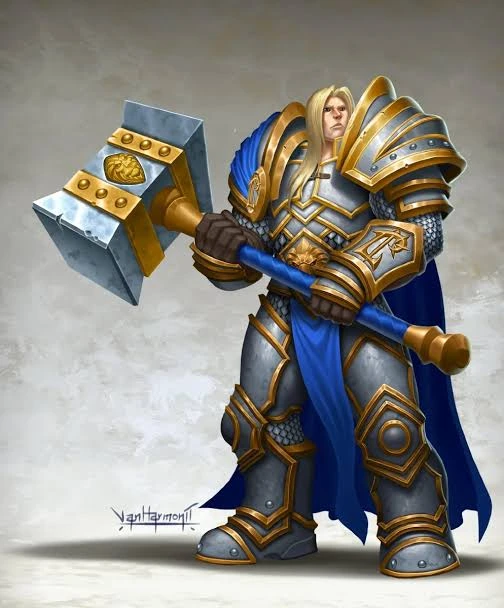
Quick Overview
A prince of Lordaeron and Uther's pupil, Arthas began as a zealous defender against the undead plague. His decision to slaughter Stratholme and his pursuit of Mal'Ganis into Northrend led him to the cursed Frostmourne, which bound him to the Lich King. He murdered King Terenas, raised Kel'Thuzad, destroyed Sylvanas's homeland, and helped summon Archimonde. After the Lich King's power faltered, Arthas returned to Icecrown and defeated Illidan. At the original WoW launch, the fallen prince has joined with Ner'zhul upon the Frozen Throne, while the Scourge still scars the lands he once protected.
Full History
Before the dead marched through Lordaeron's fields, Arthas Menethil seemed born to protect them. He was the son of King Terenas II and heir to one of the strongest human kingdoms, a young prince raised among the aftershocks of the Second War. He knew the names of battlefields long before he had commanded a soldier on one. The Alliance's victory over the old Horde had not ended the anxiety of the northern kingdoms; captured orcs remained in internment camps, defeated veterans nursed their wounds, and the question of what peace should look like divided the very people who had fought for it. In that world, a royal heir was never only a child. He was a promise about what the kingdom would become.
Arthas grew into a capable swordsman with the conviction, and impatience, of someone who had seldom been forced to imagine defeat. He admired the legendary paladin Uther the Lightbringer, who mentored him in service to the Holy Light. Their bond carried something of a family affection, though Uther also understood the distinction between courage and righteousness better than his pupil did. Arthas was formally trained as a paladin and entrusted with duties that could place the lives of common people in his hands. The Light was no mere insignia to him. He believed in it, and he wanted to be the kind of protector the people of Lordaeron could trust.
He also loved Jaina Proudmoore, a gifted mage studying in Dalaran. The prince and the young sorceress shared an affection that neither duty nor their different temperaments could entirely contain. Their romance did not produce the future that might once have seemed possible. By the time the plague reached Lordaeron, the relationship had ended, but the trust between them had not altogether disappeared. Jaina was among the few people able to meet Arthas as a person rather than merely as the king's son. That would make her departure from his side more painful when their convictions finally divided them.
When a mysterious sickness began to spread in Lordaeron, Arthas responded like a prince facing an enemy invasion: he mounted up, gathered troops, and went looking for someone to defeat. At Strahnbrad and elsewhere he confronted raiders still carrying the old Horde's banners. But the greater danger had already crossed the frontier without armies or war cries. Plague-bearing grain was moving through ordinary trade routes. Villagers and soldiers could be transformed into undead servants, and the dead did not stay obediently in their graves. It was a disaster in which the familiar divisions between battlefield and home, enemy and neighbor, were becoming useless.
With Jaina he investigated the infected settlements, learned more about the Cult of the Damned, and followed signs leading toward the necromancer Kel'Thuzad. This was not a campaign against a foreign power that could be pushed back behind a border. The threat appeared inside his own kingdom, and each delay meant more of his subjects might be turned against the living. Arthas eventually caught and killed Kel'Thuzad, but the necromancer's death did not end the plague. Instead it brought the prince closer to the trap prepared for him.
The demon Mal'Ganis was involved in guiding the Scourge's rise and tormenting the defenders of Lordaeron. His presence transformed the crisis from a simple outbreak into the deliberate destruction of a kingdom. For Arthas, the enemy had acquired a face. He could hate Mal'Ganis, hunt him, and imagine the plague ending when that figure fell. The certainty was seductive. It was also exactly the sort of certainty that could force every difficult choice into the same brutal answer.
The turning point came at Stratholme, where contaminated grain had already reached the population. Arthas concluded that the citizens were doomed to become undead and ordered his soldiers to kill them before the transformation occurred. Uther refused to obey, and Jaina could not accept the slaughter either. For the first time, the two people whose judgment mattered most to him stood against his command. Arthas dismissed Uther from service and entered the city with those who remained willing to follow him.
The horror of Stratholme is not merely that innocent people died at the hands of their prince. It is that Arthas was presented with a catastrophe for which he believed there was no merciful answer, then chose to make obedience the test of whether others cared enough to act. Uther's refusal looked to him like cowardice; Jaina's grief looked like abandonment. But they were refusing a different thing: the belief that a ruler's desperation made every deed permissible. In the plague's shadow, a young protector began teaching himself that to save a kingdom he could sacrifice whatever lay in the way.
Mal'Ganis escaped toward Northrend, and Arthas followed the trail across the sea. Revenge now had the form of a duty he could explain to himself. Whatever the prince had once meant by protecting Lordaeron, he had narrowed it to destroying a particular enemy, even at the cost of his own soldiers, mentors, and judgment. The Scourge had not only threatened the kingdom's bodies. It was steadily remaking the mind of the man who would inherit it.
Arthas landed in Northrend and encountered Muradin Bronzebeard, the dwarf with whom he had once trained and who had come north in pursuit of a legendary weapon. Their reunion offered him a familiar ally at the edge of an unfamiliar continent. Together they fought through the frozen wilderness toward Mal'Ganis. Yet back in Lordaeron, King Terenas recognized the mounting cost of the expedition and ordered his son's forces home. Arthas refused to let the campaign end. He arranged for his own ships to be burned and blamed the destruction on mercenaries, ensuring that his men would be forced to continue inland. The choice exposed how far his sense of obligation had twisted: he demanded the soldiers' loyalty while denying them the possibility of return.
Deep in the north, Arthas and Muradin found Frostmourne. The runeblade promised extraordinary power, but its guardians and inscription warned of a dreadful price. Muradin recognized that the weapon was cursed and urged the prince to leave it. Arthas believed the kingdom needed a victory more than he needed a soul unmarked by the cost. He claimed the blade. Muradin fell during the weapon's release, and Arthas emerged carrying the instrument the Lich King had placed on his path.
Frostmourne gave Arthas the force to defeat Mal'Ganis's armies and confront the demon, but its true triumph was over its wielder. The blade consumed his soul and bound him to the Lich King's will. What had begun as a desperate campaign to destroy the undead ended with the prince becoming their most dangerous champion. He abandoned the men he had led north and wandered toward the purpose now calling him. The fall of Arthas was not a single instant detached from everything before it: the sword completed a corruption already prepared by grief, pride, rage, and choices that made retreat seem impossible.
When Arthas finally returned to Lordaeron, the people welcomed him as the victorious prince who had faced the darkness beyond the sea. His father's court received him beneath banners that had once promised the kingdom a long future. Arthas stepped before King Terenas and murdered him with Frostmourne. The killing ended the Menethil dynasty's peaceful succession and plunged Lordaeron into open ruin. Whatever remained of the young paladin was hidden beneath the obedience of a death knight.
He became the hand of the Scourge in the land he had sworn to defend. At Andorhal and in the blighted countryside he gathered its forces; at Uther's stand, the student confronted the teacher whose counsel he had rejected. Arthas killed Uther and claimed the urn containing his father's ashes, because the remains of King Terenas had become a vessel useful to his master's plans. Here the inversion was complete: son, knight, and defender were reduced to titles worn by a servant of death, and the people closest to his former life suffered in the path of his mission.
The necromancer Kel'Thuzad had to be returned to unlife, and Arthas carried his remains to Quel'Thalas. The high elves defended their homeland with the desperation of a people who understood that defeat might mean extinction. Ranger-General Sylvanas Windrunner delayed his advance and refused him an easy victory. Arthas answered her resistance with a cruelty beyond killing: he raised her as a tormented banshee and forced her to witness the violation of her country while serving the power that had destroyed it. Silvermoon was ravaged, and the Sunwell's energies were used in Kel'Thuzad's resurrection. The prince who had once tried to prevent innocents from turning undead was now producing new undead by the thousands.
From Quel'Thalas the Scourge marched on Dalaran. Arthas and Kel'Thuzad broke its magical defenses, killed the archmage Antonidas, and used the Book of Medivh to summon Archimonde into Azeroth. The Burning Legion had been guiding the Scourge's spread toward a larger invasion, and the fall of the northern kingdoms opened the way. Archimonde destroyed Dalaran, demonstrating that the victory of the undead was itself only part of a wider demonic design.
Arthas did not command the Legion. He was an agent in a contest between its masters and the Lich King, a contest that would eventually turn against the demons who imagined they controlled him. The destruction of Lordaeron, Quel'Thalas, and Dalaran mattered to the entire world, but for Arthas it also stripped away the last institutions that could have given his earlier life meaning. No intact royal court awaited him, no paladin order would claim him, and no human settlement could welcome him without fear. His history had become inseparable from the devastation he carried behind him.
After Archimonde's defeat at Mount Hyjal, the Scourge remained a threat in the north and in ruined Lordaeron. Arthas asserted his brutal authority among the undead, aided by Kel'Thuzad, but enemies moved within his own ranks. The dreadlords Varimathras, Detheroc, and Balnazzar pursued their own claim to the fallen kingdom; Sylvanas, recovering her independent will as the Lich King's powers shifted, prepared to turn against her murderer. The dead no longer formed an army whose obedience could be taken for granted.
As the Lich King's strength faltered, Arthas found his command weakening. He suffered debilitating attacks and heard the summons from Northrend. The magical prison holding Ner'zhul, the Frozen Throne, had been threatened by Illidan Stormrage, whom Kil'jaeden had driven to destroy his former creation. Arthas had to leave Lordaeron for the distant north even as the structures of his authority collapsed around him.
Sylvanas attempted to assassinate him during his departure. Having escaped the domination that had kept her enslaved, she captured her former tormentor and wounded him with a poisoned arrow. She wanted more than his death: she wanted him to understand what she had endured. Kel'Thuzad's forces intervened before she could finish the vengeance. Arthas survived and departed, leaving Sylvanas and the dreadlords to fight over the remains of Lordaeron. Her rebellion would eventually produce the Forsaken, a free-willed undead people who defined themselves against the tyranny of the Scourge.
In Northrend Arthas encountered the crypt lord Anub'arak, whose knowledge of underground passages offered a route toward Icecrown before Illidan could reach it. The journey through Azjol-Nerub's depths was a race against both enemy armies and the weakening connection to the Frozen Throne. Ner'zhul's call grew more urgent as the armies converged. Arthas had gained power by betraying everyone who trusted him; now even that power depended upon an entity imprisoned in ice, beyond the reach of ordinary human loyalties.
At Icecrown, Arthas confronted Illidan and defeated him beneath the glacier. With his enemies scattered and the path finally open, the death knight climbed toward the Frozen Throne. He broke the ice prison and claimed the helm that bound him to the Lich King. The souls and wills of Arthas and Ner'zhul were joined in the being who would rule from that frozen seat. The 2003 campaign ends not with a rescue or a coronation in Lordaeron, but with the conqueror of his own homeland ascending the throne of a deathly kingdom far from it.
For the historian standing at the original launch of *World of Warcraft*, this is where Arthas's direct story must stop. The figure enthroned at Icecrown is the Lich King, and the Scourge still threatens Azeroth through the Plaguelands and its scattered agents. Later expeditions, later wars in Northrend, and later revelations about the Lich King's fate belong to histories not yet told in this archive. The ruins visible in the Eastern Kingdoms already carry enough testimony: Stratholme and Andorhal bear the plague's scars; Silvermoon remembers the slaughter of its defenders; Dalaran remembers the ruin of its magical walls; Lordaeron's people have been divided into the living, the enslaved dead, and those undead who have fought free.
Arthas is tragic without being innocent. He began as a young man genuinely determined to protect his people. The Scourge's masters exploited that determination, and Frostmourne enslaved what remained of him, but the road to the sword was lined with decisions he made while still able to choose. He treated mercy as weakness, disagreement as betrayal, and sacrifice as something demanded of others. In the end he possessed immense power and had lost everything that once made power worth possessing. The kingdom he meant to save became his first and greatest victim.
The Living Archive · Subject Chronicle
Through History
Explore documented turning points and follow their connections. The complete account remains in Full History above.
Further Reading
A research reference supplied with this article.