
Quick Overview
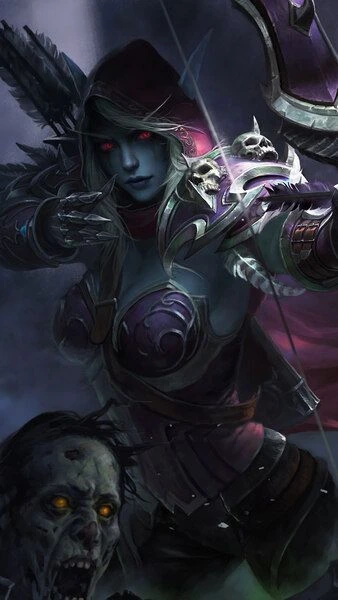
As Ranger-General of Silvermoon, Sylvanas defended Quel'Thalas against Arthas but was murdered and enslaved as a banshee. When the Lich King's grip weakened, she regained her will and attempted to kill Arthas. She defeated rival dreadlords in Lordaeron, formed the free-willed Forsaken, and established their rule beneath the ruined capital in the Undercity. At the original WoW launch she leads an uneasy Horde ally committed to securing her people against the Scourge, the Scarlet Crusade, and the possibility of enslavement again.
Full History
Before her name was spoken in whispers beneath Lordaeron, Sylvanas Windrunner was Ranger-General of Silvermoon. She belonged to the high elves of Quel'Thalas, whose forests, wardstones, and great magical traditions had endured through ages of change. Their kingdom had survived the Second War, but its people knew that the ancient woods did not make them invulnerable. Sylvanas's responsibility was the defense of that homeland: the paths through the forests, the outer settlements, and the approaches to Silvermoon. She commanded rangers whose knowledge of the land could make a small force dangerous to a much larger invader.
In that life, Sylvanas was not yet a monarch or revolutionary. She was a soldier charged with preserving an established country. The dynasty of the Sunstriders, the Sunwell's sustaining energy, and the pride of Quel'Thalas defined the political world around her. Her sisters and the wider Windrunner family belonged to the living world from which her later existence would be violently severed. The ruins of Quel'Thalas that remained after her death would become more than the setting of her defeat; they were the proof of what she had tried to prevent.
The Scourge's invasion began far beyond the borders of the elven forests. Lordaeron fell into plague and undeath, and Arthas Menethil, now a death knight, marched north with the remains of the kingdom he had destroyed. He needed the Sunwell's power to restore Kel'Thuzad as a lich. Quel'Thalas stood in his path. Sylvanas did not control the movements of that army or the demonic design behind it. She could only decide how much time her defenders could buy before the enemy broke through.
The high elves fought through forests and at defensive positions designed to resist invasion, but the Scourge could raise the slain and press onward with growing numbers. Sylvanas organized resistance and delayed Arthas. Each obstacle cost the invader time, and every delay held out some hope that Silvermoon might prepare or escape. Yet the death knight carried a form of war that conventional courage could scarcely stop. He turned death from the end of a defender's effort into an addition to his own armies.
Sylvanas was finally defeated. Arthas could have killed her and moved onward. Instead he inflicted a punishment designed to deny her even the dignity of death. He tore her spirit from her body and bound her as a banshee to the Scourge. Forced to obey, she witnessed her homeland's devastation and the corruption of the Sunwell. The Ranger-General who had resisted him became a weapon under the command of the murderer who had destroyed everything she defended.
That act explains much about the woman who later ruled the Forsaken. Her defining injury was not only that she died. She was made to serve the power she hated, forced to act against her will and endure the memory of her own resistance as something her captor could mock. She had been a commander whose decisions mattered; in undeath her will was denied. The reversal was meant to be permanent. Her later campaign for independence drew its force from the refusal to accept that permanence.
The Scourge marched from Quel'Thalas to Dalaran, helped summon Archimonde, and supported the Legion's advance toward Kalimdor. Yet the alliance between the Legion and the Lich King was unstable. After the demons' defeat at Mount Hyjal, the Lich King came under attack and his power began to waver. The loosening control over some undead opened a possibility Sylvanas had scarcely been able to imagine while trapped in Arthas's service: she could think and act without the same compulsion.
Freedom did not restore her life. She was an undead spirit in a world that had lost her kingdom and treated the dead as enemies to be destroyed. The high elven homeland remained devastated. Arthas still lived. Those who escaped the Lich King's domination included former humans of Lordaeron and other undead who remembered enough of their past to know that they had been enslaved. Sylvanas recognized a shared condition among them. They had been denied death, robbed of autonomy, and abandoned by many of the living who could not distinguish a free will from a Scourge servant.
At this stage, her desire for vengeance and the possibility of founding a people began to grow together. Arthas was not merely an enemy commander to her. He was the embodiment of the system that had made her an instrument against herself. But striking him required more than rage. She had to gather allies, survive the designs of the dreadlords, and claim ground in a kingdom that had become a battlefield among rival masters of the undead.
As Arthas departed Lordaeron in answer to the Lich King's summons from Icecrown, Sylvanas prepared an ambush. She trapped and wounded him in the forests of Tirisfal, using a poisoned arrow to bring down the death knight who had once seemed beyond reach. For a moment the balance of power reversed. The prisoner stood over her former captor, and Arthas was made to face the person whose suffering he had treated as an amusement.
The attempt failed to end his life. Kel'Thuzad's forces intervened and gave Arthas the chance to escape toward Northrend. Sylvanas was left without the satisfaction she had sought. Yet she had demonstrated something of enormous importance: the Lich King and his champion could no longer assume the obedience of all their undead servants. The rebellion was real, and others could join it. Her unsuccessful revenge became the opening move in a war for the fate of Lordaeron's dead.
Three dreadlords—Varimathras, Detheroc, and Balnazzar—contested the remnants of Lordaeron, hoping to keep authority in the wake of the Scourge's weakening command. Sylvanas had no reason to replace one demonic master with another. She fought their forces, pressured Varimathras into submission, and used the resources of her growing army to attack the dreadlords' positions. The contest brought her into uneasy contact with living human survivors under Lord Garithos, who had his own ambition to retake the ruined capital.
Garithos was no friend of the undead. His alliance with Sylvanas was an arrangement of immediate convenience: their enemies were occupying the same territory. Together they broke the final dreadlord's hold on the capital. Varimathras, pressed into Sylvanas's service, played a role in the defeat of Balnazzar. With the city in her power, Sylvanas discarded the temporary human alliance and had Garithos killed. Her promise of cooperation had been a weapon in the same conflict that established her independence.
The killing matters because it prevents the story from becoming a simple transformation from victim to benevolent liberator. Sylvanas had been brutalized by Arthas, but freedom did not make her gentle. She protected her emerging undead people with calculated ruthlessness and did not always respect the promises made to those outside them. She saw the living as possible threats and sometimes as obstacles to remove. The Forsaken would be neither the Scourge reborn nor a people whose suffering automatically absolved their rulers of cruelty.
From the damaged heart of Lordaeron, Sylvanas's followers developed the Undercity, a settlement beneath the old royal capital. The free-willed undead called themselves the Forsaken. Their name expressed both a political break and a grievance: they were no longer the Lich King's puppets, yet few among the living were eager to welcome them back. They occupied farms, roads, crypts, and ruins thick with the memories of people they had once been. Some had families who had fled or died; others remembered only fragments of the lives that the plague had destroyed.
The Undercity was not merely an enemy fortress with new banners. It was an experiment in survival by people whose bodies testified to a catastrophe that much of the world wished to forget. Sylvanas's authority came from having achieved the impossible—breaking domination—and from her willingness to use violence to prevent its return. She relied on loyal advisers and on uneasy subordinate forces, Varimathras among them. The danger of such an arrangement never disappeared. A dreadlord serving the Forsaken carried a history that made simple trust impossible.
The Scarlet Crusade's hatred of the undead threatened the Forsaken as relentlessly as it threatened the Scourge. To many Crusaders the distinction between free will and enslavement was irrelevant; undeath itself was proof of corruption. In the Plaguelands and Tirisfal Glades, Sylvanas's people had to contend with both the lingering Scourge and enemies who would destroy them regardless of their independence. The Forsaken's hard politics grew in part from that pressure, though it did not excuse every deed committed in their name.
The Forsaken eventually entered the Horde through a political alliance born of need rather than natural affection. Thrall's Horde of orcs, tauren, and Darkspear trolls offered military protection and a place among peoples who knew what it meant to be feared by the dominant human kingdoms. The Forsaken brought a position in the Eastern Kingdoms and knowledge of the Scourge. But they were also the undead, the very enemy many Horde soldiers had fought at Mount Hyjal. Even allies could look upon them with suspicion.
Sylvanas was not merely seeking friendship. The Horde provided a shield against destruction by the Scarlet Crusade, the remaining Scourge, and other enemies. Her followers could share information, resources, and a common enemy with the living peoples of Kalimdor while retaining their own political objectives in Lordaeron. Her relationship to Thrall was consequently different from the bonds among the Horde's other founders. It was useful, often necessary, and capable of producing genuine cooperation, but it had been built on calculation as much as shared memory.
At the launch of *World of Warcraft*, Sylvanas rules the Forsaken from the Undercity. Arthas has claimed the Frozen Throne in Northrend, and the Scourge still holds large parts of the Eastern Kingdoms in terror. The free undead of Tirisfal and the surrounding lands are attempting to build a society amid human suspicion and their own profound loss. The Dark Lady's ambitions are shaped by revenge, independence, and an iron conviction that the Forsaken must never again be reduced to slaves.
Her story is an inversion of Arthas's. He sought to save his people and became their destroyer. She tried to save her people and was destroyed, only to return as the protector of a new population he had helped create. The bitter irony is that freedom alone offers no guarantee of wisdom. Sylvanas has to decide, again and again, whether the memory of enslavement will teach her to respect another's will or persuade her that survival justifies any method. At the dawn of Azeroth's new era, that question remains unresolved, and her people must live beneath its shadow.
The Living Archive · Subject Chronicle
Through History
Explore documented turning points and follow their connections. The complete account remains in Full History above.
No additional documented milestones are available yet. The Full History above remains the primary account.
Further Reading
A research reference supplied with this article.