
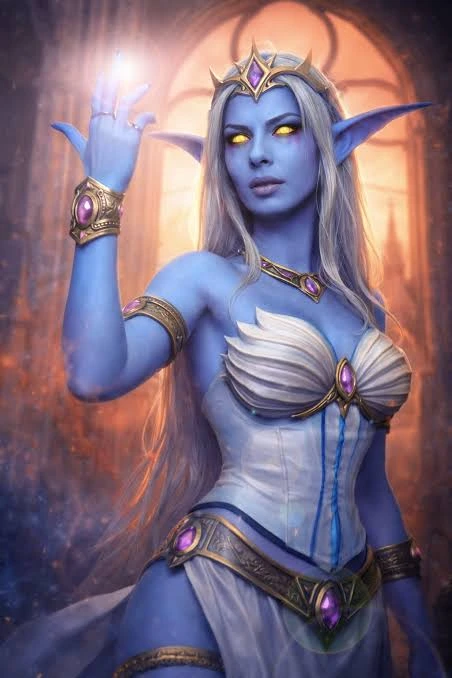
Quick Overview
Queen Azshara ruled the ancient night elf empire beside the Well of Eternity, surrounded by powerful Highborne sorcerers. Her court accepted Sargeras's promises and opened a portal that brought the Burning Legion into Kalimdor. The War of the Ancients ended with the collapse of the Well and the Sundering of the world. The naga and ruined cities preserve the shadow of Azshara's empire, but her later designs are not established by the original WoW launch story.
Full History
In the ancient empire of the night elves, Azshara's power was cultural as well as political. Her beauty and mastery of arcane magic made her the object of near-religious devotion among subjects who called their civilization the center of the world. From a magnificent palace near the Well of Eternity, she presided over a realm built on the energies of that miraculous source. The most gifted aristocratic spellcasters, the Highborne, surrounded her with ceremony, learning, luxury, and the conviction that their accomplishments entitled them to a greater destiny than the common people of Kalimdor.
That confidence hid the empire's weakness. The Well did not belong to Azshara, and its magical power was not a harmless ornament. Each act of reckless manipulation made the realm more visible to forces beyond it. The court's isolation deepened until its members could treat ordinary night elves as little more than a population to be remade according to their queen's vision. Azshara saw no need to doubt a system that praised her every wish; those outside the palace were increasingly excluded from the decisions that would determine whether their world survived.
Sargeras reached the Highborne through the magical disturbance surrounding the Well. His offer promised a transformation of the world under a power so vast that even the queen's court mistook submission for elevation. Azshara and her adviser Xavius embraced the bargain. They began to expand a gateway through which the Burning Legion could enter Azeroth, expecting the arrival of a divine master rather than a destroyer. As demonic troops poured through, cities and settlements suffered an invasion initiated at the heart of their own civilization.
The War of the Ancients exposed the difference between the queen's magnificent vision and the lives of those forced to endure it. Malfurion Stormrage, Tyrande Whisperwind, and allies from across Kalimdor opposed the Legion. The resistance included figures whose paths arrived from the future through the strange course of the War of the Ancients trilogy, but the struggle remained one shared history rather than two separate wars. While armies fought to prevent Sargeras from crossing fully into the world, Azshara's palace continued the work that was tearing the empire apart.
The defenders succeeded in disrupting the magic around the Well of Eternity. The source collapsed under impossible strain, and the resulting Sundering shattered ancient Kalimdor. Land sank, seas rushed in, and the empire that had seemed eternal vanished. Azshara's capital was lost with much of the coast and the court that had served her. The names of the drowned cities endured in memory as warnings about the dependence of a civilization on power it did not understand.
The original Warcraft histories and the events of The Frozen Throne establish that the naga who later rose from the depths were connected to the lost Highborne and their queen. They do not justify importing every explanation of the naga's transformation given in later expansions. At this editorial cutoff, Azshara survives in the setting primarily through the ancient catastrophe, the underwater civilization of the naga, and the memory of royal ambition. The exact breadth of her current plans is not established by the 2004 launch story.
Azshara's greatness was not imaginary. Ancient night elf society created astonishing works, and its command of arcane power was far beyond what many later civilizations would recover. The tragedy lies partly in how those accomplishments were distributed. The queen's Highborne lived nearest the Well of Eternity and treated access to its energies as a privilege of rank. Ordinary inhabitants could admire the civilization's splendor while having almost no influence over the dangerous experiments on which it increasingly depended. That separation between power and accountability helped make the Legion's intrusion possible. The most capable sorcerers of the age had become insulated from the consequences of their own choices.
The aftermath of the Sundering divided the survivors' memories. Malfurion and Tyrande led a people determined not to repeat the old abuse of arcane magic, while many surviving Highborne refused to abandon the abilities that had defined their lives. The banishment of such spellcasters and the later history of the high elves show that Azshara's empire did not vanish without leaving conflicts inside night elf civilization. Its descendants argued about power for millennia. When a traveler explores the ruins of the ancient empire at WoW's launch, those stones represent more than a picturesque lost age. They are evidence of a political disaster whose central question was never resolved merely by drowning its capital: who may wield dangerous knowledge, and what binds that person to the lives endangered by its use?
The naga who surfaced during the Frozen Throne campaign complicate any simple assumption that Azshara's power ended in the Sundering. Lady Vashj's followers possessed old knowledge, formidable spellcraft, and organized forces able to contend with night elf wardens and human armies. Their choices also made it clear that the great catastrophe had not severed every thread linking the ancient Highborne to the modern world. Yet the queen's direct orders, her exact location, and her private intentions were not all disclosed in the original campaigns. The restrained historical answer is therefore more interesting than an invented biography of hidden conquests. Azshara's kingdom had become an unseen presence beneath the water, and her name remained potent enough to connect those depths to the ruins on land.
When Lady Vashj led naga forces beside Illidan Stormrage and Kael'thas during The Frozen Throne, the old empire was no longer confined to ruins and legends. The naga were actors in a new struggle for power; their appearance suggested that the sea had concealed a surviving political and cultural world rather than merely burying the past. Yet the queen herself did not emerge into the surface wars in the campaigns covered by this archive. Her power is best represented by the long shadow of the choices she made ten thousand years earlier.
By the launch of World of Warcraft, travelers can cross the land called Azshara, investigate ancient night elf ruins, and encounter naga whose presence recalls a civilization older than the human kingdoms. The geography is a monument to the disaster, but the deeper story is a warning about command without accountability. The empire fell not because it lacked great works, but because its rulers mistook the ability to command a force for the wisdom to use it. Azshara remains one of Warcraft's most important figures even when absent from the battlefield: an entire age ended around the consequences of her choice.
The Living Archive · Subject Chronicle
Through History
Explore documented turning points and follow their connections. The complete account remains in Full History above.
No additional documented milestones are available yet. The Full History above remains the primary account.
Further Reading
A research reference supplied with this article.