Quick Overview
Kael'thas, prince of Quel'Thalas and a mage of the Kirin Tor, led the blood elves after Arthas devastated Silvermoon and defiled the Sunwell. Fighting the Scourge alongside Alliance survivors, he encountered Garithos's prejudice and accepted aid from Lady Vashj's naga. Condemned for that association, he escaped to Outland and pledged his followers to Illidan for help with their magical hunger. His forces helped take the 2003 Frozen Throne Black Citadel and later failed to stop Arthas at Icecrown. Later Burning Crusade plots are outside this biography.
Full History
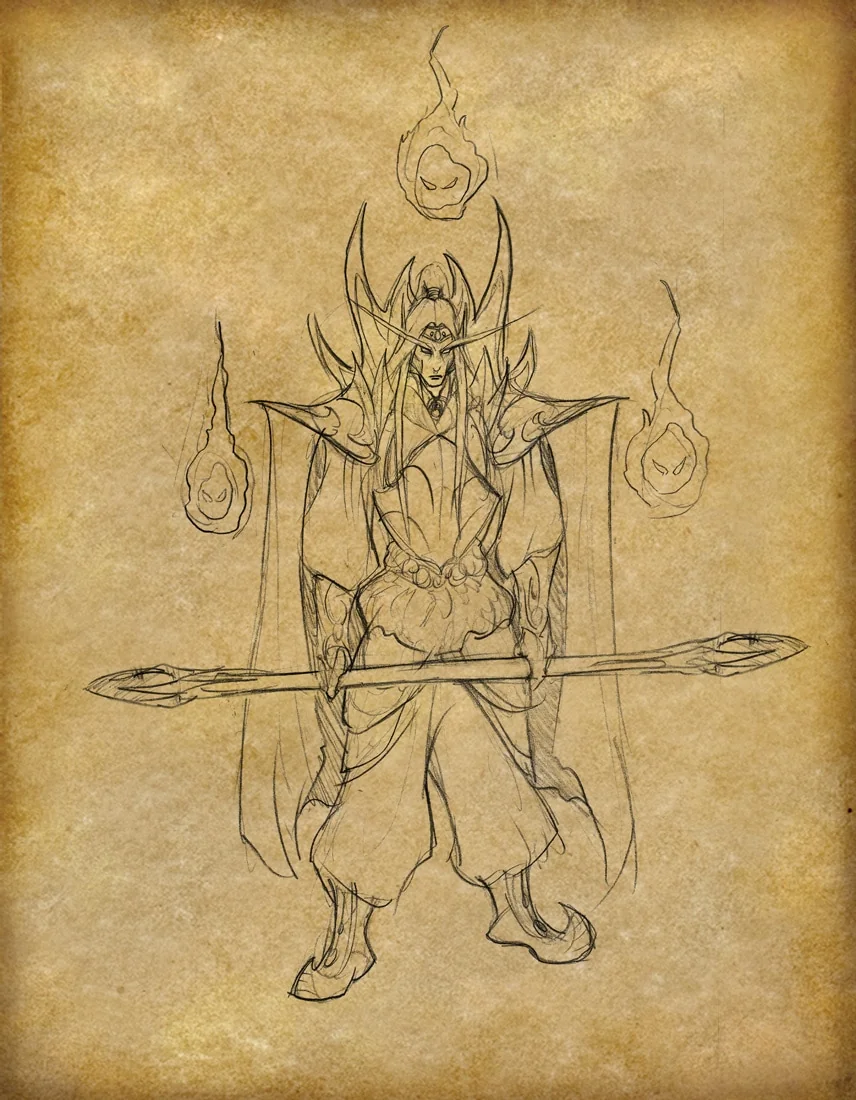
Kael'thas Sunstrider belonged to the royal dynasty of Quel'Thalas, the high elven kingdom sustained by the Sunwell and guarded by enchanted forests. Unlike rulers whose duty kept them entirely in the homeland, he had ties to Dalaran and the Kirin Tor, where his magical ability gave him a place among the learned of the human and elven worlds. He was a prince, a mage, and an heir to a society that believed its traditions could endure the changing fortunes of the continent. The destruction of that society would make his inherited responsibilities almost unrecognizable.
The Scourge's march into Quel'Thalas broke through its outer defenses and reached Silvermoon. Arthas Menethil destroyed the kingdom's defenders, killed the Ranger-General Sylvanas Windrunner, and used the Sunwell's power to restore Kel'Thuzad. The fountain that had sustained elven civilization was desecrated, and the survivors faced not only the loss of homes and kin but a growing dependence on magical energy they could no longer obtain in the old way. Kael'thas inherited a people in mourning and a problem for which courtly titles offered no ready solution.
He called the survivors blood elves in memory of the dead. The name was an act of identity and remembrance, an insistence that the loss of Quel'Thalas not be disguised beneath the appearance of an undamaged kingdom. Yet even as they mourned, they faced practical dangers: advancing undead, political isolation, and the hunger for arcane power left by the Sunwell's destruction.
Kael'thas led blood elf forces alongside the surviving Alliance armies in Lordaeron, hoping that the old ties of the high elves and humans might still offer protection. Instead he encountered Grand Marshal Garithos, a commander whose prejudice toward nonhumans made the Alliance's supposed solidarity cruelly conditional. Garithos assigned the blood elves dangerous tasks without adequate aid, treating their losses as expendable and their successes as suspect.
During these campaigns Lady Vashj and the naga offered help against the undead. Kael'thas accepted it when the alternative was the destruction of his soldiers. Garithos interpreted the association as betrayal and imprisoned the blood elves, condemning them to death. The prince who had sought safety within the old Alliance found that its surviving commander preferred execution to the possibility of an alliance with unfamiliar creatures.
Vashj helped Kael'thas and his people escape the prisons of Dalaran. The rescue forced the prince to consider a question his forebears might have regarded as heresy: if those who claimed to be allies could not be trusted, what other power could keep the blood elves alive? Their magical hunger was worsening, and the world that had once sustained Quel'Thalas appeared to have no place for its survivors.
Vashj led Kael'thas through a portal to Outland, a world already shattered by earlier wars and the disastrous opening of portals across Draenor. There they found Illidan Stormrage, an exiled night elf whose command of demonic magic and history of betrayal made him a dangerous potential patron. Kael'thas saw in Illidan someone who understood the burden of magical dependence and possessed a means to feed the hunger that followed the loss of the Sunwell. There was no cure offered, but there was power enough to continue.
The prince pledged himself and his followers to Illidan. It was a consequential bargain rather than the conclusion of his people's story. Under Illidan's leadership, the blood elves fought alongside naga and other forces against Magtheridon's holdings on Outland. Their campaign brought them to the Black Citadel in Hellfire Peninsula, the fortress represented in the original 2003 *Frozen Throne* campaign. The later Burning Crusade Black Temple raid and its altered geographic framing are not part of this launch-era account.
The blood elves had exchanged one uncertain allegiance for another. They no longer served Garithos, whose contempt might have destroyed them, but their survival now depended upon Illidan's promises and the larger demonic conflict into which he was drawn. The prince remained responsible for soldiers and refugees who had trusted him to find a future, even though the means of sustaining them lay far from their ruined homeland.
Illidan had incurred the anger of Kil'jaeden by failing to destroy the Lich King. To finish the task, he returned toward Northrend with Kael'thas and Lady Vashj. For Kael'thas, the target was also the power ultimately responsible for the Scourge's ruin of Quel'Thalas. Yet the campaign did not restore his kingdom or bring Arthas to justice. Illidan's forces fought against the death knight's armies near Icecrown and failed to prevent him from reaching the Frozen Throne.
Arthas defeated Illidan beneath the glacier and ascended to join with the Lich King. Kael'thas's dream of a decisive vengeance through his new alliance had not succeeded. The prince remained part of the Outland story established by *The Frozen Throne*, while the survivors of Quel'Thalas continued to endure deprivation and political fragmentation. The original-era games do not resolve the future of Kael'thas's people or turn his later history into an inevitable epilogue.
At the opening of *World of Warcraft*, Kael'thas is best understood through the events that have left his people without their old certainty. The Sunwell has been defiled; much of Silvermoon is in ruins; their historic relationship with the Alliance has been shattered by Garithos's betrayal; and their prince has gone beyond Azeroth in pursuit of magical power and a means of survival. What happens in later expansion campaigns should not be read backward as though every choice had already been made at the original launch.
Kael'thas is neither only a victim of prejudice nor simply a noble prince vindicated by necessity. His willingness to risk allegiance to Illidan arose from real catastrophe, and the dangers within that choice were real as well. He preserved followers who might otherwise have died under Garithos, but his people were led into a war between powers whose aims extended far beyond Quel'Thalas. The tragedy is that a dynasty born to guard one sacred well was reduced to seeking fragments of power wherever they could be found. The question of what the blood elves will become remains open at the end of the original story's horizon.
The Living Archive · Subject Chronicle
Through History
Explore documented turning points and follow their connections. The complete account remains in Full History above.
No additional documented milestones are available yet. The Full History above remains the primary account.
Further Reading
A research reference supplied with this article.