
Quick Overview
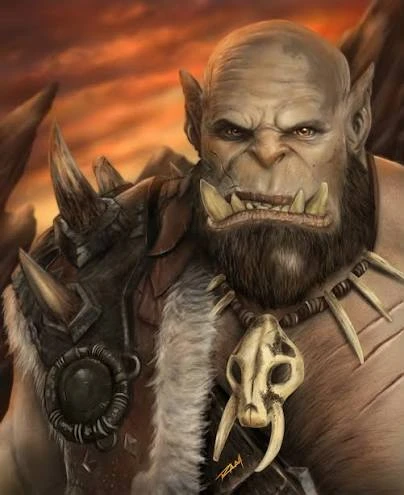
Orgrim Doomhammer overthrew Blackhand and crushed much of Gul'dan's Shadow Council, then led the old Horde in the Second War. Betrayed when Gul'dan deserted in pursuit of the Tomb of Sargeras, Orgrim fell to the Alliance after Anduin Lothar's death at Blackrock Spire. In later years he joined Thrall to free interned orcs and died during those campaigns, entrusting Thrall with his armor, hammer, and the mantle of Warchief. At the original WoW launch Orgrimmar bears his name and Thrall seeks a different future from the conquests Orgrim once led.
Full History
Orgrim Doomhammer grew up among the clans of Draenor long before human kingdoms learned to fear the orcs. A warrior connected to the Blackrock clan, he came of age within a society shaped by ancestral traditions, rival clan loyalties, and old friendships that reached beyond those divisions. Durotan of the Frostwolves was among the figures whose character and judgment mattered to him. When demonic influences began changing the clans, the bonds of that earlier life became a measure by which Orgrim could see the damage being done.
Gul'dan and his warlocks elevated Blackhand as Warchief while shaping the Horde's true direction through the secret Shadow Council. The orcs attacked the draenei and later crossed the Dark Portal into Azeroth, becoming the army by which the Burning Legion expected to break a foreign world. Orgrim served within that Horde and shared responsibility for its campaigns. Yet he also learned to distrust the hidden power manipulating the leadership. The idea that the clans could have been deceived was not comfortable: it forced him to question victories purchased at the cost of their own freedom.
During the First War the invading Horde laid waste to the kingdom of Stormwind, but the struggle exposed the influence of Medivh and Gul'dan. When Gul'dan fell into a coma after Medivh's death, Orgrim recognized an opportunity to break the warlocks' grip on the Horde. He challenged and killed Blackhand, took the title of Warchief, and struck at the Shadow Council that had secretly ruled behind the throne. Many of its members were destroyed, while the survivors learned that Doomhammer's authority would not be as easily bent as Blackhand's.
The change did not make Orgrim a peaceful leader. He commanded an invading army, regarded the human kingdoms as obstacles to its survival and victory, and continued the campaign after Stormwind's fall. He also chose to spare Gul'dan, whose knowledge remained useful, despite recognizing the danger of retaining him. The decision was a military calculation made by a Warchief trying to win a war while freeing the Horde from hidden masters. It would become one of the largest strategic mistakes of his command.
Orgrim carried the Horde into the northern kingdoms, challenging the newly formed Alliance of Lordaeron. His forces fought humans, dwarves, elves, and other peoples across forests, mountains, and coasts. The campaign brought the Horde close to Lordaeron's capital, and his reputation grew as an enemy commander who could match the Alliance's best soldiers in determination and courage. Yet the empire of conquest he commanded rested upon internal divisions the warlocks had not erased.
At a decisive moment Gul'dan deserted with the Stormreaver and Twilight's Hammer clans to seek the Tomb of Sargeras. Doomhammer was forced to divert strength to pursue the traitors. The sudden loss of fighting power helped the Alliance recover and advance. Orgrim had spared a dangerous servant in the hope of using his knowledge, and the servant had chosen personal power over the survival of the Horde.
The remaining orcs withdrew toward Blackrock Spire. There Doomhammer clashed with the Alliance commander Anduin Lothar, who was killed in the fighting. Orgrim may have hoped the loss would shatter the human army, but Turalyon rallied the defenders and pressed forward with new fury. The Horde was defeated, and Orgrim was captured. The Second War ended not in the triumph the old Horde had promised its warriors but in camps, disarmament, and scattered survivors.
The Alliance imprisoned surviving orcs in internment camps. As the demonic energy and rage that had sustained their armies faded, many captives sank into despair and lethargy. Orgrim, once Warchief of a force that threatened the northern kingdoms, lived to see the war's end and the humiliation of people who no longer seemed to know what they fought for. His capture did not erase the wars he had led or the suffering caused by the Horde, but it forced him to confront the possibility that his people needed something other than another campaign of conquest.
He eventually escaped and remained apart from the armies he had once commanded. The possibility of an orcish future seemed uncertain until the appearance of Thrall, the son of his old friend Durotan. Thrall had been raised as a human slave and trained as a gladiator, yet had rediscovered the shamanic traditions the warlocks had almost destroyed. In the young orc, Orgrim saw something he had rarely found in the later years of the old Horde: hope without the promise of domination.
Orgrim joined Thrall in campaigns to free the captive orcs. Grom Hellscream and his Warsong warriors also aided the rising movement. The attacks against internment camps did not simply reverse battlefield defeats; they offered scattered survivors a purpose and a chance to become a people again. Thrall's vision centered on freedom, renewed contact with ancestral spirits, and the rejection of the Legion's blood pact. Orgrim lent the cause the reputation and practical military knowledge of a former Warchief.
During one of the camp liberations, Doomhammer was mortally wounded. He entrusted the future of the Horde to Thrall and passed on the armor and hammer by which generations had known him. The gesture marked a transfer greater than a single commander's rank. An old Warchief who had helped conquer a foreign world was asking a younger leader to build something that did not require repeating that conquest.
By the launch of *World of Warcraft*, Orgrim has long been dead, and Thrall rules from Orgrimmar, a capital named to honor the predecessor whose weapon and mantle he inherited. To members of the New Horde, Orgrim is remembered as the leader who broke the power of Gul'dan's Shadow Council and finally entrusted his people to a different future. To the kingdoms that suffered the Second War, he remains the Warchief whose armies advanced against their homes. Both histories are true within the era this archive preserves.
Orgrim's character cannot be reduced to a simple turn from villain to hero. He opposed demonic manipulation but still led the conquering Horde. He valued honor yet made decisions that brought death far beyond his people. He spared Gul'dan and suffered the warlock's betrayal. In the end he accepted that the orcs would survive through a leader whose ambition differed from his own. His last act was not to win a final victory but to relinquish command. The New Horde's capital carries the name of a man who understood too late that its future must be more than an echo of his wars.
The Living Archive · Subject Chronicle
Through History
Explore documented turning points and follow their connections. The complete account remains in Full History above.
No additional documented milestones are available yet. The Full History above remains the primary account.
Further Reading
A research reference supplied with this article.