
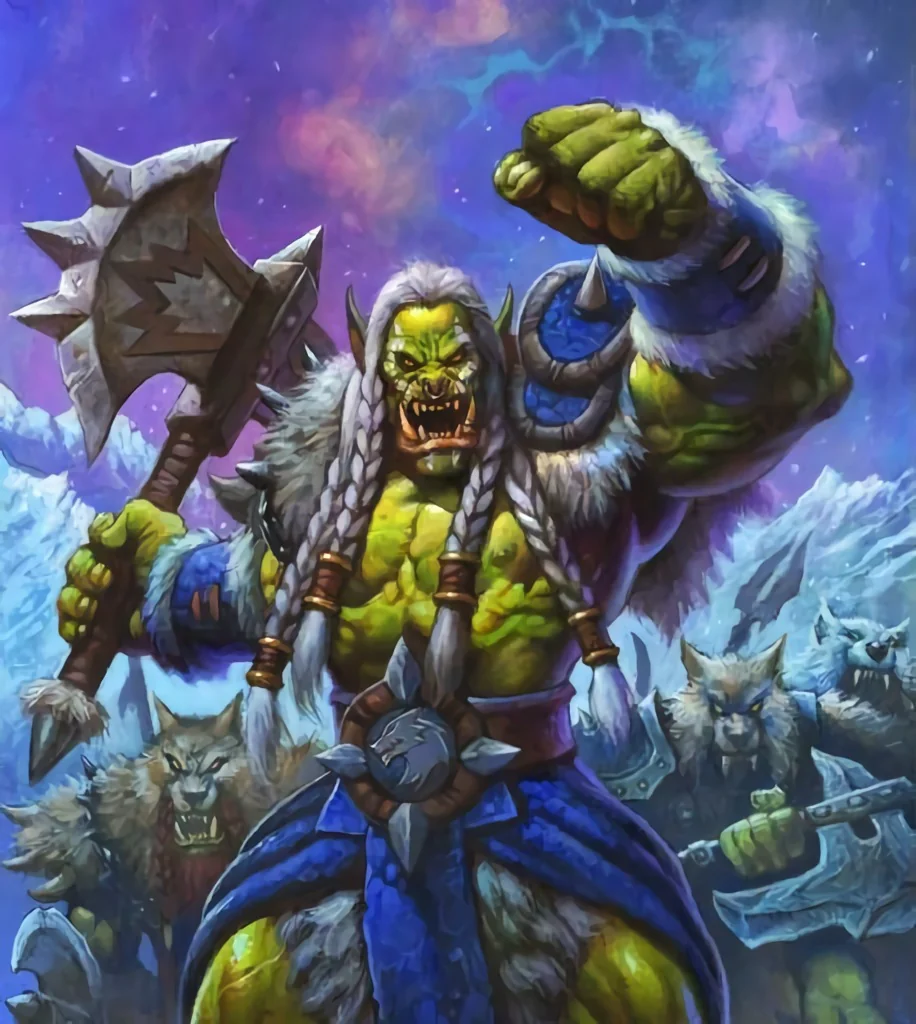
Quick Overview
The Blackrock clan became one of the greatest powers in the war machine that rose under Blackhand; Varok Saurfang is remembered among its warriors. The death of Grom Hellscream after his victory over Mannoroth broke the demonic blood curse that had bound the orcs' fate. The orcs are no longer merely an invading army, but neither are they strangers to war. He matters because the Horde's story cannot be told only through the dreams of its new warchief.
Full History
Before there was Orgrimmar, there was Draenor. Its orc clans belonged to a world of ancestral spirits, rival chieftains, hunting grounds, and customs older than the Horde that crossed the Dark Portal. The Blackrock clan became one of the greatest powers in the war machine that rose under Blackhand; Varok Saurfang is remembered among its warriors. His exact birth date, childhood, and earliest service are not established in the original game accounts. That silence matters. The later Saurfang became so famous that it is easy to write the old legend backward and give him speeches, commands, and private convictions that no launch-era source records.
What is certain about the historical world he came from is not flattering. A people who had once followed the counsel of shamans were turned toward conquest by leaders who accepted demonic bargains. The destruction on Draenor came before the march on Azeroth. The orcs' strength was real, but it had been gathered into an army whose appetite for victory made it a weapon of powers far beyond the clans. Saurfang belonged to that generation. Unlike the younger fighters who would grow up under Thrall, he had lived long enough to know that the Horde's name had once meant invasion to the people it encountered.
When the Dark Portal opened, the old Horde invaded the human kingdom of Stormwind. Its advance was not a single charge by nameless barbarians. Clans, warlords, scouts, and supply trains brought organized war into lands whose inhabitants had never known the orcs. The First War ended in Stormwind's ruin. Any history of its orc veterans must reckon with that achievement and with its victims together: a battle won for the Horde was also a home destroyed for the people of Azeroth.
Saurfang's later reputation as a formidable veteran belongs against this background. The original Warcraft I narrative does not assign him a separate campaign or identify which walls he personally assaulted. We should not give him credit for every battle simply because he later became an icon of orcish warfare. His story is the longer one of an experienced soldier who survived while the purposes of the army around him changed.
The killing of Blackhand and Orgrim Doomhammer's rise changed the Horde's command without undoing the consequences of its invasion. Doomhammer distrusted Gul'dan's designs and sought to bring the unruly clans under more disciplined leadership. His armies pushed north through the human kingdoms, into lands defended by dwarves and elves as well as men. The conflict became the Second War, a struggle whose scale the peoples of the Eastern Kingdoms had never witnessed. Saurfang's established identity as a veteran of those early Horde wars places him in this generation of commanders and fighters; the precise assignments sometimes attributed to him come from later retellings, not from an individual mission bearing his name in Warcraft II.
The Blackrock legacy also left a bitter division among orcs. To some survivors, the old banners represented the lost possibility of victory. To others they represented a chain of decisions that had carried the clans into corruption and defeat. When the Alliance broke the Horde's campaign and the survivors scattered or were captured, there was no simple path back to the world before the portal. An orc who had known the war's triumphs now had to live after its collapse.
There is an important gap in Saurfang's surviving early record. The aftermath of the Second War is richly documented for Orgrim, the orc internment camps, and the scattered clan leaders, but it does not furnish a reliable day-by-day account of Varok's movements. A responsible biography cannot turn that absence into a fictional prison escape, a secret expedition, or a decisive meeting. Much of the old Horde's army was broken; some orcs were held in human camps, while others lived outside their walls. Saurfang survived into the generation that joined the new Horde, but the exact path is not clearly established by the original-era materials.
The years themselves are significant. The orcs suffered lethargy and despair as demonic power ebbed from their lives. Young Thrall would eventually discover that the camps held not an army waiting to be unleashed but a people whose older beliefs had nearly been smothered. The difference between freeing soldiers and recovering a society would shape every choice made in the Horde's rebirth.
Thrall did not inherit a unified kingdom. He escaped human captivity, found the Frostwolf clan, learned the ways of the elements, and sought Orgrim Doomhammer's counsel. Together they helped liberate captive orcs. When Doomhammer fell, his hammer and the responsibility of leadership passed to Thrall. The younger warchief carried the memory of an earlier honor he had barely been allowed to know, and he faced surviving warriors whose entire lives had been shaped by war.
For veterans like Saurfang, the new Horde offered a place in a project unlike the campaigns of Blackhand or Gul'dan. Thrall intended to build a people capable of ruling themselves without demonic masters. He did not demand that the orcs forget their power as fighters; he demanded that they find a purpose for it beyond endless invasion. This is the central tension in Saurfang's launch-era portrait. His experience gives him weight beside a younger warchief, but the new order cannot be judged only by victories measured in enemy dead.
Saurfang's specific conversations with Thrall during the liberation campaign are not preserved in the Warcraft III missions. That does not make his role meaningless. By the beginning of the World of Warcraft era, the old veteran's place in the Horde's leadership shows that Thrall's movement did not simply discard the warriors who had survived the earlier wars. It asked them to serve a different kind of nation.
The Burning Legion's return sent Thrall west toward Kalimdor. There the orcs found allies no previous Horde warlord could have predicted: the Darkspear trolls rescued on the journey, the tauren led by Cairne Bloodhoof, and eventually even human forces willing to stand against the Legion. The death of Grom Hellscream after his victory over Mannoroth broke the demonic blood curse that had bound the orcs' fate. The Battle of Mount Hyjal brought a coalition of former enemies together against Archimonde.
These are achievements of Thrall's Horde as a whole. They should not be recast as unrecorded personal exploits of Varok. The original Warcraft III campaign foregrounds Thrall, Grom, Cairne, Jaina, and the night elf defenders; it does not make Saurfang the hidden champion of its major battles. His importance is better understood as the continuing presence of the old war generation inside the people that survived them.
After the Legion's defeat, Thrall's orcs established Durotar. Orgrimmar was raised as the heart of their new home, named in honor of Orgrim Doomhammer. The city was neither the ancient citadel of a conquering empire nor a peaceful settlement untouched by danger. Its walls guarded a harsh land, its people competed for limited resources, and its leaders had to defend allies while negotiating with suspicious neighbors. The human fortress of Theramore, the hostile orcs of the Dark Horde, and the scattered dangers of Kalimdor reminded the new nation how fragile its security remained.
In the original Classic world Saurfang is represented as a senior Horde warrior in Orgrimmar, remembered for extraordinary combat prowess. Later versions of Classic place him prominently near the Valley of Strength. The exact date when every associated title, position, and in-game announcement first appeared requires independent client-build verification; a database presence in later Classic snapshots is not proof of patch 1.1 availability. His historical function at the launch cutoff is nevertheless clear: he is a living link to the first orc armies and a veteran standing in the new Horde's capital, not a commander who has already led the later Ahn'Qiraj campaign.
That distinction gives the character unusual force. The young guards around Orgrimmar may know the old wars only through veterans' accounts. Saurfang represents the generation that remembers them firsthand. In an old Horde he would have been judged primarily by his effectiveness in battle. In the new one, the question facing him and other senior warriors is what kind of people that strength should protect.
Orcish warrior culture prizes courage, loyalty, resilience, and deeds worth remembering. But the history of the Horde shows what happens when those qualities are separated from judgment. Blackhand's strength could not save his people from manipulation. Doomhammer's discipline could not win a war against a united Alliance. Grom's ferocity was both a danger and, at the moment of his final choice, a means of liberation. Saurfang stands at the junction of these examples. He has seen enough campaigns to know that victory is a temporary condition, while the consequences of conquest linger after armies depart.
Later Warcraft stories give him explicit speeches about honor, remorse, family, and the cost of battle. Those speeches make a compelling portrait, but they belong to later publications and should not be inserted into the 2004 setting as if the player has already heard them. What the original-era biography can say is narrower and stronger: the veteran has survived the Horde's greatest mistakes and joined a society deliberately attempting to move beyond them. He can embody the legacy without having invented words placed in his mouth.
Readers familiar with later stories will know of Broxigar and Dranosh. Broxigar's extraordinary role in the War of the Ancients belongs to the eligible original-era novel narrative; the identification of Varok as Broxigar's brother is explicitly voiced in the 2006 Ahn'Qiraj material and is therefore not treated here as an event learned by a launch-era player. Dranosh's life in Outland and his later fate belong to expansions beyond the archive's cutoff. Their family connections can be maintained in editorial research notes without bringing those later revelations or events into Varok's launch biography.
Likewise, the commanding title 'High Overlord,' his leadership of the Might of Kalimdor, and the famous player jokes about his overpowering attacks need separate treatment. The jokes belong to community folklore, not Warcraft's historical events. The Ahn'Qiraj campaign begins years after this article's stopping point. It can be linked as an explicitly later chapter in other editions of Warcraft, but it has not happened in the story told here.
When the original game opens, Thrall rules the Horde from Orgrimmar. The orcs are no longer merely an invading army, but neither are they strangers to war. Darkspear trolls and tauren share their fortunes, enemies test their borders, and the mistakes of past generations have not been erased. Varok Saurfang belongs among the veterans who make this uneasy new order possible. His presence places the earliest chapters of the Horde's history within sight of its uncertain future.
He is not remembered because everything he did was right. He matters because the Horde's story cannot be told only through the dreams of its new warchief. It must also account for those who lived through the old one—and who now stand guard over a home that its founders hope will endure.
The Living Archive · Subject Chronicle
Through History
Explore documented turning points and follow their connections. The complete account remains in Full History above.
No additional documented milestones are available yet. The Full History above remains the primary account.
Further Reading
Search result, not a direct source citation.