
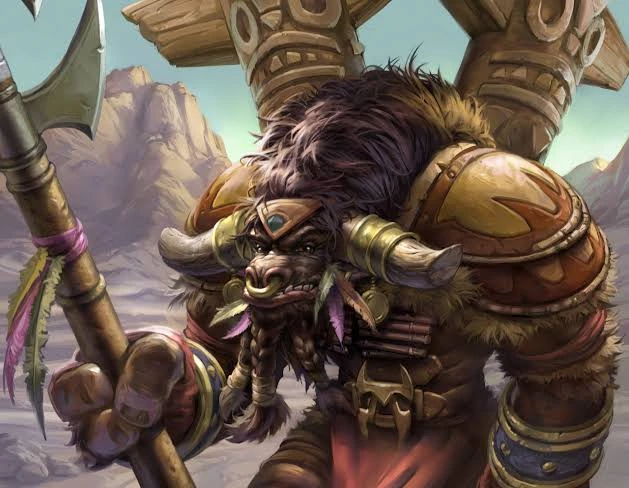
Quick Overview
Cairne Bloodhoof led the tauren against the centaur and helped his people establish a lasting home in Mulgore. He befriended Thrall during the Horde's journey across Kalimdor and became one of the new Horde's wisest allies. Cairne supported the defense of Mount Hyjal and later aided Rexxar during the conflict over Durotar. By World of Warcraft's launch he ruled from Thunder Bluff, embodying the Horde's hope for strength without demonic conquest.
Full History
Before the orcs built Orgrimmar, Cairne Bloodhoof led a people whose greatest victories had often been acts of survival. The tauren of Kalimdor possessed a deep reverence for the Earth Mother, the land, and the ancestral traditions that tied tribes together. They also faced relentless pressure from the centaur. Migration and defense were necessities rather than adventures. As a chieftain, Cairne bore responsibility for warriors and children alike, and his wisdom was judged in the simple, unforgiving measure of whether his people would see another season.
The arrival of Thrall's Horde was unexpected. Orcs had crossed the sea from a land of internment and loss, searching for a new home in Kalimdor. To the tauren, they were strangers armed for war; to Thrall, the tauren were another people threatened by forces stronger than themselves. Cairne recognized something in the young warchief beyond a shared enemy. Thrall sought to restore a dishonored people without repeating the violence that had brought them to ruin. Cairne needed allies who could help the tauren survive without surrendering their way of life.
Cairne aided Thrall as the Horde moved across the Barrens, and the orcs helped defend tauren settlements against centaur attackers. Their bond became a foundation of the new Horde, not merely an agreement to trade soldiers. Cairne was older and more patient than many of Thrall's commanders. He understood how to wait, how to listen to the land, and how to distinguish a necessary battle from a battle fought for pride. Thrall, whose people had spent generations under demonic influence, found an ally whose culture still carried older spiritual obligations.
The tauren eventually established themselves in Mulgore, sheltered among the mesas and grasslands. Thunder Bluff rose as a capital worthy of their communities, with Cairne as high chieftain of the Bloodhoof and a leading voice among the tribes. The settlement did not end the centaur threat or the disputes along its borders. It gave a mobile people a place from which they could build something more enduring than another guarded camp. Cairne's role as leader remained bound to the practical needs of his people: safe roads, defended villages, and the freedom to practice their traditions.
Cairne also took part in the conflicts that culminated in the defense of Mount Hyjal. The burning of Ashenvale and the return of the Burning Legion threatened far more than the orcs' tentative settlement. He had seen how quickly enemies could turn the land itself into a battlefield. Tauren warriors joined the larger defense, and the alliance among orcs, humans, and night elves proved that even ancient hostility could be set aside when the survival of the world required it.
His partnership with Thrall endured into the period of The Frozen Throne. In the Founding of Durotar campaign, Cairne aided Rexxar and the new Horde during crises that threatened its future. His son Baine became caught in the centaur conflict and required rescue, bringing the danger home to the chieftain as a father as well as a leader. When the forces of Admiral Daelin Proudmoore moved against Durotar, Cairne again stood among those who believed the Horde's homeland was worth defending.
Thunder Bluff was a political decision as much as an architectural one. The tauren who settled Mulgore had been forced to move under the pressure of centaur raids, and establishing a defensible center allowed scattered families to gather without always preparing for the next flight. The surrounding villages and great mesas became places where ritual, trade, and leadership could be maintained over generations. Cairne's decision to join the Horde must be understood from that ground. An alliance was worthwhile if it preserved the tauren's right to live according to their own customs and defend their children.
His friendship with Thrall was important because the Horde might easily have defined itself only through orcish grievances. The Darkspear trolls, the tauren, and later the Forsaken brought different histories and different limits to the coalition. Cairne offered a voice that remembered the earth before the current wars and a way of judging strength that did not begin with vengeance. The dangers facing the Barrens—centaur warbands, contested settlements, unstable borders, and the possibility of renewed conflict with the Alliance—could not be solved by battle alone. Cairne's value as an elder was his insistence that the Horde's future should be measured by the safety of the communities it built, not only the enemies it defeated.
Cairne's authority is especially important because the Horde's new leaders are not all members of a single people. Thrall commands orcs haunted by their enslavement and the old blood curse. Vol'jin's trolls have their own traditions and displacements. The tauren have suffered generations of centaur pressure and carry a relationship with the land that does not begin with the wars in the Eastern Kingdoms. A coalition of such peoples requires a kind of leadership more patient than issuing orders. Cairne offers counsel grounded in community memory. He can disagree with another leader without turning disagreement into betrayal. At launch, his presence in Thunder Bluff demonstrates that the Horde might endure as a gathering of peoples rather than another army assembled around a conquering master.
At the original World of Warcraft launch, Cairne remains in Thunder Bluff, a respected elder whose word carries beyond the tauren tribes. His association with Thrall is one of the Horde's strongest arguments that it has changed since the First and Second Wars. The new coalition is not bound by the blood of Mannoroth or by a warlock's promise of conquest. It depends on tribes and peoples willing to act together without surrendering what makes them distinct.
Cairne's story is quieter than that of many warlords, but no less important. He did not need to become a king of armies to shape a continent. He helped guide a displaced people toward a home and convinced another displaced people that strength could be measured in protection rather than destruction. In the Barrens and Mulgore, where wars, caravans, migrations, and ancestral duties intersect, his authority is felt whenever the Horde is forced to decide what kind of nation it intends to become.
The Living Archive · Subject Chronicle
Through History
Explore documented turning points and follow their connections. The complete account remains in Full History above.
No additional documented milestones are available yet. The Full History above remains the primary account.
Further Reading
A research reference supplied with this article.