
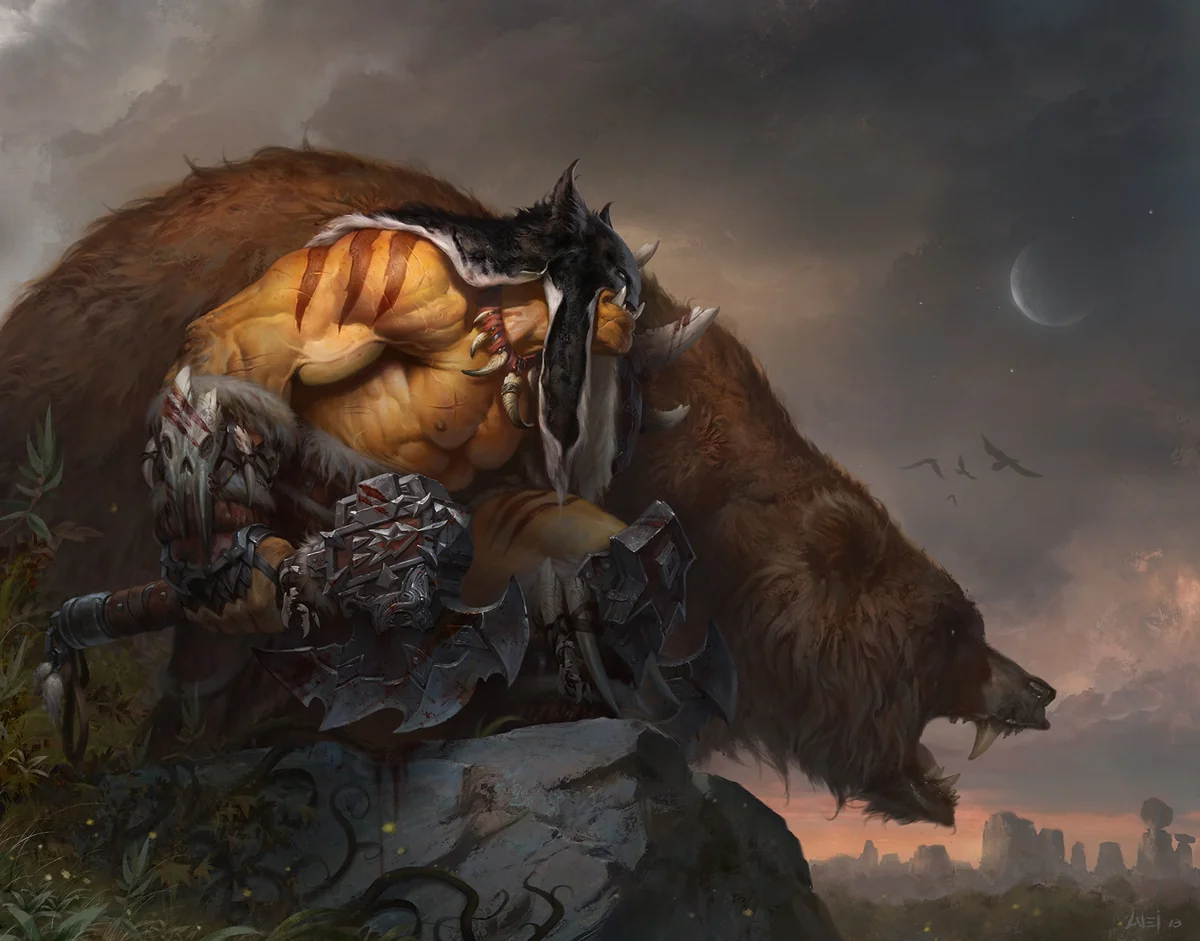
Quick Overview
Rexxar, the Mok'Nathal beastmaster who traveled with his bear Misha, preferred the wilds to the wars of kings. After carrying a dying orc messenger's charge to Thrall, he became the principal hero of The Founding of Durotar. Alongside Rokhan, Chen Stormstout, and Cairne he uncovered threats to the new Horde and helped resist Grand Admiral Daelin Proudmoore. He remained a wandering champion rather than accepting a throne or permanent command.
Full History
Rexxar entered the great wars of Azeroth as an outsider. A Mok'Nathal, born of the mixed heritage of orcs and ogres, he possessed the strength of both but belonged comfortably to neither. The old Horde's conduct had given him good reason to distrust the ambitions of chiefs and warlocks. By the time he reached Kalimdor, he preferred the company of beasts and the open wilds to politics. His bear Misha was not a decorative companion but the creature with whom he shared his road and his battles.
His connection to Thrall's Horde began with a dying messenger. Rexxar encountered a mortally wounded orc carrying an urgent message for the warchief in Durotar. Honoring the messenger's final charge brought Rexxar to Orgrimmar and introduced him to a people struggling to make a homeland out of harsh terrain and uncertain peace. He did not arrive to seek rank. The obligation was small enough to appear ordinary, but fulfilling it placed him in the middle of a crisis that would decide whether the new Horde survived.
Thrall needed someone who could move beyond the city and investigate threats without provoking a war by marching an army into every dispute. Rexxar's independence became his advantage. In The Founding of Durotar he traveled with allies such as the Darkspear shadow hunter Rokhan and the wandering pandaren brewmaster Chen Stormstout. The trio brought different traditions into one expedition, meeting dangers across the Barrens and the regions around Theramore. Their investigation joined scattered clues into a story of intrigue, hostile forces, and an Alliance admiral unwilling to let the orcs build a future.
Rexxar's path also crossed that of Cairne Bloodhoof and the tauren. Their struggles against the centaur had not ended with the establishment of Thunder Bluff. When the chieftain's son Baine was threatened, the rescue drew the wanderer directly into the responsibilities that leadership imposes on a family. These events matter because they reveal Rexxar's character more clearly than titles do. He claims to prefer solitude, yet he repeatedly chooses to help people who have no authority to command him.
The central danger arose from Grand Admiral Daelin Proudmoore, Jaina's father, whose experience of the old Horde left him convinced that orcs could never be trusted. He used his forces to threaten the settlements of Durotar, refusing to believe that Thrall's people might be different from the armies that destroyed so much during the Second War. Jaina, who had helped defend Hyjal alongside the Horde, was caught between her father's resolve and the hard-won trust she had forged with Thrall.
Rexxar became one of the figures who carried the resistance against Daelin's campaign. The defense of Durotar required reconnaissance, unconventional allies, and the ability to see beyond the inherited anger of each faction. The eventual confrontation ended with Daelin's death, a victory that protected Orgrimmar while deepening the grief and suspicion between the surviving peoples. It was not a triumph that made reconciliation simple. It proved how readily old hatred could overrule the evidence of change.
The Founding of Durotar tells its history through a wanderer because a traveler sees consequences that rulers often receive only in reports. Rexxar moves among outposts, passes through dangerous country, hears grievances, and meets allies outside the ordinary command structure. The route brings the new Horde's problems into focus: survival in dry lands, fragile friendships between peoples, fear of another invasion, and disputes that can become war before leaders have spoken. He encounters these problems as individual obligations long before they become decisions for armies.
Rokhan and Chen are also essential to that story. A Darkspear shadow hunter and a wandering brewmaster do not share Rexxar's upbringing, but they join him in a campaign that relies on trust across great cultural distance. Their company suggests a model of the new Horde quite unlike the old one assembled by the Shadow Council. Its members choose to assist one another without demonic compulsion, and their success depends on curiosity and cooperation as much as strength. Rexxar ultimately prefers the wilderness to an office in Orgrimmar, yet that refusal is consistent with his service. The Horde he helps defend is a home for peoples who should not all be forced to become the same.
Rexxar's strength could have made him another warlord, but the period story consistently gives him a different measure of honor. He honors a dying messenger, answers the call of a vulnerable settlement, and joins allies without demanding that they accept his command. When the threat to Durotar becomes a war, he acts decisively, yet he does not use victory to claim the political authority of the people he saved. This makes his wandering after the campaign more than a picturesque character detail. In a setting filled with commanders whose ambition brought ruin to whole continents, Rexxar shows a hero who knows when to leave power in other hands. His friendship with Misha and his life on the road remain central to who he is, not rewards he must abandon to become important.
Thrall offered Rexxar a place among the Horde and recognized the scale of what he had done. Rexxar did not become a settled ruler. He remained attached to the wilds and to the freedom of traveling with Misha, but his bond with the new Horde was real. Unlike the warlords who sought land and power as proof of greatness, he helped secure a home he did not demand for himself. The choice made him an unusual hero for a nation struggling to reconcile warrior traditions with the hope of peace.
At the launch of World of Warcraft, Rexxar remains a wandering champion associated with the Horde and the untamed country of Kalimdor, not the ruler of a city. His history joins the founding of Orgrimmar, the friendship between Thrall and Cairne, the Darkspear's new place in the Horde, and the bitter legacy of Daelin Proudmoore. A player who meets Rexxar is encountering someone whose greatest political act was to stand outside politics long enough to see who needed help, then act when those with armies could not.
The Living Archive · Subject Chronicle
Through History
Explore documented turning points and follow their connections. The complete account remains in Full History above.
Further Reading
A research reference supplied with this article.