
Quick Overview
Turalyon rose from Uther’s early paladins to become one of the Alliance’s greatest commanders after Anduin Lothar fell at Blackrock. He marched with the Sons of Lothar through the Dark Portal to stop Ner’zhul’s renewed threat. When Draenor broke apart, the expedition closed the gateway to save Azeroth and vanished beyond it. His fate remains unknown to the Alliance at the beginning of World of Warcraft.
Full History
Before Turalyon commanded an army, he belonged to a generation of young knights who had been taught to believe that kingdoms could survive through duty, discipline, and shared purpose. Lordaeron was strong, but its strength had not yet been tested by the disaster unfolding far to the south. When survivors of Stormwind arrived with news that an orcish Horde had destroyed their kingdom, the northern rulers could no longer regard the war as someone else's calamity. Anduin Lothar had brought the refugees to safety, and King Terenas helped assemble the Alliance that would carry the fight back to the invaders.
Turalyon was among the earliest paladins trained under Uther the Lightbringer. The new order of holy warriors joined faith to martial discipline, creating leaders who could defend the living while confronting the terrible things the Horde had unleashed. Turalyon's devotion did not erase the doubts that accompanied command. Unlike a seasoned general, he was still learning what it meant to lead soldiers who would die if he judged poorly. The question would follow him beyond the battlefield on which he first earned his fame.
The Second War drew together peoples who had long defended their borders separately. Turalyon served under Lothar, the champion of ruined Stormwind, as the Alliance sought to halt the Horde's advance through Khaz Modan and into the north. Human armies fought beside dwarves, high elves, and others who had discovered that the threat was too large for any kingdom to withstand alone. Turalyon saw the Alliance at its strongest when its members trusted one another—and at its most vulnerable when fear and rival ambitions threatened to undo their agreement.
At Blackrock Spire, the war reached its terrible turning point. Lothar fell in the confrontation with Horde forces. Accounts of the precise circumstances differ in later retellings, but the original story's result is clear: the Alliance lost the man whose authority had helped bind it together. Turalyon faced an army shaken by grief and the apparent loss of its purpose. He rallied the survivors, raised Lothar's fallen standard, and helped drive the counterattack that broke the Horde's remaining strength. Victory could not restore Lothar, yet it transformed Turalyon from a promising paladin into one of the Alliance's defining commanders.
That victory was also unfinished. The Dark Portal had enabled an invasion, and the defeated Horde left behind prisoners, bitter territories, and enemies still willing to fight. Turalyon did not step out of history as a triumphant hero with a peaceful kingdom waiting. Instead, he inherited the burden of preventing the same catastrophe from returning.
The Second War also brought Turalyon together with Alleria Windrunner, an elven ranger whose homeland had suffered from the Horde's attack. Where the paladin looked for the discipline needed to rebuild order, Alleria carried the anger of someone whose family and people had paid for the war in blood. They did not see the enemy—or the future—in precisely the same way. Their growing attachment was shaped by danger and by their different responses to loss.
Alleria's skill gave Turalyon a partner who understood the forests and the movement of hostile forces in ways a human field commander could not. Their shared campaign became part of the larger Alliance story: a partnership across kingdoms whose peoples had once been distant allies at best. The relationship mattered not because it guaranteed a happy ending, but because the war continued to ask what their commitments were worth when duty demanded another departure.
When the Dark Portal threatened to reopen, Khadgar warned that Azeroth might face another invasion from Draenor. The Alliance assembled an expedition under leaders who had already proved themselves: Turalyon, Alleria, Khadgar, Danath Trollbane, and Kurdran Wildhammer. Remembering the fallen commander, they became known as the Sons of Lothar. The title proclaimed that the new campaign belonged to those who had survived the last one and refused to leave its work unfinished.
The expedition passed through the Portal into Draenor. The land beyond was not an empty staging ground, but the orcs' wounded homeworld, already transformed by years of fel magic and war. Turalyon's task was different from defending Lordaeron. Supply lines were tenuous, allies few, and the armies could not rely on a secure route home. The leaders fought to disrupt Ner'zhul's plans and recover the dangerous artifacts needed for his portals. Each success carried them deeper into a crisis that threatened both worlds.
As Ner'zhul's attempts to open new gateways tore Draenor apart, Khadgar made the decision to close the Dark Portal from the far side to protect Azeroth. The expedition's leaders and their troops remained beyond it. The action was a strategic sacrifice, not a neatly resolved death scene. Original-era history did not bring Turalyon home or reveal the subsequent course of his life. The certainty belonged to what he and his companions had chosen, not to their ultimate fates.
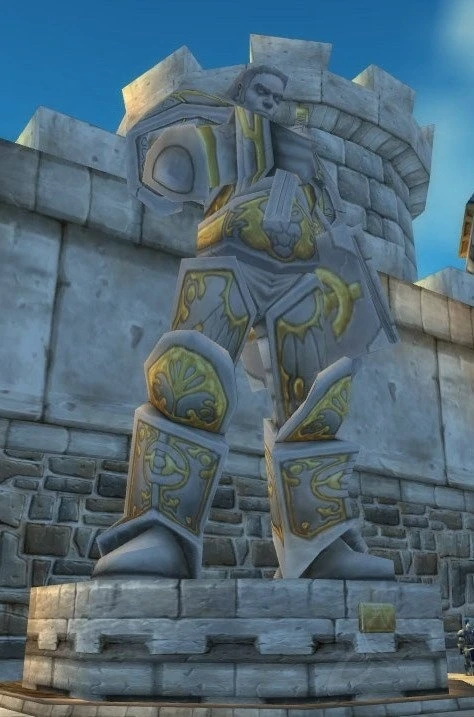
By the time adventurers enter the original World of Warcraft, Turalyon is absent from the Alliance's present councils. Lordaeron has fallen; the kingdom whose knights once rallied behind Lothar and Uther is a ruin contested by the living and dead. His former homeland's institutions have changed beyond recognition. Yet the statues and memories of the Sons of Lothar remain a reminder that the Alliance survived because soldiers crossed the Dark Portal and accepted the risk of never returning.
No messenger has brought reliable news of the expedition's fate. The Alliance remembers a completed act of leadership paired with an unresolved absence: a knight who inherited a fallen general's standard and carried it into a world that might never release him.
The Living Archive · Subject Chronicle
Through History
Explore documented turning points and follow their connections. The complete account remains in Full History above.
Further Reading
A research reference supplied with this article.