
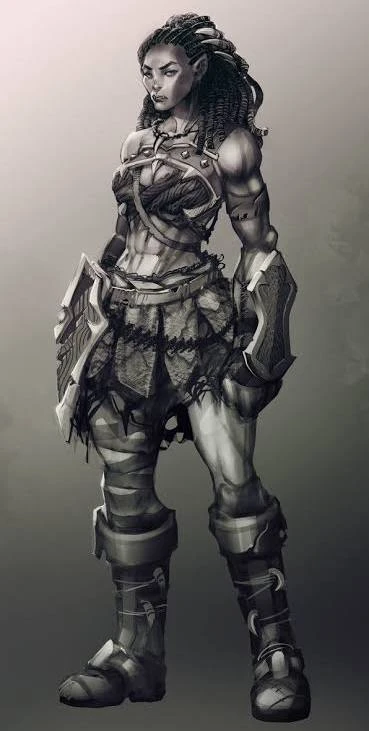
Quick Overview
Garona was an orcish emissary and agent caught between the Horde, the Shadow Council, and the humans she came to know during the First War. She helped Khadgar and Anduin Lothar expose Medivh's corruption, yet later assassinated King Llane of Stormwind in circumstances shaped by the council's influence. Her actions contributed to Stormwind's fall and the formation of the wider Alliance. Much of her early ancestry and later fate remains uncertain under the original-era source rules.
Full History
Garona's life began in the shadow of the Horde's rise, but the original-era sources leave details of her parentage and early childhood uncertain. She was presented to human courts as a half-orc, a person whose appearance and knowledge made her useful to the Horde while also placing her outside the easy loyalties of any clan. In the older telling, she served as an emissary and agent of the orcish war leaders, moving between a conquering army and the human world it intended to break. People who saw only the face of an enemy seldom understood how much of her own life had already been shaped by powers she did not command.
The First War brought her to the orbit of Medivh, the Guardian of Tirisfal, and his apprentice Khadgar. Karazhan was full of wonders and threats, and Garona proved invaluable to a human student who could not see the war through an orc's eyes. Their acquaintance crossed a line few in either army would have approved. It did not erase distrust, and it did not make Garona free of her obligations, but it demonstrated that knowledge could pass between enemies even while their commanders demanded hatred.
As Khadgar uncovered the corruption within Medivh, Garona helped expose connections the Guardian had concealed. The tower's master was implicated in the opening of the Dark Portal, the gateway through which the Horde invaded Azeroth. Garona and Khadgar worked with Anduin Lothar in the confrontation that ended Medivh's life. The destruction of the Guardian did not end the First War. Stormwind remained under attack, and distrust deepened around anyone who had belonged to both sides of the struggle.
Garona's knowledge was invaluable precisely because it was dangerous to possess. She understood the Horde's leadership and customs, knew human figures who had treated her as more than a monster, and lived under the shadow of Gul'dan and the Shadow Council. In the oldest accounts the council's influence over her actions matters deeply, but the exact mechanisms and family details described in much later continuity are not imported into this edition.
Garona is remembered most darkly for the assassination of King Llane Wrynn of Stormwind. The king had offered her a measure of trust despite the war, and the act helped drive Stormwind toward collapse. Accounts from the original games and The Last Guardian connect her betrayal to the sinister manipulation of the Shadow Council. This makes her tragedy different from that of a simple turncoat. She is responsible within the recorded story for a decisive crime, yet she was also a person long used by leaders who treated obedience as more important than a will of her own.
The killing changed more than the fate of one king. Stormwind's survivors fled north; Anduin Lothar became the leader who would help unite the human kingdoms; and the First War's disaster laid the groundwork for a larger Alliance. Garona's name survived among humans as a warning about misplaced trust and among students of the Horde as evidence of how ruthlessly the old warlocks controlled their agents. Her real history resists either easy label.
Khadgar's willingness to work with Garona was remarkable because the first war had made almost every human city suspicious of anyone connected to the Horde. Garona's language and knowledge could save lives, yet the same knowledge made her seem dangerous to the people she hoped to convince. At Karazhan she encountered a student who looked past the most obvious divisions long enough to investigate Medivh's secret. The relationship did not repair the war, but it provided a rare example of cooperation before either side had reason to expect reconciliation.
King Llane's trust made her later crime far more devastating. In a war already marked by raids and cities in flames, the death of a king at the hand of someone permitted close to him altered the survivors' sense of safety. It also gave generations of storytellers a temptation to reduce Garona to a single label: traitor, assassin, puppet, or victim. None captures everything that the original narrative permits us to say. Her deeds had immense consequences, and her freedom of action was contested by the sinister masters who had used her. That ambiguity is not a gap for a writer to fill with invented private thoughts. It is a feature of the story the original games and novels handed down, and the reason she remains central to any serious account of Stormwind's fall.
The survivors of Stormwind carried Garona's story north with them. King Llane's death became one element of the catastrophe that forced refugees, soldiers, and noble households into the wider Alliance. It left a stain on the memory of the early encounters between humans and orcs. Yet those encounters included Khadgar and Garona's cooperation against Medivh, proof that mutual understanding was possible even within the First War. The contradiction should remain visible. If the story is told only as treachery, it loses the tragedy of trust betrayed under manipulation. If it is told only as victimhood, it hides a killing that helped break a kingdom. The original material asks readers to hold both truths without pretending either cancels the other.
The original World of Warcraft opens decades after the First War with Stormwind rebuilt, the old Horde defeated and transformed, and Gul'dan's council long broken. Garona is not a central on-screen political leader in the launch story. The archive should not invent a secret office for her, grant her later family relationships, or declare a definitive end to her life based on expansions outside its cutoff. Her role remains that of a crucial First War witness and participant whose actions continue to echo through the house of Wrynn and the history of the Dark Portal.
Garona is one of Warcraft's most difficult people to judge because every institution around her demanded uncomplicated allegiance. The Horde needed a weapon, the Alliance wanted assurance, and the Shadow Council prized control. When she stepped between those worlds, the consequences were catastrophic. The real narrative question is not whether she belonged wholly to one people or the other; it is how much choice anyone can preserve when powerful masters arrange for loyalty itself to become a trap.
The Living Archive · Subject Chronicle
Through History
Explore documented turning points and follow their connections. The complete account remains in Full History above.
No additional documented milestones are available yet. The Full History above remains the primary account.
Further Reading
A research reference supplied with this article.