
Quick Overview
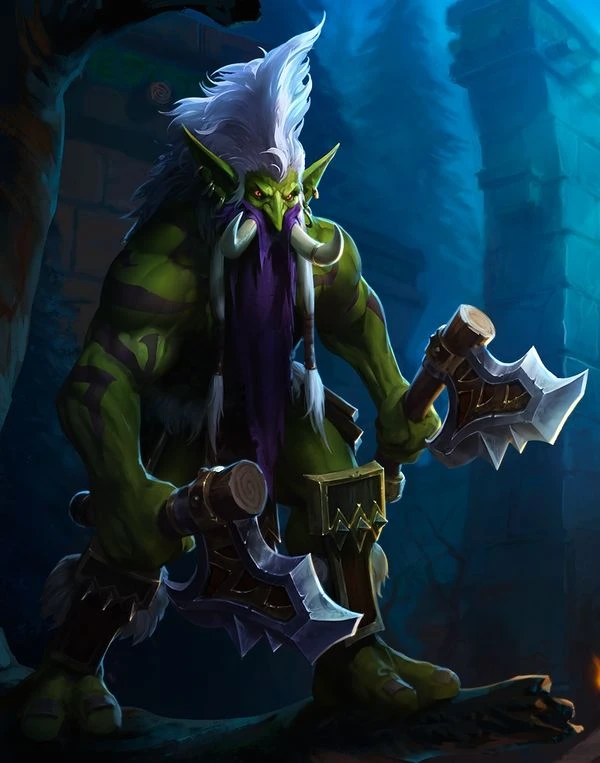
Zul'jin was the legendary warlord of the Amani forest trolls, who united rival warbands against the high elves occupying lands his people considered their own. During the Second War he initially rejected Orgrim Doomhammer's invitation to join the old Horde, but accepted an alliance after Horde forces rescued him and his captured warriors near Hillsbrad. His trolls helped carry the war toward Quel'Thalas, hoping to restore Amani power, only to see Doomhammer's campaign collapse without delivering the promised victory. Zul'jin disappeared after the war, while the forest trolls followed separate paths; his story belongs to an earlier Horde than the one joined by Sen'jin and his son Vol'jin.
Full History
The northern forests had been a troll homeland long before the human kingdoms rose. The Amani had once ruled a powerful empire, but the high elves established Quel'Thalas in lands the forest trolls claimed as their own. In the Troll Wars, humans and elves joined forces to break a great troll offensive. The defeat did not end the struggle. It left generations of forest trolls remembering lands lost to elven settlements, fortified borders, and magic they could not easily overcome.
Zul'jin rose from this long conflict. Famous for daring attacks on guarded elven villages, he drew scattered forest-troll warbands behind a common leader. To the Amani he was more than another chieftain: he embodied the hope that divided tribes might again fight for a shared homeland. Uniting the forest trolls did not mean that every tribe would later march in the same army. When the orcs entered their war, only some of Zul'jin's people fought beside them.
The opportunity came with Orgrim Doomhammer's old Horde. Doomhammer sought allies for a widening war against the human kingdoms and their elven partners; for Zul'jin, the one prize worth an alliance was Quel'Thalas. The warchief offered the forest trolls a place in the Horde and assistance in restoring Amani power. Zul'jin first refused. The orcs had their own ambitions, and he had not spent his life fighting the elves merely to put his warriors under a foreign banner.
Events near Hillsbrad changed the bargain. Human soldiers captured a war party led by Zul'jin and held the trolls in a prison near the town. Doomhammer ordered his warriors to free the prisoners and return them to their people. The raid succeeded. Soon afterward, Zul'jin's fighters supplied the orcs with axethrowers and aided the Horde's naval preparations around Southshore. The rescue gave Zul'jin a reason to trust the warchief's offer, but his loyalty belonged first to the Amani and their struggle against the elves.
As the Horde pressed north, the alliance brought war to the borders of Quel'Thalas. Troll warriors saw a chance to strike the kingdom that had resisted their ancestors for centuries. Horde forces devastated elven settlements, and the conflict drove the high elves to commit fully to the Alliance. The invaders also took and desecrated elven runestones, which the warlock Gul'dan used to empower his Altars of Storms. What the orcs gained in the campaign was not what Zul'jin had been promised. Neither a restored Amani empire nor the conquest of Quel'Thalas followed.
The Second War ended in defeat for Doomhammer's Horde. Its retreat and the imprisonment of many surviving orcs shattered the alliance that had seemed to offer the forest trolls their greatest opportunity in generations. Furious at the failure to deliver victory over the elves, most forest trolls abandoned their former orcish allies. Zul'jin himself disappeared from public view after the war. His followers remembered his deeds, but the warlord who had rallied the northern tribes no longer led a visible campaign to reclaim their lost lands.
The tribes did not all make the same choice. The Revantusk maintained a loose connection with Thrall's New Horde, while the Firetree and Smolderthorn remained with Rend Blackhand's renegade Dark Horde at Blackrock Spire. Other forest trolls pursued conflicts in their own regions. The divergence mattered: the banner of the old Horde had never erased the ambitions and grievances that separated the tribes. Zul'jin's fame endured even among forest trolls who no longer followed a single political course.
The Darkspear joined the Horde through a different history. Their chieftain Sen'jin, a jungle-troll witch doctor, met Thrall during the orcs' voyage toward Kalimdor years after Zul'jin had fought beside Doomhammer. Sen'jin died while helping Thrall's people survive the threats around the Darkspear islands. His son Vol'jin inherited leadership and brought the tribe into Thrall's new alliance. Sen'jin was Vol'jin's father, not Zul'jin's; the similar names join no established family line. The Amani warlord's bargain with Doomhammer and the Darkspear chieftain's pact with Thrall belong to separate moments in Horde history.
By the time Thrall had founded Orgrimmar, Zul'jin remained absent, yet the world he had fought to change was still divided by his choices. The Amani held to Zul'Aman; scattered forest-troll tribes served different causes; and the high elves' northern kingdom had suffered terrible wars without becoming a restored Amani realm. Zul'jin's legacy was neither a lasting victory nor a permanent place in the New Horde. It was the memory of a leader who briefly brought a divided people together and wagered their hopes on an alliance that could not fulfill them.
The Living Archive · Subject Chronicle
Through History
Explore documented turning points and follow their connections. The complete account remains in Full History above.
No additional documented milestones are available yet. The Full History above remains the primary account.
Further Reading
A research reference supplied with this article.