
Quick Overview
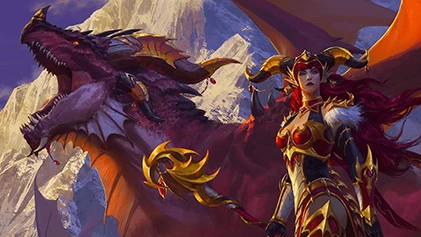
Alexstrasza, the Life-Binder, guided the red dragonflight and helped create Nordrassil after the Sundering. In the Second War, the Dragonmaw used the Demon Soul to imprison her at Grim Batol and force her children into warfare. Rhonin and his allies helped break the artifact and restore her freedom. At the original World of Warcraft era she remains a guardian of life whose flight bears the wounds of that captivity.
Full History
Alexstrasza was entrusted with one of the most far-reaching duties held by the ancient dragons: the preservation and nurturing of life. The red dragonflight answered to her, and the other Aspects recognized the breadth of her responsibility. Yet her title did not make her master of every living thing. It meant that the lives scattered across Azeroth, from great forests to fragile mortal settlements, were worth defending against powers that could destroy them indiscriminately.
For ages, that charge joined her to Nozdormu, Ysera, Malygos, and Neltharion. Their powers were different, but the trust between them was central to their ability to defend the world. When the Burning Legion threatened ancient Kalimdor, the dragons sought a weapon that could overcome the invaders. Neltharion persuaded his peers to contribute strength to the Dragon Soul. He then turned the artifact against them. In a moment, the life-giver was forced to reckon with the fact that a fellow guardian could place the entire world at risk.
After the Sundering, the night elves faced the task of surviving amid a transformed world. On Mount Hyjal, the remaining Well of Eternity threatened to draw the Legion's attention again. Alexstrasza and the other great dragons came to a pact with Malfurion and the survivors. To help guard the Well, Alexstrasza placed an enchanted acorn within its waters. From it grew Nordrassil, the World Tree whose roots and branches became symbols of the night elves' renewed bond with the natural world.
Nozdormu's blessing would shelter the night elves from age and illness while the tree stood; Ysera linked it to the Emerald Dream. Alexstrasza's contribution was life itself, given a form capable of protecting and healing a wounded land. The gift also carried a warning. Nordrassil could not make the ancient catastrophe disappear. It could only help the survivors build a future in which they guarded the world more wisely.
Long after the War of the Ancients, the Second War brought a new humiliation upon the red flight. The Dragonmaw clan obtained the Demon Soul, the name by which the surviving Dragon Soul became known. They used it to force Alexstrasza into captivity at Grim Batol. Her children and the red dragons raised under that imprisonment were driven to serve armies that spread fire and death. The very power appointed to protect life was made to carry destruction over mortal cities.
The horror was personal as well as political. The clan held a queen hostage and coerced the flight that answered to her. Dragon riders seemed to give the Horde an advantage on the battlefield, but their triumph rested on an older betrayal: Neltharion's creation of the artifact that controlled her. The red dragons' suffering is therefore inseparable from the ancient rupture among the Aspects.
*Day of the Dragon* tells how Rhonin's mission drew him, Vereesa Windrunner, Falstad Wildhammer, and Korialstrasz into the attempt to break the Dragonmaw's power. Their allies did not possess the strength to defeat every dragon or orc alone. They needed to destroy the means by which the queen was held. The Demon Soul's breaking restored the captives' freedom and returned the withheld power of the other Aspects.
Alexstrasza turned against those who had enslaved her. Freed from the relic, she and the other great dragons drove Deathwing from the field. The victory did not restore the lives lost to the war, but it ended the Dragonmaw's ability to command the queen as a living weapon. The red dragonflight could begin to rebuild its place among Azeroth's ancient guardians.
In the years following the Third War, Alexstrasza does not govern a mortal kingdom or take command of its armies. Her concerns remain vast, and the dragonflights continue to carry wounds from the old wars. In the mortal world, traces of the Dragonmaw's occupation and the struggle at Grim Batol testify to the effects of her enslavement. The scars are visible even when the queen herself is distant.
The fate of the great dragons remains bound to challenges beyond the knowledge of most mortal nations. Alexstrasza's early significance is already profound: she gave Nordrassil life, endured a captivity that turned her children into tools of war, and survived to reclaim her duty. Her biography makes clear that even the most powerful guardian may need help from mortals—and that protecting life is not the same as being spared suffering.
The Living Archive · Subject Chronicle
Through History
Explore documented turning points and follow their connections. The complete account remains in Full History above.
No additional documented milestones are available yet. The Full History above remains the primary account.
Further Reading
A research reference supplied with this article.