
Quick Overview
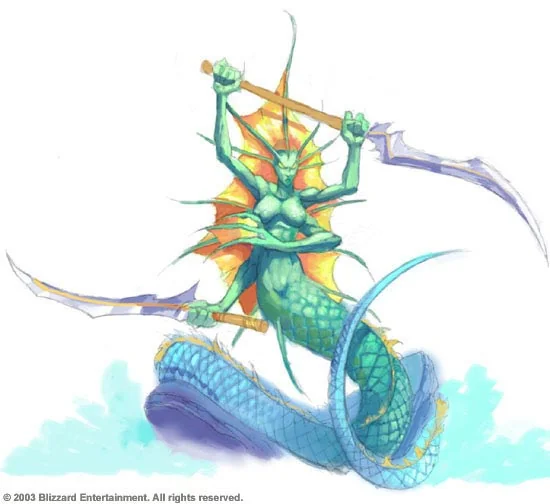
The Hatecrest naga operated around Sardor Isle and the waters near Feathermoon Stronghold, threatening the night elven position in Feralas. Their movements raised fears that they intended to seize the island while they investigated older ruins and artifacts. Under Lord Shalzaru, their expedition displayed an organized chain of command as well as a dangerous curiosity about the region's forgotten past. The conflict joined the ancient consequences of the naga's transformation to a new struggle along Feralas's coast.
Full History
Sardor Isle stood close to the night elves' coastal stronghold in Feralas. Its strategic importance came from geography as much as history: hostile forces on the neighboring shores could threaten the routes by which Feathermoon Stronghold communicated with the mainland. When the Hatecrest naga began operating there, General Shandris Feathermoon had reason to take notice. The naga were not simply passing through the nearby waters; their activity suggested plans that could place the island under their control.
The night elves' anxiety carried an older memory. The naga descended from Highborne who had followed Queen Azshara before the Sundering transformed the world. To encounter them among night elven ruins was to confront a terrible survival of the ancient kingdom, no longer bound to the people who had endured the catastrophe upon land. That history explained why their presence felt more ominous than that of an ordinary coastal raiding party.
Shandris delegated the immediate military problem to Latronicus Moonspear. He intended to reduce the naga's strength and learn what they were seeking among the ruins. The plan balanced offense against the need to protect the stronghold from other enemies; committing every defender to the coast would leave the night elves exposed elsewhere. The Hatecrest therefore forced a difficult choice in a region where neither the Alliance nor Horde controlled every approach.
Scouting reports identified Lord Shalzaru as one of the commanding nobles among the naga. He was associated with an excavation on the Isle of Dread and with a mysterious relic recovered from a cave south of the main ruins. That discovery gave the conflict a second dimension. The night elves were defending a frontier, but they were also trying to prevent a hostile group from obtaining something whose meaning was not yet fully understood. The surviving descriptions never establish precisely what the relic could do, and there is no reason to supply it with imaginary powers.
The Hatecrest were thus both a military and historical threat. Their actions brought an old catastrophe back into the geography of Feralas, while their interest in the ruins pointed toward mysteries the stronghold could not afford to ignore. In the coastlands of the original world, the sea carried enemies whose connection to Azeroth's past was deeper than their immediate campaign.
The Living Archive · Subject Chronicle
Through History
Explore documented turning points and follow their connections. The complete account remains in Full History above.
No additional documented milestones are available yet. The Full History above remains the primary account.