Quick Overview
The old troll civilizations did not all seek rich soil and open forests. By the era of Warcraft III, the Lich King has made Northrend into a center of the Scourge. It is tempting to borrow the richly developed later Gundrak and Zul'Drak stories to fill the gaps. Zul'Drak and Gundrak belong on a historical map, not as launch-era dungeon markers.
Full History
The old troll civilizations did not all seek rich soil and open forests. In the northern reaches of ancient Kalimdor, groups that later formed the Drakkari endured a harsher world. The original Troll Compendium records a tradition in which particularly violent northern tribes were driven from established lands and settled in the snowy wastes. Whatever their precise route, they became a recognizable ice-troll people whose communities stood far apart from the Zandalari priestly homeland, the Amani forests, and the Gurubashi jungles.
The kingdom that formed around Zul'Drak never reached the wealth or geographical scale attributed to the southern empires in that older account. Yet a smaller realm could still endure for ages. Hunting, warfare, and religious practice developed in the cold, and the Drakkari came to be known for their stature, strength, and isolation. The original account treats them as a people with their own long history, not merely as blue-skinned jungle trolls.
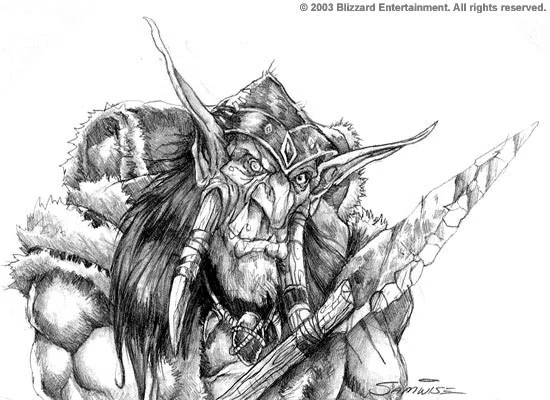
The Sundering left Zul'Drak on the new northern continent of Northrend. The Drakkari continued in the cold lands while other ice-troll communities eventually appeared far away in the Eastern Kingdoms. The Frostmane of Dun Morogh and the Winterax associated with Alterac preserve traces of that older shared identity, though surviving historians cannot trace every stage of their migration. A family resemblance is not proof of direct Drakkari government over each southern village.
By the era of Warcraft III, the Lich King has made Northrend into a center of the Scourge. The Drakkari's northern homeland consequently exists beside a growing power that raises the dead and threatens living nations. The Compendium discusses a looming danger to the trolls and reports the loss of Drak'Tharon Keep. This is background research, not an invitation to import every later Northrend expansion campaign or its outcomes into the original WoW timeline.
The Drakkari remain part of the wider troll religious tradition, but the original game supplies limited detail about their individual temples and priestly rites. It is tempting to borrow the richly developed later Gundrak and Zul'Drak stories to fill the gaps. Doing that without an era label would mislead a player studying the world as it existed at launch. This article therefore confines itself to the ancient kingdom, the ice-troll branches, and the threats recognizable in the earlier sources.
The original WoW adventurer may encounter Frostmane trolls in Dun Morogh, but cannot travel the later Drakkari quest zones as playable content. Zul'Drak and Gundrak belong on a historical map, not as launch-era dungeon markers. The surviving northern nation helps explain why distant ice-troll tribes share an ancestry while fighting for their own local reasons. Their cold kingdom belongs to Azeroth's deep history even when its heart lies beyond the original game's playable world.
The Living Archive · Subject Chronicle
Through History
Explore documented turning points and follow their connections. The complete account remains in Full History above.
No additional documented milestones are available yet. The Full History above remains the primary account.
Further Reading
A research reference supplied with this article.