
Quick Overview
Ancient troll civilizations fought a prolonged war against the insectoid aqir. The original Troll Compendium describes the Amani and Gurubashi as established powers whose conflict helped divide the aqiri realm. Later accounts make the reawakened Kith’ix central to the war and describe campaigns that carried the Amani east, Gurubashi south, and Drakkari north. These traditions should be connected, but their different chronologies must remain visible.
Full History
The oldest available Blizzard narrative places a sprawling troll civilization on the single continent of ancient Kalimdor. From the Zandalar tribe grew cultures whose loyalties were anchored in different forests, jungles, and northern hunting lands. The Amani and Gurubashi did not have to be identical in language, ritual, or kingship to oppose the same enemy. The Compendium names the aqir as a formidable insectoid people who sought to exterminate other life and who could not be defeated in one quick campaign.
Fighting stretched across vast distances and, in that original telling, lasted for thousands of years. Eventually the aqiri kingdom splintered and populations took refuge in remote cities associated with Azjol-Nerub in the north and Ahn’Qiraj in the south. The trolls did not conquer those places outright; they believed they had driven the insectoids out of their established heartlands. The old empires continued to exist but did not build a single peaceful troll nation.
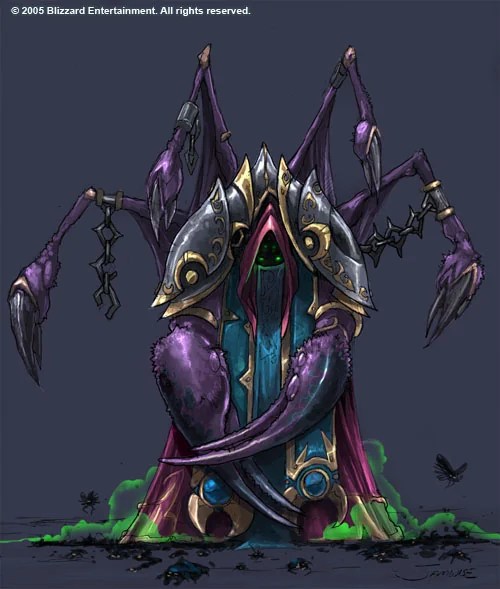
A later Chronicle-era chronology develops a different emphasis. It places the reawakening of Kith’ix near Zandalar at the opening of a decisive crisis, then describes the Zandalari rallying otherwise independent peoples. The Amani pursue the ancient general, the Gurubashi campaign through jungles and southern territories, and the Drakkari head into the frozen north. The eventual defeat of Kith’ix and the dispersal of the aqir transform military camps and conquered frontiers into new centers of territorial power.
From this standpoint the political differences among troll civilizations emerge not just because they worship different loa, but because they inhabited different climates, fought different enemies, and invested in different military and priestly institutions. The Amani became guardians of forest territory and Zul’Aman; the Gurubashi cultivated southern jungle wealth and the prestige of Zul’Gurub; the Drakkari preserved a northern stronghold in Zul’Drak. The Zandalari remained a source of ancestry, learning, and priestly authority across those divisions.
Neither version justifies saying that Tyr directly ordered trolls into their regions. Tyr died long before the major troll war in the retrospective storyline. The relationship passes through Kith’ix’s survival, its later awakening, the aqir threat, and the troll response. The shared past makes the different tribes intelligible, but it does not remove the centuries of later conflicts that gave each tribe its own identity.
A later historical perspective
Ancient history revealed later
The original account describes a long struggle between troll empires and the aqir. Chronicle-era history adds the role of Kith'ix, the wounded servant of the Old Gods who survived Tyr's final stand, later awakened the insectoid legions and provoked a war that brought the Zandalari and other troll peoples into a common defense.
The old histories remembered a continent divided by a terrible war: the Gurubashi and Amani fought an insectoid empire that seemed bent on destroying life unlike itself. In the later account, the first spark is carried from a still older conflict. Kith'ix, a servant of the Old Gods wounded in Tyr's last battle, survived and lay dormant until later rites disturbed its resting place. When it rose again, it summoned the long-hidden aqir.
The assault threatened troll settlements across ancient Kalimdor. The Zandalari played a coordinating role in the resistance, while other peoples and tribes contributed their strength against the insectoid advance. Long campaigns and hard fighting drove the aqir back, and separate surviving populations took root far from one another. The remnants would come to be associated with northern Azjol-Nerub, southern Ahn'Qiraj and a further southern lineage described in later sources.
The difference between the accounts matters. The original Blizzard history portrayed the Gurubashi and Amani as the dominant powers of a war that continued for thousands of years and spoke chiefly of two known aqiri successor cities. Chronicle's later account gave greater weight to the Zandalari-led alliance, Kith'ix and additional surviving peoples, and presented the sequence differently. Warcraft: Forever can tell both stories without pretending the later explanation was already known in the original-era telling.
The Living Archive · Subject Chronicle
Through History
Explore documented turning points and follow their connections. The complete account remains in Full History above.
Further Reading
A research reference supplied with this article.