
Quick Overview
A troll is recognizable from a distance, but that does not make all trolls physically identical. A visually dramatic body type should not be turned into a fabricated evolutionary sequence or assigned a precise origin without evidence. Physical difference has also been used by outsiders to justify crude judgments. The point of the physical record is not to catalogue monsters.
Full History
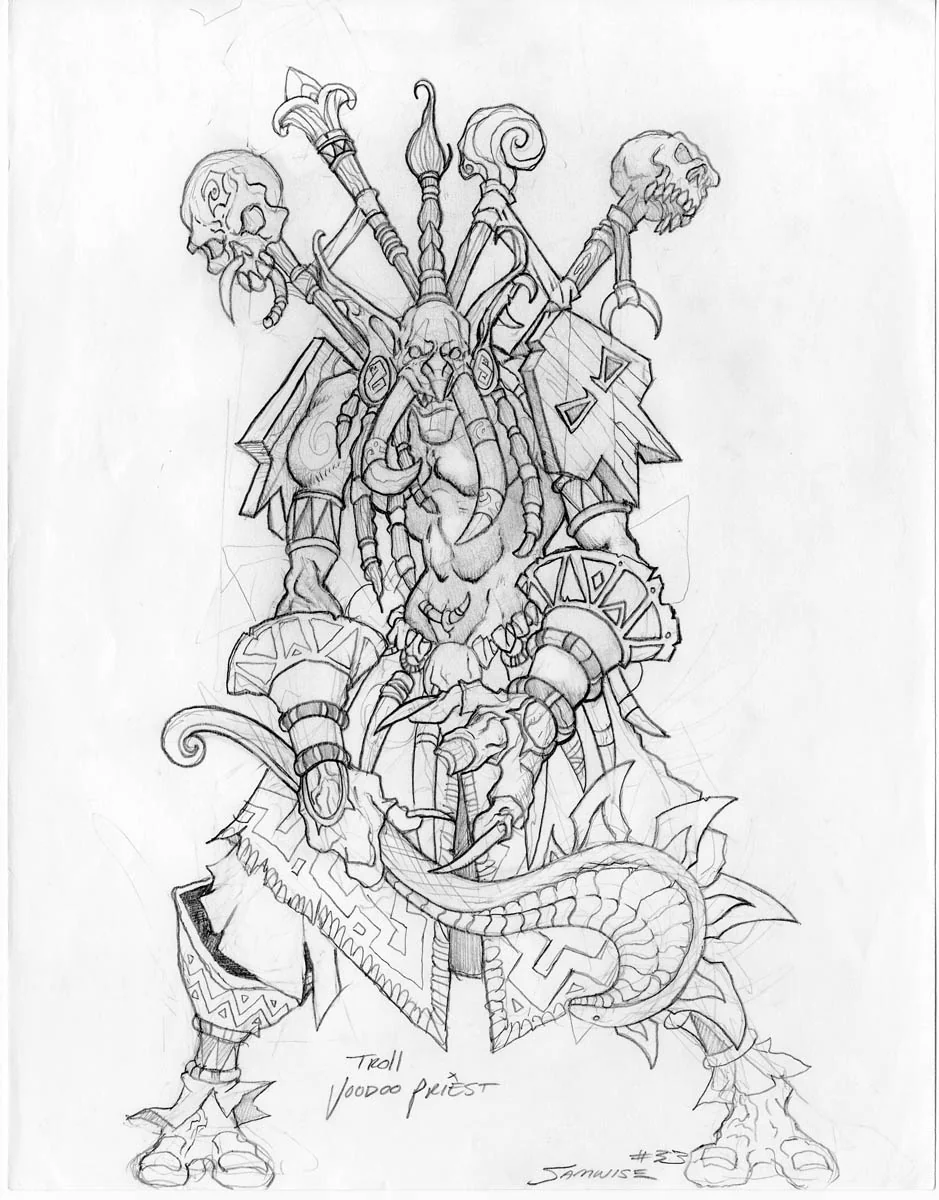
A troll is recognizable from a distance, but that does not make all trolls physically identical. The broad shoulders of a forest troll, the lithe frame of a jungle troll, and the heavy build of certain northern trolls reflect different peoples living in very different environments. Ancient history and migration have left their marks on bodies as well as borders. The original Blizzard Troll Compendium was careful to distinguish those variations instead of presenting a single universal appearance.
Tusks are among the race's most prominent features. They are teeth that project from the mouth, not horns jutting from the cheek. Their shapes vary among individuals and populations. Height and build also vary; the Zandalari and Drakkari are described as notably larger on average than many other trolls. Jungle trolls are generally lithe and covered in fine fur, while forest trolls carry a characteristic green coloration connected in the early account with moss or plant growth on their skin. Ice trolls range through pale and blue tones.
Trolls are famed for exceptional regeneration. The 2002 Warcraft III unit descriptions express this through battlefield recovery; the early compendium discusses the trait as part of the race's distinctive physiology. This is a genuine capacity, not a guarantee that every wound can be shrugged off or that a troll is immortal. Individuals die in the games, and tribal histories contain generations of loss. Healing helps explain resilience without making grief, injury, or mortality meaningless.
Some exceptionally large individuals are described as dire trolls. The original compendium does not establish a separate race for them. It treats their size as a variation for which several explanations might exist, including magic or alchemy, and explicitly leaves the cause uncertain. That restraint is useful. A visually dramatic body type should not be turned into a fabricated evolutionary sequence or assigned a precise origin without evidence.
Physical difference has also been used by outsiders to justify crude judgments. Human, elven, and orcish sources frequently describe trolls through hostility inherited from war. A Darkspear protagonist may be mocked for looking like a foe that an Alliance soldier has fought elsewhere, though their tribe's politics are unlike those of the Amani or Skullsplitter. The body tells an observer something about ancestry and environment; it does not announce a person's loyalties or moral character.
At launch the playable Darkspear are therefore both recognizably troll and distinct within a diverse race. Their tusks, resilience, and traditions belong to an inheritance older than the Horde, but their future depends upon decisions made by Sen'jin, Vol'jin, and their living community. The point of the physical record is not to catalogue monsters. It is to give the characters on the screen a credible place among the many troll peoples of Azeroth.
The Living Archive · Subject Chronicle
Through History
Explore documented turning points and follow their connections. The complete account remains in Full History above.
No additional documented milestones are available yet. The Full History above remains the primary account.