
Quick Overview
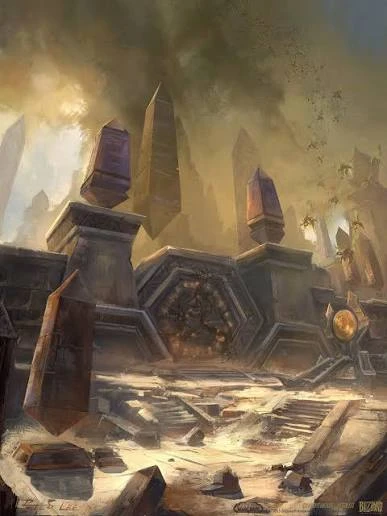
The gates of Ahn'Qiraj remained closed in southern Kalimdor when the original World of Warcraft began. Beyond them lay the legacy of the ancient qiraji and the War of the Shifting Sands. Their sealed condition meant a great threat had been contained, not erased from Azeroth's history.
Full History
Long before the kingdoms of men, the insectoid aqir challenged the ancient troll empires. Their wars reshaped the distribution of peoples across Kalimdor, and surviving aqir powers eventually became associated with the northern city of Azjol-Nerub and the southern stronghold of Ahn'Qiraj. This distant history joined the fate of desert ruins with the struggles of peoples separated by immense spans of time.
Ahn'Qiraj later became the center of another great crisis in southern Kalimdor. Night-elven defenders and their allies fought the qiraji in the War of the Shifting Sands, and the closing of the gates marked a decision to contain an enemy that could not simply be dismissed. The barrier stood in a region where signs of ancient civilization survived beneath the sands. Even when no open campaign crossed the threshold, the danger beyond it remained significant.
The existence of the sealed stronghold also recalled the role of the bronze dragons and the ancient guardians of Azeroth. The dragons' history was never confined to the War of the Ancients or the Second War. They remained bound to lands, time, and conflicts that mortal powers could barely comprehend. In the south, that guardianship acquired an especially visible form in the continuing barrier against the qiraji.
At the first playable moment of World of Warcraft, the gates had not yet been opened by an adventuring campaign. The proper historical description is therefore the existence of an old, sealed danger and the remembered war that created the barrier. Later battles at the gates are possible future developments, not accomplishments already assigned to the world's inhabitants.
The Living Archive · Subject Chronicle
Through History
Explore documented turning points and follow their connections. The complete account remains in Full History above.
Further Reading
A research reference supplied with this article.